


Terrestrial ecosystems remove about 30 per cent of the carbon dioxide (CO2) emitted by human activities each year1, yet the persistence of this carbon sink depends partly on how plant biomass and soil organic carbon (SOC) stocks respond to future increases in atmospheric CO2 (refs. 2,3). Although plant biomass often increases in elevated CO2 (eCO2) experiments4–6, SOC has been observed to increase, remain unchanged or even decline7. The mechanisms that drive this variation across experiments remain poorly understood, creating uncertainty in climate projections8,9. Here we synthesized data from 108 eCO2 experiments and found that the effect of eCO2 on SOC stocks is best explained by a negative relationship with plant biomass: when plant biomass is strongly stimulated by eCO2, SOC storage declines; conversely, when biomass is weakly stimulated, SOC storage increases. This trade-off appears to be related to plant nutrient acquisition, in which plants increase their biomass by mining the soil for nutrients, which decreases SOC storage. We found that, overall, SOC stocks increase with eCO2 in grasslands (8 ± 2 per cent) but not in forests (0 ± 2 per cent), even though plant biomass in grasslands increase less (9 ± 3 per cent) than in forests (23 ± 2 per cent). Ecosystem models do not reproduce this trade-off, which implies that projections of SOC may need to be revised.
Soil C Sequestration as a Biological Negative Emission Strategy
Soil carbon (C) sequestration in one of three main approaches to carbon dioxide removal and storage through management of terrestrial ecosystems. Soil C sequestration relies of the adoption of improved management practices that increase the amount of carbon stored as soil organic matter, primarily in cropland and grazing lands. These C sequestering practices act by increasing the rate of input of plant-derived residues to soils and/or by reducing the rates of turnover of organic C stocks already in the soil. In addition to carbon dioxide removal potential, increases in soil organic matter/soil C content are highly beneficial from the standpoint of soil health and soil fertility Practices to increase soil C stocks include well-known, proven techniques or “best management practices” (BMP) for building soil carbon. A second category includes what we refer to as frontier technologies for which significant technological and/or economic barriers exist today, but for which further R&D and/or economic incentives might offer the potential for greater sequestration over the longer term. We reviewed published estimates of global soil carbon sequestration potential, representing the biophysical potential for managed cropland and/or grassland systems to store additional carbon assuming widespread (near complete) adoption of BMPs. The majority of studies suggests that 4 to 5 GtCO2/y as an upper limit for global biophysical potential with near complete adoption of BMPs. In the longer-term, if frontier technologies are successfully deployed, the global estimate might grow to 8 GtCO2/y. There is a strong scientific basis for managing agricultural soils to act as a significant carbon (C) sink over the next several decades. A two-stage strategy, to first incentivize adoption of well developed, conventional soil C sequestering practices, while investing in R&D on new frontier technologies that could come on-line in the next 2-3 decades, could maximize benefits. Implementation of such policies will require robust, scientifically-sound measurement, reporting, and verification (MRV) systems to track that policy goals are being met and that claimed increases in soil C stocks are real.

Biogeochemical constraints on climate change mitigation through regenerative farming
This review suggests that most of the management practices associated with regenerative agriculture are not likely to lead to a large net sequestration of organic carbon in soils. Some improved management practices, such as increased fertilizer use, manuring, and applications of biochar, are constrained by biogeochemical stoichiometry and the availability of organic inputs. Other management practices, such as fertilizer applications, irrigation, and applications of ground silicate minerals, entail ancillary and off-site emissions of carbon dioxide that reduce the net sequestration of carbon in soils. Carbon sequestration in agricultural soils, even with best management practices, is only likely to offer a small net storage of carbon that can be marketed as a credit to emissions from other sectors of the economy.

The Climate Solution Actually Adding Millions of Tons of CO2 Into the Atmosphere — ProPublica
New research shows that California’s climate policy created up to 39 million carbon credits that aren’t achieving real carbon savings. But companies can buy these forest offsets to justify polluting more anyway.

A Soil-Science Revolution Upends Plans to Fight Climate Change | Quanta Magazine
A centuries-old concept in soil science has recently been thrown out. Yet it remains a key ingredient in everything from climate models to advanced carbon-capture projects.

Carbon Removal Technologies | YC Request for Startups
Climate change presents an existential threat to humanity. We are already seeing the effects and they are showing up faster and stronger than anticipated. A report by United Nations' scientific panel on climate change released this month expects the atmosphere-on our current trajectory-to warm up by 1.5 degrees Celsius by 2040. Even the effects of a 0.5 degrees increase will have far-reaching consequences. This research indicates that we are already past the tipping point; even if we significantly reduced emissions, climate change would continue (Source IPCC summary C3 section). We believe there's still time to make a change if we look both to renewal energy and CO2 removal.

Carbon Captured
How the fossil fuel industry turned the plan to solve climate change into a plan to save itself

Human domination of the biosphere: Rapid discharge of the earth-space battery foretells the future of humankind
Earth is a chemical battery where, over evolutionary time with a trickle-charge of photosynthesis using solar energy, billions of tons of living biomass were stored in forests and other ecosystems and in vast reserves of fossil fuels. In just the last few hundred years, humans extracted exploitable energy from these living and fossilized biomass fuels to build the modern industrial-technological-informational economy, to grow our population to more than 7 billion, and to transform the biogeochemical cycles and biodiversity of the earth. This rapid discharge of the earth’s store of organic energy fuels the human domination of the biosphere, including conversion of natural habitats to agricultural fields and the resulting loss of native species, emission of carbon dioxide and the resulting climate and sea level change, and use of supplemental nuclear, hydro, wind, and solar energy sources. The laws of thermodynamics governing the trickle-charge and rapid discharge of the earth’s battery are universal and absolute; the earth is only temporarily poised a quantifiable distance from the thermodynamic equilibrium of outer space. Although this distance from equilibrium is comprised of all energy types, most critical for humans is the store of living biomass. With the rapid depletion of this chemical energy, the earth is shifting back toward the inhospitable equilibrium of outer space with fundamental ramifications for the biosphere and humanity. Because there is no substitute or replacement energy for living biomass, the remaining distance from equilibrium that will be required to support human life is unknown.

Climate change
Present-day climate change includes both global warming—the ongoing increase in global average temperature—and its wider effects on Earth's climate system. Climate change in a broader sense also includes previous long-term changes to Earth's climate. The modern-day rise in global temperatures is driven by human activities, especially fossil fuel burning since the Industrial Revolution. Fossil fuel use, deforestation, and some agricultural and industrial practices release greenhouse gases. These gases absorb some of the heat that the Earth radiates after it warms from sunlight, warming the lower atmosphere. Earth's atmosphere now has roughly 50% more carbon dioxide, the main gas driving global warming, than it did at the end of the pre-industrial era, reaching levels not seen for millions of years.

Benefits of Native Mycorrhizal Amendments to Perennial Agroecosystems Increases with Field Inoculation Density
Perennial polyculture cropping systems are a novel agroecological approach used to mirror some of the ecological benefits provided by native perennial ecosystems including increased carbon and nitrogen storage, more stable soils, and reduced anthropogenic input. Plants selected for perennial agroecosystems are often closely related to native perennials known to be highly dependent on microbiome biota, such as arbuscular mycorrhizal (AM) fungi. However, most plantings take place in highly disturbed soils where tillage and chemical use may have rendered the AM fungal communities less abundant and ineffective. Studies of mycorrhizal amendments include inoculation densities of 2–10,000 kg of inocula per hectare. These studies report variable results that may depend on inocula volume, composition, or nativeness. Here, we test the response of 19 crop plant species to a native mycorrhizal fungal community in a greenhouse and field experiment. In our field experiment, we chose eight different densities of AM fungal amendment, ranging from 0 to 8192 kg/hectare, representing conventional agricultural practices (no AM fungi addition), commercial product density recommendations, and higher densities more typical of past scientific investigation. We found that plant species that benefited from native mycorrhizal inocula in the greenhouse also benefited from inoculation in the field polyculture planting. However, the densities of mycorrhizal inocula suggested on commercial mycorrhizal products were ineffective, and higher concentrations were required to detect significant benefit plant growth and survival. These data suggest that higher concentrations of mycorrhizal amendment or perhaps alternative distribution methods may be required to utilize native mycorrhizal amendment in agroecology systems.

The story of CO2 is the story of everything: how carbon dioxide made our world
"How carbon dioxide, the world's most important substance, shaped the planet's past and present-and holds the key to our future Carbon dioxide: this seemingly simple and ubiquitous substance is fundamental to how our planet works. All life is made from CO2, and its behavior on this planet has kept Earth bizarrely habitable for hundreds of millions of years. In its workings lie both the splendor of our world and the potential for life's destruction. In short, it is the most important substance in history. But why is CO2 as essential to life on Earth as it is capable of destroying it? In The Story of CO2 Is the Story of Everything, award-winning science journalist Peter Brannen reveals carbon dioxide's fundamental role in the operation and maintenance of our planet. Starting at the beginning of time and working all the way up to our present reality, he illuminates how CO2 has been responsible for the planet's many deaths and rebirths, the evolution of life, and the development of modern human society. Carbon dioxide's movement through rocks, air, oceans, and life has kept our planet's climate livable, its air breathable, and its oceans hospitable to complex life for more than five hundred million years. And only by understanding CO2 in the context of deep Earth history can we see how it gave rise to today's industrial economy-and more clearly recognize what it means to be churning through hundreds of millions of years of old life in the form of fossil fuels and converting it all to carbon dioxide. With groundbreaking research and a clear-eyed perspective, Brannen shows how a deep exploration into the mechanics of the carbon cycle and the history of our planet can provide hope for averting environmental catastrophe in the future. It all starts with a richer understanding of the essential role of one substance"--

RETRACTED ARTICLE: The economic commitment of climate change
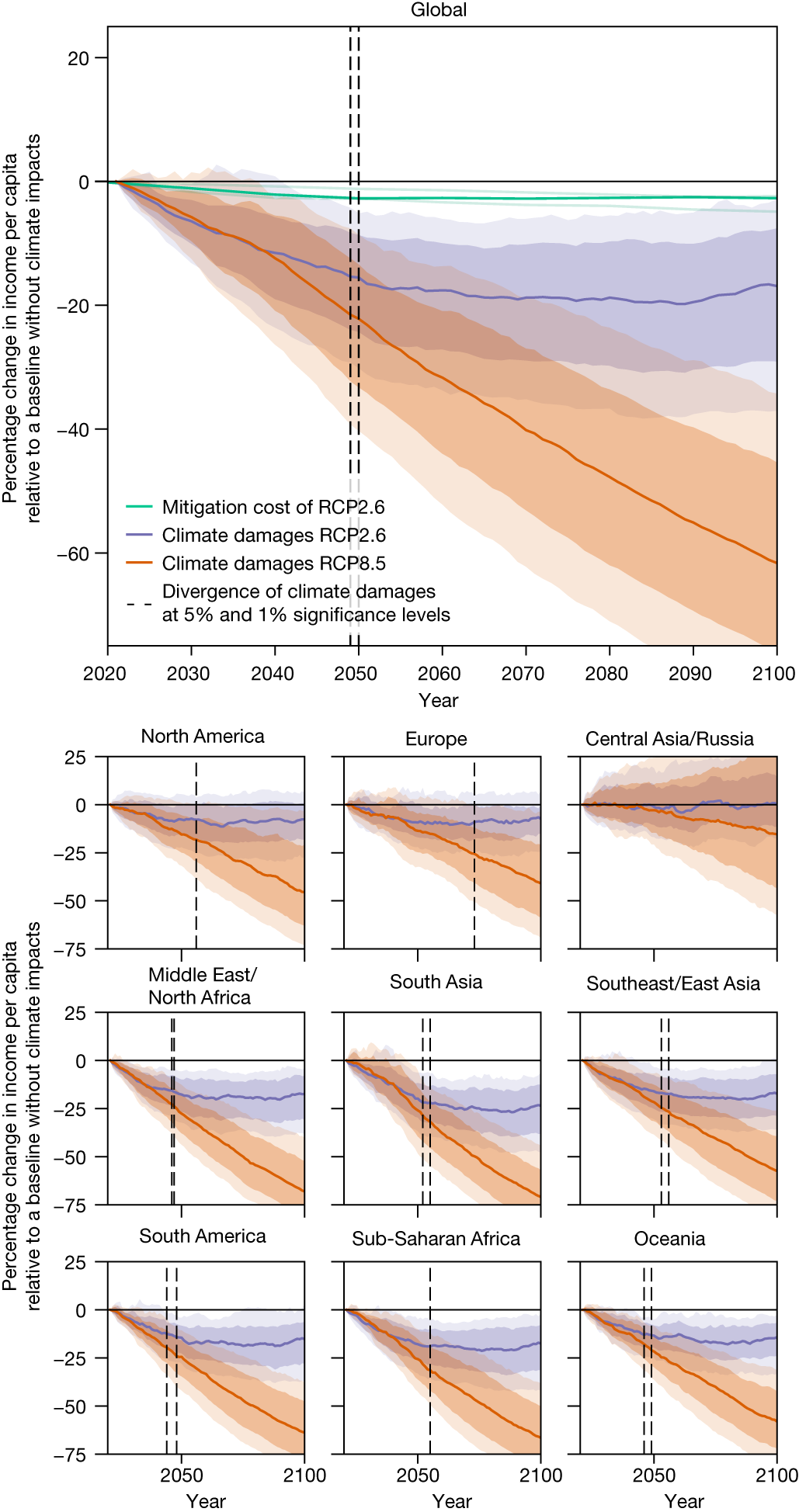
Global projections of macroeconomic climate-change damages typically consider impacts from average annual and national temperatures over long time horizons1–6. Here we use recent empirical findings from more than 1,600 regions worldwide over the past 40 years to project sub-national damages from temperature and precipitation, including daily variability and extremes7,8. Using an empirical approach that provides a robust lower bound on the persistence of impacts on economic growth, we find that the world economy is committed to an income reduction of 19% within the next 26 years independent of future emission choices (relative to a baseline without climate impacts, likely range of 11–29% accounting for physical climate and empirical uncertainty). These damages already outweigh the mitigation costs required to limit global warming to 2 °C by sixfold over this near-term time frame and thereafter diverge strongly dependent on emission choices. Committed damages arise predominantly through changes in average temperature, but accounting for further climatic components raises estimates by approximately 50% and leads to stronger regional heterogeneity. Committed losses are projected for all regions except those at very high latitudes, at which reductions in temperature variability bring benefits. The largest losses are committed at lower latitudes in regions with lower cumulative historical emissions and lower present-day income.
Food systems are responsible for a third of global anthropogenic GHG emissions
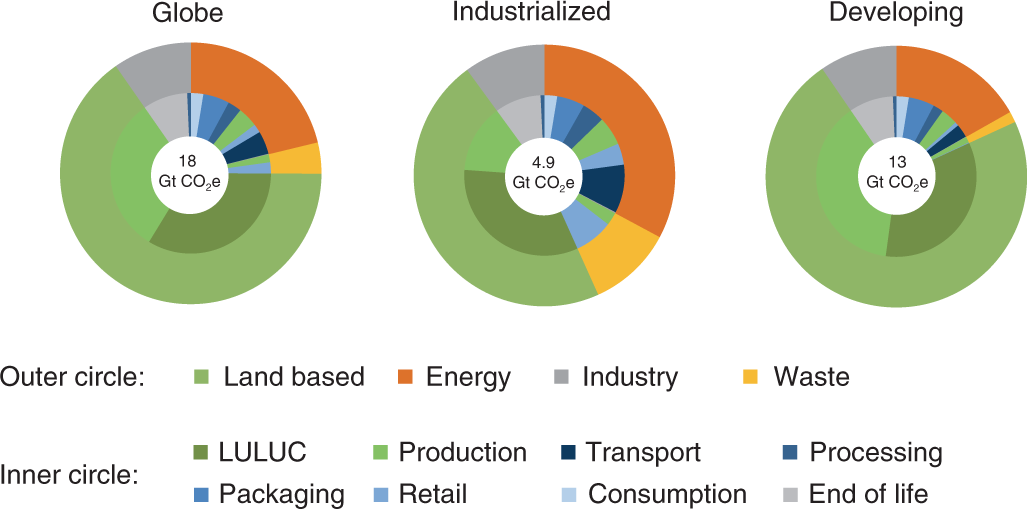
We have developed a new global food emissions database (EDGAR-FOOD) estimating greenhouse gas (GHG; CO2, CH4, N2O, fluorinated gases) emissions for the years 1990–2015, building on the Emissions Database of Global Atmospheric Research (EDGAR), complemented with land use/land-use change emissions from the FAOSTAT emissions database. EDGAR-FOOD provides a complete and consistent database in time and space of GHG emissions from the global food system, from production to consumption, including processing, transport and packaging. It responds to the lack of detailed data for many countries by providing sectoral contributions to food-system emissions that are essential for the design of effective mitigation actions. In 2015, food-system emissions amounted to 18 Gt CO2 equivalent per year globally, representing 34% of total GHG emissions. The largest contribution came from agriculture and land use/land-use change activities (71%), with the remaining were from supply chain activities: retail, transport, consumption, fuel production, waste management, industrial processes and packaging. Temporal trends and regional contributions of GHG emissions from the food system are also discussed.
Addressing Climate Change Will Not “Save the Planet”
The dismal reality is that green energy will save not the complex web of life on Earth but the particular way of life of one domineering species.
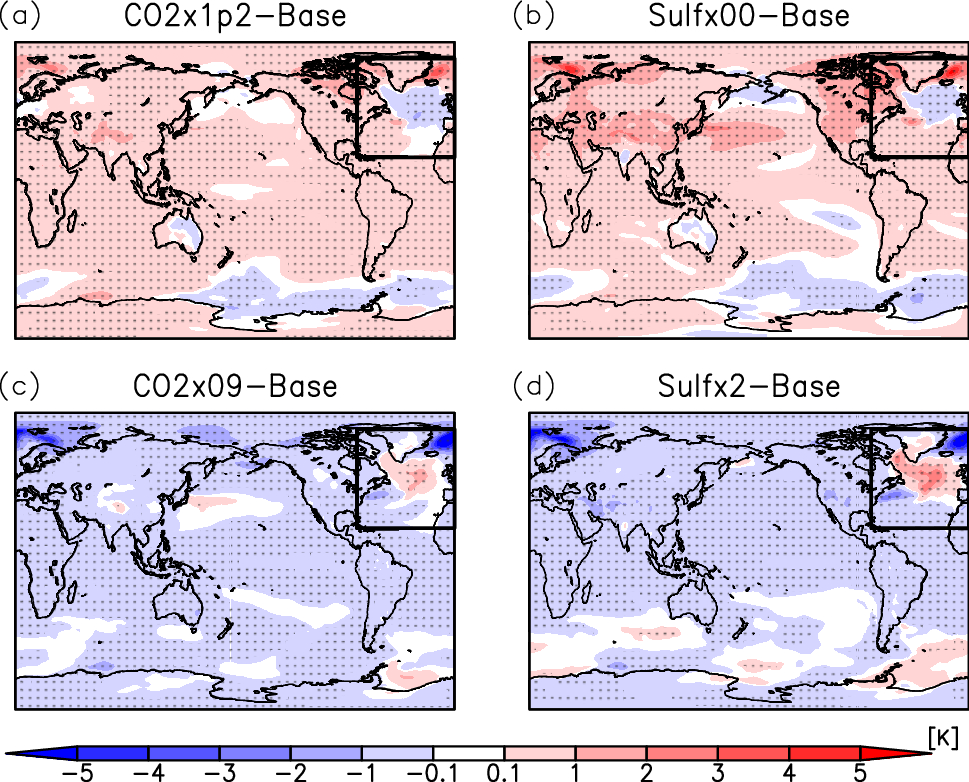
Formation of the North Atlantic Warming Hole by reducing anthropogenic sulphate aerosols
The North Atlantic Warming Hole (NAWH) has been observed and predicted due to the increase in carbon dioxide (CO2) concentration. If sulphate aerosols, which have a cooling effect on the atmosphere, are reduced by air pollution control, the NAWH may form as it would if CO2 concentrations increased. In this study, sensitivity experiments using a coupled atmosphere–ocean-aerosol model were conducted by varying the amount of sulphur dioxide (SO2) emissions, a precursor of sulphate which is the primary anthropogenic aerosol in the atmosphere, to analyse the changes in the ocean temperature, salinity, and density. The results showed that although the spatial patterns of the NAWH due to the changes in SO2 emissions was similar to that due to the changes in the CO2 concentrations, the magnitude of the shifts in the ocean parameters due to the changes in SO2 emissions is larger even when changes in global mean temperature are comparable. This can be due to the spatial concentration of sulphate aerosols in the mid-latitudes of the Northern Hemisphere, resulting larger changes in the heat transport from the south on the Gulf Stream and the North Atlantic Current along with changes in freshwater inflow from the Arctic through the Labrador Sea.
How close are we to the temperature tipping point of the terrestrial biosphere?
Future anticipated warming could reduce the terrestrial carbon sink by ~50% by mid-century.
