

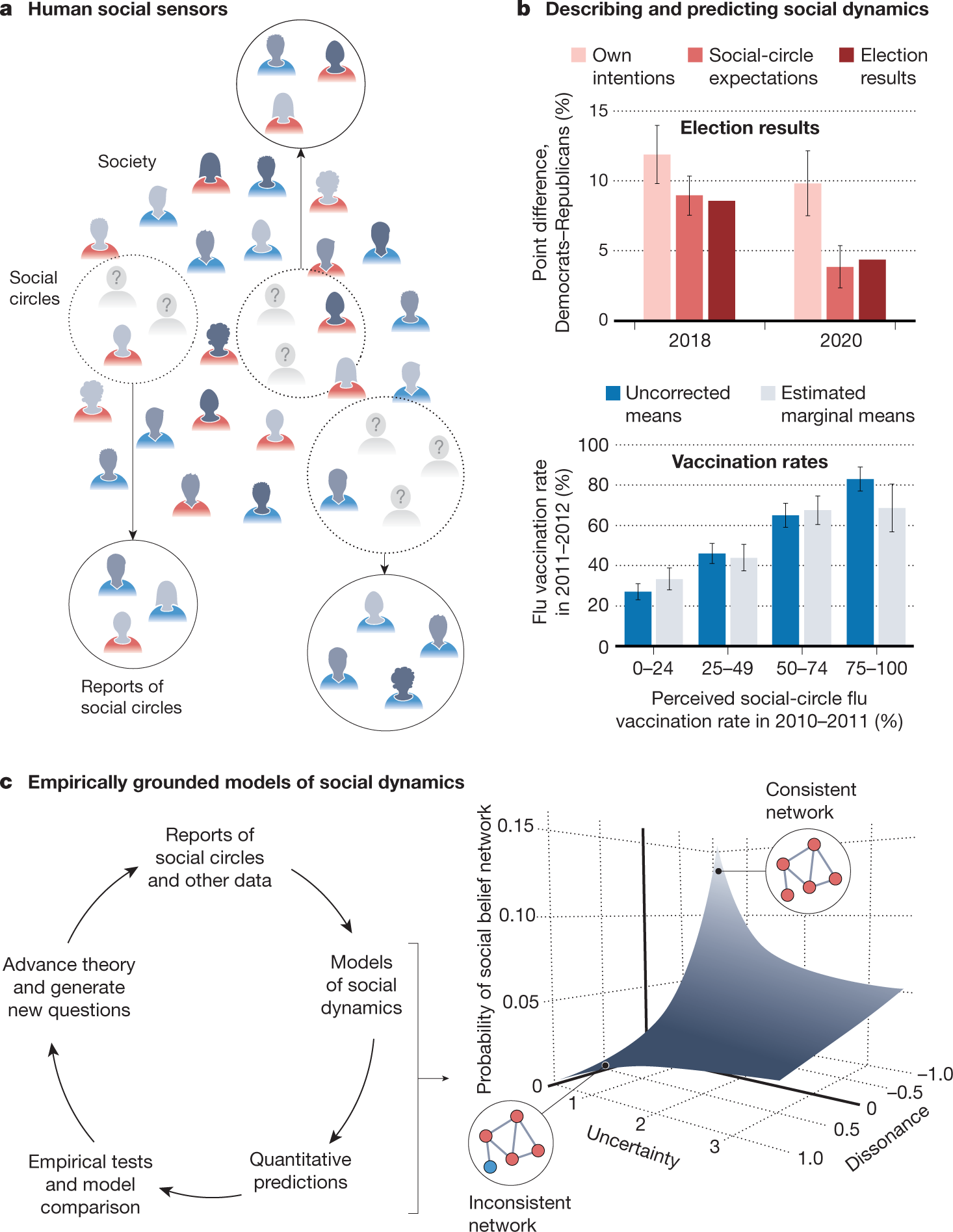
The ability to ‘sense’ the social environment and thereby to understand the thoughts and actions of others allows humans to fit into their social worlds, communicate and cooperate, and learn from others’ experiences. Here we argue that, through the lens of computational social science, this ability can be used to advance research into human sociality. When strategically selected to represent a specific population of interest, human social sensors can help to describe and predict societal trends. In addition, their reports of how they experience their social worlds can help to build models of social dynamics that are constrained by the empirical reality of human social systems.
Manoel Horta Ribeiro (@manoelhortaribeiro.bsky.social)
Assistant Professor @ Princeton Previously: EPFL 🇨🇭, UFMG 🇧🇷 Interests: Computational Social Science, Platforms, GenAI, Moderation

AI Behavioral Science
We outline a foundation for a new field of ``AI Behavioral Science,'' covering three perspectives. First, as AI becomes ubiquitous and is increasingly proprietary and opaque, it becomes vital to develop techniques for assessing AI behavior. We outline how tools developed to assess people's behaviors by social scientists can be used to assess and infer AI's behaviors biases, tendencies, and heuristics. Second, we also discuss how AI can change the ways in which we learn about human behavior. Beyond its computational power, AI offers new techniques for simulating, inferring, and predicting human behaviors that we outline and discuss. Third, as humans and AI are interacting in increasingly complex and intertwined systems, we need to understand the implications for the resulting economic and political outcomes. We outline issues that are increasingly pressing concerning the future of human-AI interactions and potential changes and disruptions that can ensue.

How Online Mobs Act Like Flocks Of Birds
A growing body of research suggests human behavior on social media is strikingly similar to collective behavior in nature.

How Online Mobs Act Like Flocks Of Birds
A growing body of research suggests human behavior on social media is strikingly similar to collective behavior in nature.
AI Behavioral Science: A Framework and Agenda
We discuss the challenges and opportunities present in the rapidly emerging area of “AI Behavioral Science.” We frame it via three subfields. First, as AI becomes ubiquitous and is increasingly proprietary and opaque, it becomes vital to develop models of AI and methods for assessing AI behavior. We outline how tools developed to assess people’s behaviors by social scientists can be used to model, assess and infer AI’s behaviors biases, tendencies, and heuristics. Second, we also discuss how AI can change the ways in which we learn about human behavior. Beyond its computational power, AI offers new techniques for simulating, inferring, predicting, and analyzing human behaviors. Third, as humans and AI are interacting in increasingly complex and intertwined systems, we need to analyze and model human-AI interactions including how human and AI behaviors depend on interactions at the individual level, how interacting systems of humans and AI behave, and ultimately how AI’s integration into society affects economic and political outcomes. We discuss current research, questions, agendas, and goals in each of these three subfields and how they depend upon each other.
[Keynote 01] A Theory of Appropriateness: Social Norms for Humans and AIs
[Keynote 04] AgentSociety: Exploring Large Language Model Agents for Piloting Social Experiments
AI for identifying social norm violation
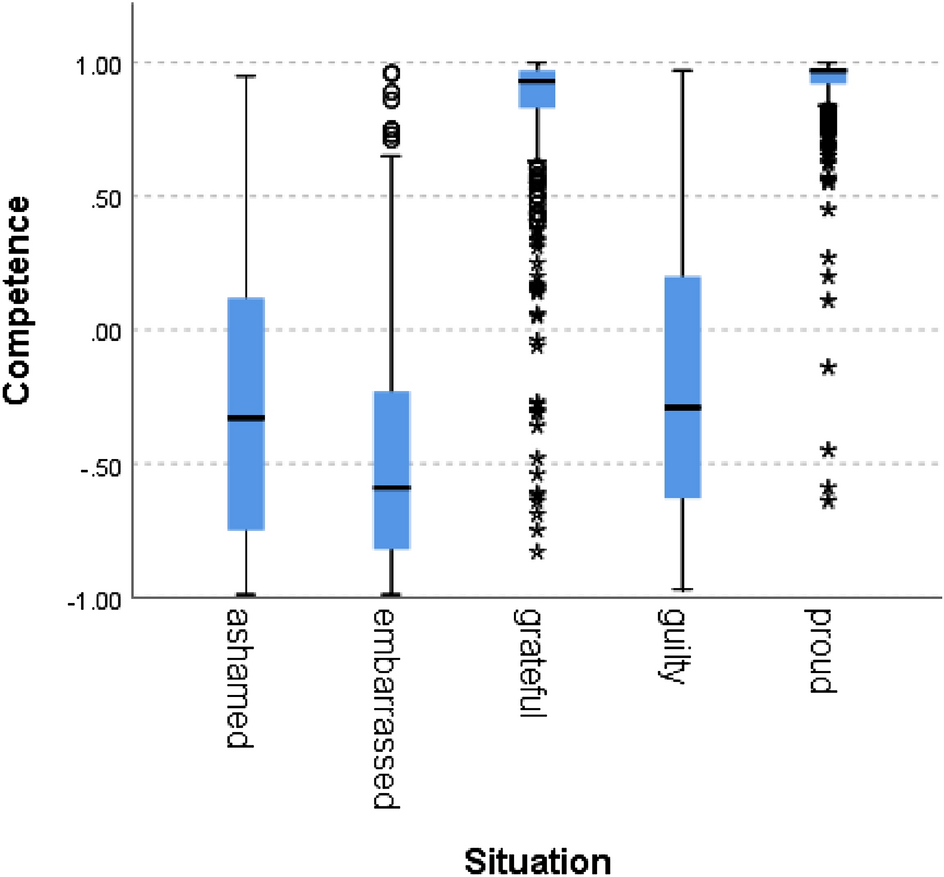
Identifying social norms and their violation is a challenge facing several projects in computational science. This paper presents a novel approach to identifying social norm violations. We used GPT-3, zero-shot classification, and automatic rule discovery to develop simple predictive models grounded in psychological knowledge. Tested on two massive datasets, the models present significant predictive performance and show that even complex social situations can be functionally analyzed through modern computational tools.
Social Physics in the Age of Generative AI: How, Exactly, Is Society Complex?
The aspiration for a social physics — a science that would reveal universal laws of social life analogous to those governing the natural world—has haunted the social sciences since Comte. Each new wave of quantitative and computational methods breathes fresh life into this vision. The current moment is no exception: advances in artificial intelligence and large language models have reinvigorated attempts to model society through the methods of social physics. This essay argues that these ambitions rest on a confusion about the nature of social complexity. Drawing a distinction between systems complexity and anthropological complexity, we identify the limitations of analyzing society as a complex system akin to natural systems. One crucial obstacle for social physics is the analysis of meaning and interpretation. Generative artificial intelligence (GenAI) offers important opportunities to model language and reflexivity, inviting and perhaps compelling social physics to confront meaning and interpretation as constitutive features of the social world. At the same time, GenAI leaves untouched and may even aggravate social physics’ failure to grasp power, institutions, and inequality.
Stewardship of global collective behavior
Collective behavior provides a framework for understanding how the actions and properties of groups emerge from the way individuals generate and share information. In humans, information flows were initially shaped by natural selection yet are increasingly structured by emerging communication technologies. Our larger, more complex social networks now transfer high-fidelity information over vast distances at low cost. The digital age and the rise of social media have accelerated changes to our social systems, with poorly understood functional consequences. This gap in our knowledge represents a principal challenge to scientific progress, democracy, and actions to address global crises. We argue that the study of collective behavior must rise to a “crisis discipline” just as medicine, conservation, and climate science have, with a focus on providing actionable insight to policymakers and regulators for the stewardship of social systems.

Field Theory: AI as Social Science Question, Object & Tool
Uses of advanced artificial intelligence are changing how societies organize labor, govern, produce knowledge, and make meaning. In light of these developments, this essay argues that AI models, tools, and systems pose three interrelated imperatives for social science: they demand renewed attention to social theories of how technology, human experience, and social order are entangled; they require study as objects of inquiry in their own right; and they offer capabilities that may transform—or upend—the practice of social investigation itself. From Weber’s analysis of rationalization to Du Bois’s study of technology and inequality to contemporary scholarship on algorithmic governance, the essay examines what social science distinctively offers: the capacity to historicize the apparently unprecedented, to trace connections across scales, and to center those most affected by technological change. It identifies how algorithmic systems are remaking the distribution of opportunity and risk as a central task of social inquiry and asks what futures social science might help bring into being.
Governing Together: Toward Infrastructure for Community-Run Social Media | Proceedings of the 2026 CHI Conference on Human Factors in Computing Systems
Collaborative and social computing theory, concepts and paradigms

Bridging Social Movements and the New Social Web (working draft) - Variable Context with @CaptainCalliope.blue
On connecting movements, media, and new protocol ecosystems to rebuild the civic, cultural, and technical foundations of a freer, more self-determining society.
Socialized Proof of Work — Open Indie
There’s an increasing obsession with “humanness” these days: Humanness in the age of AI Worldcoin: a solution in search of its problem (...
I’ve been hearing about this project for years from @fernpizza.bsky.social and I’m stoked to see it out. It’s wildly elegant mixture of theory and empirics, with novel methods that manages to ask and answer deep questions about selection. Paper of the year. science.org/doi/10.1126/science.adx0665

Intracellular competition shapes plasmid population dynamics
www.science.org✨New paper out @nature.com ✨ For 8 weeks around the 2024 US election, we randomly assigned 2,000 people to use social media algos we built ourselves. Do engagement-based algorithms amplify intergroup, moral & emotional (IME) content—and does that distort how we see political norms? 🧵🔗 👇

