


Macro-economic assessments of climate impacts lack an analysis of the distribution of daily rainfall, which can resolve both complex societal impact channels and anthropogenically forced changes1–6. Here, using a global panel of subnational economic output for 1,554 regions worldwide over the past 40 years, we show that economic growth rates are reduced by increases in the number of wet days and in extreme daily rainfall, in addition to responding nonlinearly to the total annual and to the standardized monthly deviations of rainfall. Furthermore, high-income nations and the services and manufacturing sectors are most strongly hindered by both measures of daily rainfall, complementing previous work that emphasized the beneficial effects of additional total annual rainfall in low-income, agriculturally dependent economies4,7. By assessing the distribution of rainfall at multiple timescales and the effects on different sectors, we uncover channels through which climatic conditions can affect the economy. These results suggest that anthropogenic intensification of daily rainfall extremes8–10 will have negative global economic consequences that require further assessment by those who wish to evaluate the costs of anthropogenic climate change.
RETRACTED ARTICLE: The economic commitment of climate change
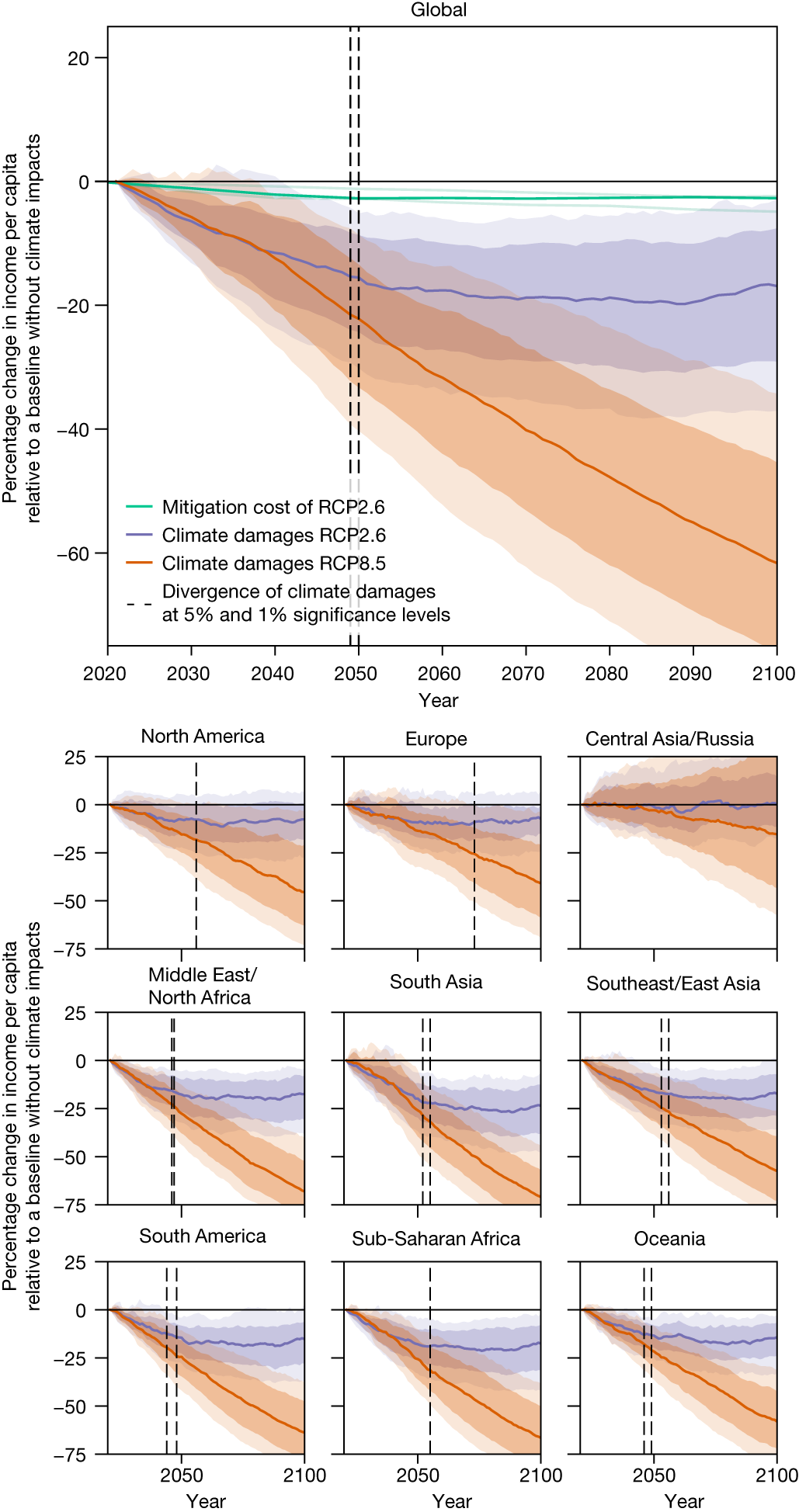
Global projections of macroeconomic climate-change damages typically consider impacts from average annual and national temperatures over long time horizons1–6. Here we use recent empirical findings from more than 1,600 regions worldwide over the past 40 years to project sub-national damages from temperature and precipitation, including daily variability and extremes7,8. Using an empirical approach that provides a robust lower bound on the persistence of impacts on economic growth, we find that the world economy is committed to an income reduction of 19% within the next 26 years independent of future emission choices (relative to a baseline without climate impacts, likely range of 11–29% accounting for physical climate and empirical uncertainty). These damages already outweigh the mitigation costs required to limit global warming to 2 °C by sixfold over this near-term time frame and thereafter diverge strongly dependent on emission choices. Committed damages arise predominantly through changes in average temperature, but accounting for further climatic components raises estimates by approximately 50% and leads to stronger regional heterogeneity. Committed losses are projected for all regions except those at very high latitudes, at which reductions in temperature variability bring benefits. The largest losses are committed at lower latitudes in regions with lower cumulative historical emissions and lower present-day income.
The macroeconomic implications of extreme weather events: Insights from advanced economies
Extreme weather events are increasing in frequency and intensity, yet their macroeconomic impacts remain poorly understood. This column argues that the highly localised nature of climate-related natural disasters means impacts should be assessed at the subnational level, with explicit accounting for cross-region spillovers. Such an approach uncovers significant adverse effects of about 0.3% of GDP per year in OECD economies, roughly half occurring outside the disaster zone via negative spillovers.

Why unilateral decarbonisation can pay for itself
Anthropogenic greenhouse gas emissions are rapidly warming our planet, with potentially severe economic, social, and health consequences. Conventional estimates of climate damages suggest that while coordinated global efforts are desirable, unilateral action is rarely cost-effective due to a classic free-rider problem. Why should a country bear the costs of reducing emissions when the benefits are shared globally? This column re-evaluates this view in light of new climate damage estimates based on global temperature variation, showing that the economic case for unilateral decarbonisation is far stronger than previously thought.

Can We Have Prosperity Without Growth?
The critique of economic growth, once a fringe position, is gaining widespread attention in the face of the climate crisis.

The roles of aerosol direct and indirect effects in past and future climate change
Abstract Using the Geophysical Fluid Dynamics Laboratory's (GFDL's) fully coupled chemistry‐climate (ocean/atmosphere/land/sea ice) model (CM3) with an explicit physical representation of aerosol indirect effects (cloud‐water droplet activation), we find that the dramatic emission reductions (35%–80%) in anthropogenic aerosols and their precursors projected by Representative Concentration Pathway (RCP) 4.5 result in ~1 °C of additional warming and ~0.1 mm day −1 of additional precipitation, both globally averaged, by the end of the 21st century. The impact of these reductions in aerosol emissions on simulated global mean surface temperature and precipitation becomes apparent by mid‐21st century. Furthermore, we find that the aerosol emission reductions cause precipitation to increase in East and South Asia by ~1.0 mm day −1 through the second half of the 21st century. Both the temperature and the precipitation responses simulated by CM3 are significantly stronger than the responses previously simulated by our earlier climate model (CM2.1) that only considered direct radiative forcing by aerosols. We conclude that the indirect effects of sulfate aerosol greatly enhance the impacts of aerosols on surface temperature in CM3; both direct and indirect effects from sulfate aerosols dominate the strong precipitation response, possibly with a small contribution from carbonaceous aerosols. Just as we found with the previous GFDL model, CM3 produces surface warming patterns that are uncorrelated with the spatial distribution of 21st century changes in aerosol loading. However, the largest precipitation increases in CM3 are colocated with the region of greatest aerosol decrease, in and downwind of Asia. , Key Points Aerosol reductions (RCP4.5) cause 1K warming and +0.1 mm/day of precipitation. Sulfate indirect effects greatly enhance aerosol impacts on surface temperature. Aerosol reductions increase precipitation in Asia by 0.5–1.0 mm/day by 2100.

A recent doubling of global warming rate signals a 1.5 °C breach by 2028
Timely and accurate projections of when global warming will exceed the Paris Agreement’s 1.5 °C threshold are essential for effective climate policy. Existing estimates place this exceedance in the early 2030 s but carry substantial uncertainty. Here we analyze the latest observational temperature records through 2025 and identify a statistically significant doubling of the global warming rate during 2011–2025 (0.40 °C per decade) compared to 1971–2025 (0.20 °C per decade). Extrapolating this accelerated rate projects a crossing of the 1.5 °C threshold by 2028, nearly a decade earlier than previous estimates. Regional analyses attribute this acceleration primarily to intensified warming over East Asia–the North Pacific, mid-latitude Eurasia, and the South Atlantic–Antarctic regions. The ensemble mean of 26 climate models fails to capture the observed doubling of the warming rate, simulating a rate of only 0.29 °C per decade. These findings suggest a narrower window remains to limit warming to 1.5 °C, underscoring the urgency for rapid and substantial reductions in greenhouse gas emissions.
Imperialist appropriation in the world economy: Drain from the global South through unequal exchange, 1990–2015
Unequal exchange theory posits that economic growth in the “advanced economies” of the global North relies on a large net appropriation of resources and labour from the global South, extracted through price differentials in international trade. Past attempts to estimate the scale and value of this drain have faced a number of conceptual and empirical limitations, and have been unable to capture the upstream resources and labour embodied in traded goods. Here we use environmental input-output data and footprint analysis to quantify the physical scale of net appropriation from the South in terms of embodied resources and labour over the period 1990 to 2015. We then represent the value of appropriated resources in terms of prevailing market prices. Our results show that in 2015 the North net appropriated from the South 12 billion tons of embodied raw material equivalents, 822 million hectares of embodied land, 21 exajoules of embodied energy, and 188 million person-years of embodied labour, worth $10.8 trillion in Northern prices – enough to end extreme poverty 70 times over. Over the whole period, drain from the South totalled $242 trillion (constant 2010 USD). This drain represents a significant windfall for the global North, equivalent to a quarter of Northern GDP. For comparison, we also report drain in global average prices. Using this method, we find that the South’s losses due to unequal exchange outstrip their total aid receipts over the period by a factor of 30. Our analysis confirms that unequal exchange is a significant driver of global inequality, uneven development, and ecological breakdown.
How Climate Change Is Disrupting the Global Supply Chain
The impact of the Covid pandemic on the global supply chain has been widely reported. But extreme weather, from floods to wildfires, is increasingly hammering ports, highways, and factories worldwide, and experts warn these climate-induced disruptions will only get worse.

Three-quarters of the world's land is drying out, 'redefining life on Earth'
Climate change has made great swaths of the planet's land drier and saltier, jeopardizing food production and water access for billions.
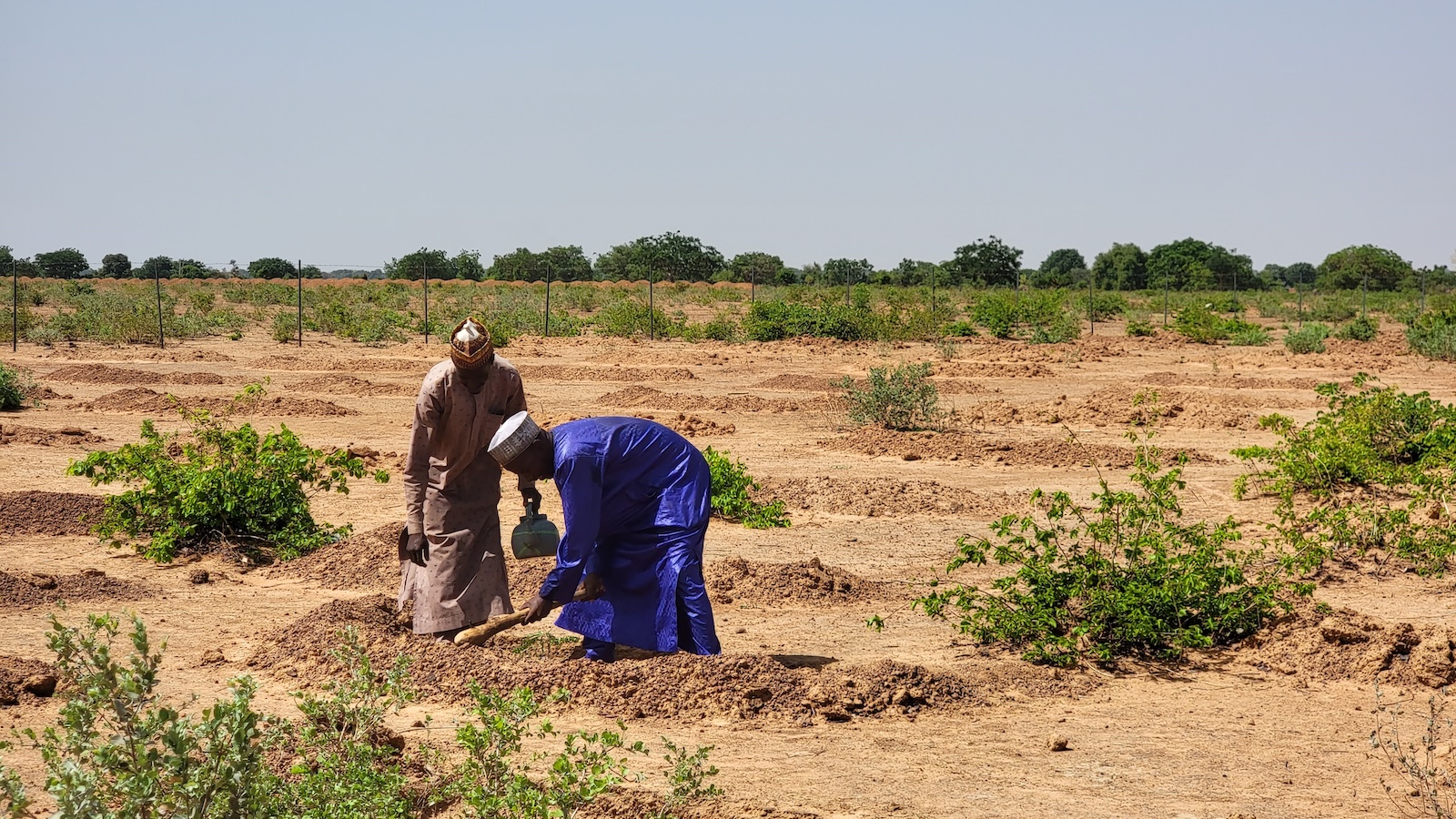
Why Climateflation Will Drive Food Prices More Than War
Economists expect this summer's heatwaves to drive 2027 food prices more than the Iran war. Climateflation, explained: from your grocery bill to your mortgage rate.

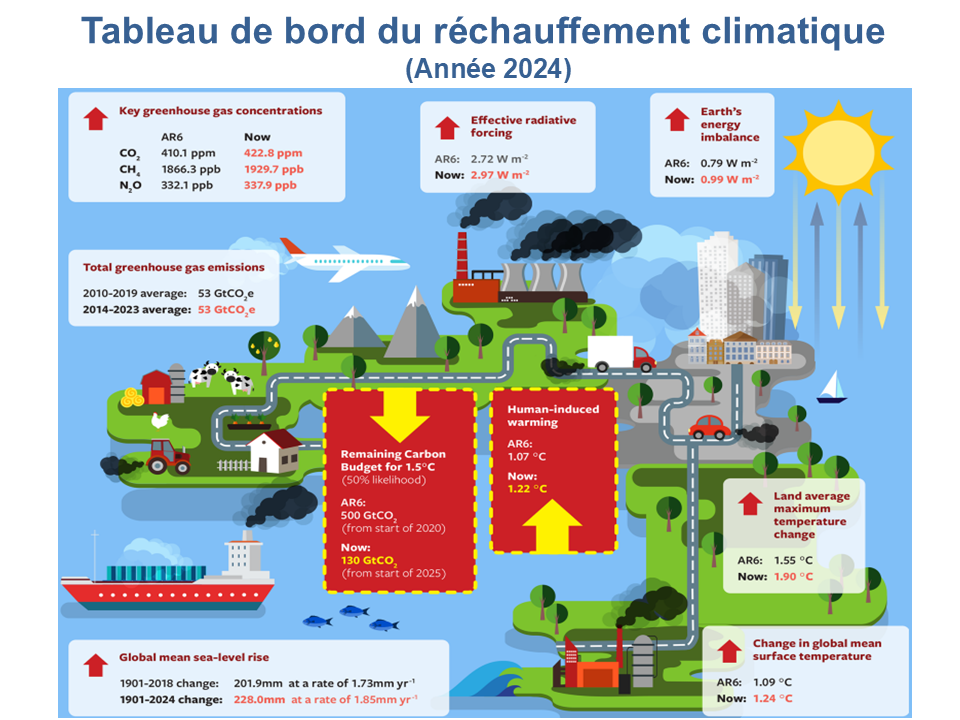
L’état du climat mondial en 2024 : ce qu’il faut retenir
Source : Indicators of Global Climate Change 2024, juin 2025 L’univers virtuel des réseaux sociaux est celui de l’immédiateté. Un utilisateur de TikTok y navigue en moyenne 95 minutes chaque jour, …
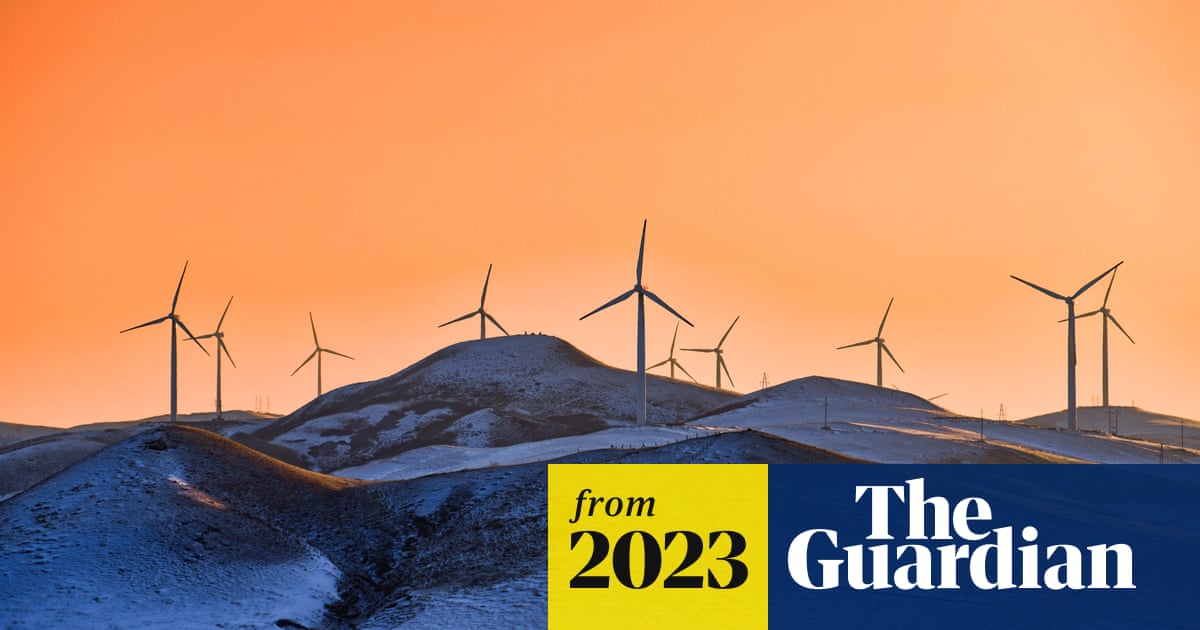
Climate change is affecting mental health literally everywhere
Extreme weather, water scarcity, air pollution, and more are taking a toll on people across the world.

Climate change
Present-day climate change includes both global warming—the ongoing increase in global average temperature—and its wider effects on Earth's climate system. Climate change in a broader sense also includes previous long-term changes to Earth's climate. The modern-day rise in global temperatures is driven by human activities, especially fossil fuel burning since the Industrial Revolution. Fossil fuel use, deforestation, and some agricultural and industrial practices release greenhouse gases. These gases absorb some of the heat that the Earth radiates after it warms from sunlight, warming the lower atmosphere. Earth's atmosphere now has roughly 50% more carbon dioxide, the main gas driving global warming, than it did at the end of the pre-industrial era, reaching levels not seen for millions of years.

The ‘wicked trinity’ of late capitalism: Governing in an era of stagnation, surplus humanity, and environmental breakdown
Scholars within the fields of political ecology, environmental political theory, and international political economy tend to evaluate the prospects of state-led environmental transitions in general terms – enquiring as to the capitalist state’s inherent properties and their environmental implications. Less attention has been paid to how the state’s green capacities are conditioned by contemporary evolutions in the form and pace of capital accumulation. Capitalism’s directional pattern of historical development poses unique challenges for green state projects. Its drive to raise labour productivity metabolises nature on a growing scale, while generating conditions of overproduction and rendering a progressively larger portion of the population superfluous to the production process.Thus, the question is not simply whether the state can rise to the challenge of climate change, but rather how states are scrambling to govern the intersecting crises of climate catastrophe, economic stagnation, and surplus humanity. This ‘wicked trinity’ compounds the tensions at the heart of the capitalist state, resulting in an increasing inability to perform its role while sustaining its liberal form. This governance trilemma is illustrated by the case of the solar photovoltaic boom, where the spectacular increase in the productivity and scale of solar panel manufacturing have generated oversupply and falling profitability. States have reacted by indefinitely providing subsidies, financing automation technologies thatexacerbate labour superfluity, and relocating solar panel manufacturing to places with authoritarian labour regimes. The case of photovoltaics is a microcosm of the general predicament faced by states as they struggle to govern capitalism’s secular developmental tendencies.
Eight things the world must do to avoid the worst of climate change
Latest IPCC report highlights key measures countries must take to avoid climate catastrophe
Heat-related urban mortality attributable to human-induced climate change in Europe in summer 2026
The summer of 2026 was characterised by a series of extreme heatwaves across Western Europe, with both monthly and annual temperature records broken repeatedly across many countries from May onwards. Several government agencies took the unprecedented step of issuing near-real-time estimates of the mortality associated with the most intense heat events, reflecting the severity of the threat to public health. In this study we combine probabilistic climate attribution with city- and age-specific temperature–mortality relationships to estimate heat-related mortality in 854 European cities during the summer months (June-August) and compare with counterfactual climate conditions representing a world without human-caused warming. We estimate 50,391 heat-related excess deaths across the 854 cities during the summer, with around two thirds of these attributable to anthropogenic climate change. These results highlight the threat from human-caused warming and the need for rapid emissions reductions alongside preparation and adaptation measures.
