

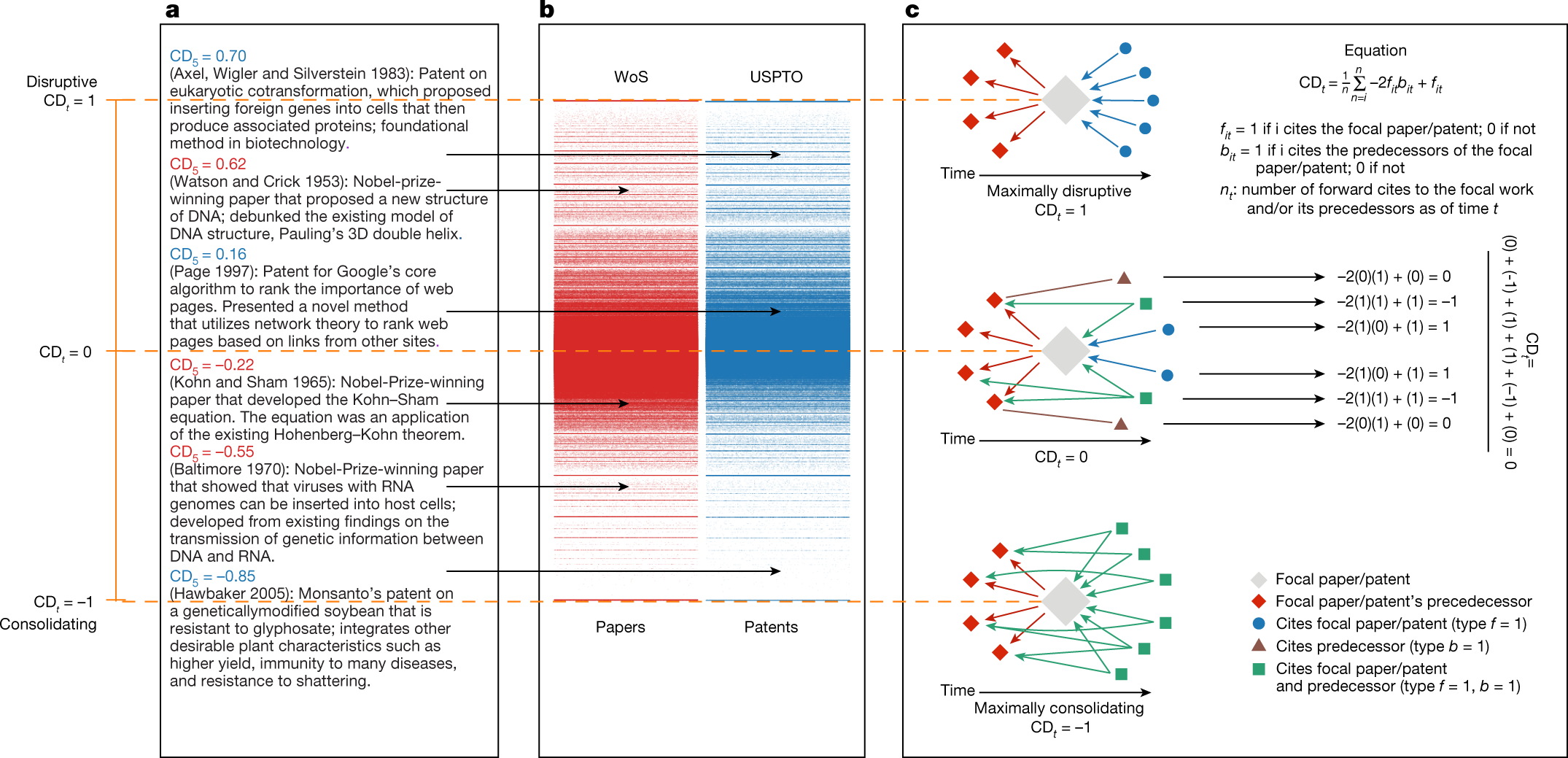
Theories of scientific and technological change view discovery and invention as endogenous processes1,2, wherein previous accumulated knowledge enables future progress by allowing researchers to, in Newton’s words, ‘stand on the shoulders of giants’3–7. Recent decades have witnessed exponential growth in the volume of new scientific and technological knowledge, thereby creating conditions that should be ripe for major advances8,9. Yet contrary to this view, studies suggest that progress is slowing in several major fields10,11. Here, we analyse these claims at scale across six decades, using data on 45 million papers and 3.9 million patents from six large-scale datasets, together with a new quantitative metric—the CD index12—that characterizes how papers and patents change networks of citations in science and technology. We find that papers and patents are increasingly less likely to break with the past in ways that push science and technology in new directions. This pattern holds universally across fields and is robust across multiple different citation- and text-based metrics1,13–17. Subsequently, we link this decline in disruptiveness to a narrowing in the use of previous knowledge, allowing us to reconcile the patterns we observe with the ‘shoulders of giants’ view. We find that the observed declines are unlikely to be driven by changes in the quality of published science, citation practices or field-specific factors. Overall, our results suggest that slowing rates of disruption may reflect a fundamental shift in the nature of science and technology.

The Discovery Engine: A Framework for AI-Driven Synthesis and Navigation of Scientific Knowledge Landscapes
Scientific progress relies on the effective accumulation, synthesis, and critical evaluation of knowledge. Traditionally, the well-documented, peer reviewed publication served as the primary standard for filtering and disseminating credible findings within the scientific community. Recently, however, we are witnessing an unprecedented acceleration in research output, a veritable explosion of scientific publications across all disciplines [1]. Yet, this very abundance creates a paradox: the sheer volume threatens to overwhelm the mechanisms designed for its assimilation and synthesis. Researchers, even within highly specialized subfields, face an almost insurmountable challenge in keeping abreast of relevant developments, integrating disparate findings, and identifying the truly novel signals amidst the noise [2]. This information overload contributes to disciplinary fragmentation, hindering the cross-pollination of ideas essential for disruptive innovation [3]. Furthermore, persistent concerns regarding "reproducibility crisis" [2], predatory journals, inflation of research areas[4], growing retractions and the potential influences of bibliometrics on research direction [5] highlight systemic challenges in validating and prioritizing scientific contributions to fundamental knowledge.
Topics, Authors, and Institutions in Large Language Model Research: Trends from 17K arXiv Papers
Large language models (LLMs) are dramatically influencing AI research, spurring discussions on what has changed so far and how to shape the field's future. To clarify such questions, we analyze a new dataset of 16,979 LLM-related arXiv papers, focusing on recent trends in 2023 vs. 2018-2022. First, we study disciplinary shifts: LLM research increasingly considers societal impacts, evidenced by 20x growth in LLM submissions to the Computers and Society sub-arXiv. An influx of new authors -- half of all first authors in 2023 -- are entering from non-NLP fields of CS, driving disciplinary expansion. Second, we study industry and academic publishing trends. Surprisingly, industry accounts for a smaller publication share in 2023, largely due to reduced output from Google and other Big Tech companies; universities in Asia are publishing more. Third, we study institutional collaboration: while industry-academic collaborations are common, they tend to focus on the same topics that industry focuses on rather than bridging differences. The most prolific institutions are all US- or China-based, but there is very little cross-country collaboration. We discuss implications around (1) how to support the influx of new authors, (2) how industry trends may affect academics, and (3) possible effects of (the lack of) collaboration.

Topics, Authors, and Institutions in Large Language Model Research: Trends from 17K arXiv Papers
Large language models (LLMs) are dramatically influencing AI research, spurring discussions on what has changed so far and how to shape the field's future. To clarify such questions, we analyze a new dataset of 16,979 LLM-related arXiv papers, focusing on recent trends in 2023 vs. 2018-2022. First, we study disciplinary shifts: LLM research increasingly considers societal impacts, evidenced by 20x growth in LLM submissions to the Computers and Society sub-arXiv. An influx of new authors -- half of all first authors in 2023 -- are entering from non-NLP fields of CS, driving disciplinary expansion. Second, we study industry and academic publishing trends. Surprisingly, industry accounts for a smaller publication share in 2023, largely due to reduced output from Google and other Big Tech companies; universities in Asia are publishing more. Third, we study institutional collaboration: while industry-academic collaborations are common, they tend to focus on the same topics that industry focuses on rather than bridging differences. The most prolific institutions are all US- or China-based, but there is very little cross-country collaboration. We discuss implications around (1) how to support the influx of new authors, (2) how industry trends may affect academics, and (3) possible effects of (the lack of) collaboration.
Scientific production in the era of Large Language Models
Large Language Models (LLMs) are rapidly reshaping scientific research. We analyze these changes in multiple, large-scale datasets with 2.1M preprints, 28K peer review reports, and 246M online accesses to scientific documents. We find: 1) scientists adopting LLMs to draft manuscripts demonstrate a large increase in paper production, ranging from 23.7-89.3% depending on scientific field and author background, 2) LLM use has reversed the relationship between writing complexity and paper quality, leading to an influx of manuscripts that are linguistically complex but substantively underwhelming, and 3) LLM adopters access and cite more diverse prior work, including books and younger, less-cited documents. These findings highlight a stunning shift in scientific production that will likely require a change in how journals, funding agencies, and tenure committees evaluate scientific works.
The strain on scientific publishing
Scientists are increasingly overwhelmed by the volume of articles being published. Total articles indexed in Scopus and Web of Science have grown exponentially in recent years; in 2022 the article total was approximately ~47% higher than in 2016, which has outpaced the limited growth - if any - in the number of practising scientists. Thus, publication workload per scientist (writing, reviewing, editing) has increased dramatically. We define this problem as the strain on scientific publishing. To analyse this strain, we present five data-driven metrics showing publisher growth, processing times, and citation behaviours. We draw these data from web scrapes, requests for data from publishers, and material that is freely available through publisher websites. Our findings are based on millions of papers produced by leading academic publishers. We find specific groups have disproportionately grown in their articles published per year, contributing to this strain. Some publishers enabled this growth by adopting a strategy of hosting special issues, which publish articles with reduced turnaround times. Given pressures on researchers to publish or perish to be competitive for funding applications, this strain was likely amplified by these offers to publish more articles. We also observed widespread year-over-year inflation of journal impact factors coinciding with this strain, which risks confusing quality signals. Such exponential growth cannot be sustained. The metrics we define here should enable this evolving conversation to reach actionable solutions to address the strain on scientific publishing.
Artificial intelligence tools expand scientists’ impact but contract science’s focus
Developments in artificial intelligence (AI) have accelerated scientific discovery1. Alongside recent AI-oriented Nobel prizes2–9, these trends establish the role of AI tools in science10. This advancement raises questions about the influence of AI tools on scientists and science as a whole, and highlights a potential conflict between individual and collective benefits11. To evaluate these questions, we used a pretrained language model to identify AI-augmented research, with an F1-score of 0.875 in validation against expert-labelled data. Using a dataset of 41.3 million research papers across the natural sciences and covering distinct eras of AI, here we show an accelerated adoption of AI tools among scientists and consistent professional advantages associated with AI usage, but a collective narrowing of scientific focus. Scientists who engage in AI-augmented research publish 3.02 times more papers, receive 4.84 times more citations and become research project leaders 1.37 years earlier than those who do not. By contrast, AI adoption shrinks the collective volume of scientific topics studied by 4.63% and decreases scientists’ engagement with one another by 22%. By consequence, adoption of AI in science presents what seems to be a paradox: an expansion of individual scientists’ impact but a contraction in collective science’s reach, as AI-augmented work moves collectively towards areas richest in data. With reduced follow-on engagement, AI tools seem to automate established fields rather than explore new ones, highlighting a tension between personal advancement and collective scientific progress.

Maybe scientific progress isn’t slowing, after all
A new paper takes aim at the claim that science has become less disruptive

We are Who We Cite: Bridges of Influence Between Natural Language Processing and Other Academic Fields
Natural Language Processing (NLP) is poised to substantially influence the world. However, significant progress comes hand-in-hand with substantial risks. Addressing them requires broad engagement with various fields of study. Yet, little empirical work examines the state of such engagement (past or current). In this paper, we quantify the degree of influence between 23 fields of study and NLP (on each other). We analyzed \textasciitilde77k NLP papers, \textasciitilde3.1m citations from NLP papers to other papers, and \textasciitilde1.8m citations from other papers to NLP papers. We show that, unlike most fields, the cross-field engagement of NLP, measured by our proposed Citation Field Diversity Index (CFDI), has declined from 0.58 in 1980 to 0.31 in 2022 (an all-time low). In addition, we find that NLP has grown more insular—citing increasingly more NLP papers and having fewer papers that act as bridges between fields. NLP citations are dominated by computer science; Less than 8% of NLP citations are to linguistics, and less than 3% are to math and psychology. These findings underscore NLP's urgent need to reflect on its engagement with various fields.
The Risks of Industry Influence in Tech Research
Emerging information technologies like social media, search engines, and AI can have a broad impact on public health, political institutions, social dynamics, and the natural world. It is critical to develop a scientific understanding of these impacts to inform evidence-based technology policy that minimizes harm and maximizes benefits. Unlike most other global-scale scientific challenges, however, the data necessary for scientific progress are generated and controlled by the same industry that might be subject to evidence-based regulation. Moreover, technology companies historically have been, and continue to be, a major source of funding for this field. These asymmetries in information and funding raise significant concerns about the potential for undue industry influence on the scientific record. In this Perspective, we explore how technology companies can influence our scientific understanding of their products. We argue that science faces unique challenges in the context of technology research that will require strengthening existing safeguards and constructing wholly new ones.
#predictingthefuture #newfutureofwork | Jaime Teevan
🌱 Prediction: Knowledge will outgrow publication. We’re already seeing academic publication start to buckle under AI, sometimes absurdly. I still publish research more or less the way Darwin did. I run a study, write it up, a few other scientists check it over, and the result gets filed away as a document with my name on the front. Faster than Darwin, with better figures, but the same basic shape. I predict that shape won’t last another decade. Academic authors are starting to slip hidden instructions into papers to flatter the AI that might review them. Reviewers are spending time checking whether citations exist or were hallucinated. Researchers asking AI to tell them about a paper instead of reading it directly. These are signs that the creation of new knowledge is outgrowing the articles that used to contain it. An academic paper serves many purposes at once. It makes an argument legible. It lets strangers check one's reasoning. It assigns credit and responsibility. It records who knew what and when. A paper was the only container we had for these different jobs, so it carried all of them together. With AI, they can be separated. My guess is that means the unit of publication will get smaller. Much of my research has focused on microproductivity, developing the idea that large accomplishments can be built from many small contributions. Publication will start to become a form of microproductivity. Instead of holding onto a result until it can be wrapped in a narrative large enough to justify a paper, researchers will publish it the moment it’s solid. Each finding, method, or negative result will be citable and carry its own provenance, so credit and reasoning travel with it. Reviewing will shrink to match, so claims get checked as they’re made instead of in one verdict at the end. But more than changing publication, the deeper change will be to how research itself is done. You may have heard the term “compound engineering,” where every bug fixed, evaluation written, workflow documented, or lesson learned becomes part of the system’s memory. I predict we’re about to see “compound science,” where every experiment, evaluation, insight, artifact, and learned capability becomes a reusable asset for future discovery. Findings will become evidence. Methods will become building blocks. Failed approaches will become constraints. For centuries, science has relied on humans to navigate an ever-growing body of knowledge. Soon that body of knowledge will help navigate itself. Scientists will spend less time searching for hypotheses and more time deciding which opportunities to pursue. AI systems will propose explanations, design experiments, run analyses, and explore many possibilities in parallel. Every discovery will become a part of the machinery that produces the next one. Papers ten years from now will look less like my current papers than my current papers look like Darwin’s. If they exist at all. #PredictingTheFuture #NewFutureOfWork

The Engine of Scientific Discovery: How New Methods and Tools Spark Major Breakthroughs
Abstract. How do we spark new scientific discoveries? Why do some breakthroughs seem even accidental? And most importantly, how can we accelerate them and
AI in Science: Boosting Productivity and Innovation | Arthur Turrell posted on the topic | LinkedIn
Today at Google & Google DeepMind, we published work led by Mihai Codreanu on AI in Science, drawing on 15 million Gemini interactions, 2,600 specialised AI models & a 600-scientist survey. What did we find about how AI is changing science? Read on... First, why does this matter? If AI is a tech boost we get a one-off economic growth boost. But if AI is an "innovation in the method of innovation", we get long run higher expected future growth rates! Compound interest makes those scenarios very different for future prosperity. Where might we see innovation in the method of innovation first? Well, science of course—the engine of innovation and one of the main drivers behind the huge increase in prosperity over the last 200 years. So what do we find? 1) In our data, scientists are about 2.7x overrepresented in AI use compared to what you'd expect from employment share. Scientists are using AI a lot! 2) Science convos are longer (tokens), more multimodal, and involve more domain expertise 3) Computer science has highest use 4) specialised models and LLMs are complements: LLMs do code, stats, literature, drafting, teaching, admin while specialised models predict, generate, classify — eg protein structures, weather. 5) within LLMs, analysis & modelling + communicating research findings are top 2 tasks But are we getting *improvements*? 6) 74% of scientists surveyed report net time savings; (6% report losses). Average saving of ~7 hours/week. This is mostly going back into more research. 47% report an increase in outputs of 10% or more. There's another effect too though—as some things (hypothesis generation, modelling) become 'cheap', science gets bottlenecked by other tasks... 7) 89% of those who save time spend more than a tenth of it checking AI outputs & 41% report a growing backlog of untested hypotheses Looking a bit beyond, we expect time spent on bottleneck tasks to grow as a %, more papers that recombine ideas from across disciplines, & publication volume increases for fields that don't need wet lab work. Unfortunately, not all of this volume may be high quality ("sci-slop") So what's our early take on AI as an innovation in the method of innovation? There's significant potential to increase scientific productivity, & 7 hours/week (big!) is *already* being saved. But it's early days & bottlenecks (inc. verification) limit sci-productivity take off Huge team involved in this work, as you can imagine—see the paper for more! https://lnkd.in/g55s4MtC | 38 comments on LinkedIn

The State of Papers, Retractions, and Preprints: Evidence from the CrossRef Database (2004-2024)
A 20-year analysis of CrossRef metadata demonstrates that global scholarly output -- encompassing publications, retractions, and preprints -- exhibits strikingly inertial growth, well-described by exponential, quadratic, and logistic models with nearly indistinguishable goodness-of-fit. Retraction dynamics, in particular, remain stable and minimally affected by the COVID-19 shock, which contributed less than 1% to total notices. Since 2004, publications doubled every 9.8 years, retractions every 11.4 years, and preprints at the fastest rate, every 5.6 years. The findings underscore a system primed for ongoing stress at unchanged structural bottlenecks. Although model forecasts diverge beyond 2024, the evidence suggests that the future trajectory of scholarly communication will be determined by persistent systemic inertia rather than episodic disruptions -- unless intentionally redirected by policy or AI-driven reform.
AI maps science papers to predict research trends two to three years ahead
The number of scientific papers is growing so rapidly that scientists are no longer able to keep track of all of them, even in their own research area. Researchers from the Karlsruhe Institute of Technology ...

The Scientific Contribution Graph: Automated Literature-based Technological Roadmapping at Scale
Sir Isaac Newton famously wrote, “If I have seen further, it is by standing on the shoulders of giants”. Scientific contributions are rarely developed in isolation, but build upon prior contributions, such as problem framings, experimental methods, and empirical findings. Understanding these prerequisite relationships is important for studying scientific progress, and for automated scientific discovery systems that must reason about which existing capabilities can be used to develop new ones (e.g. Lu et al., 2024; Jansen et al., 2025b; Baek et al., 2025).