


SciPy is an open-source scientific computing library for the Python programming language. Since its initial release in 2001, SciPy has become a de facto standard for leveraging scientific algorithms in Python, with over 600 unique code contributors, thousands of dependent packages, over 100,000 dependent repositories and millions of downloads per year. In this work, we provide an overview of the capabilities and development practices of SciPy 1.0 and highlight some recent technical developments.
Python Tutorial | Learn Python Programming Language - GeeksforGeeks
Your All-in-One Learning Portal: GeeksforGeeks is a comprehensive educational platform that empowers learners across domains-spanning computer science and programming, school education, upskilling, commerce, software tools, competitive exams, and more.

Array programming with NumPy
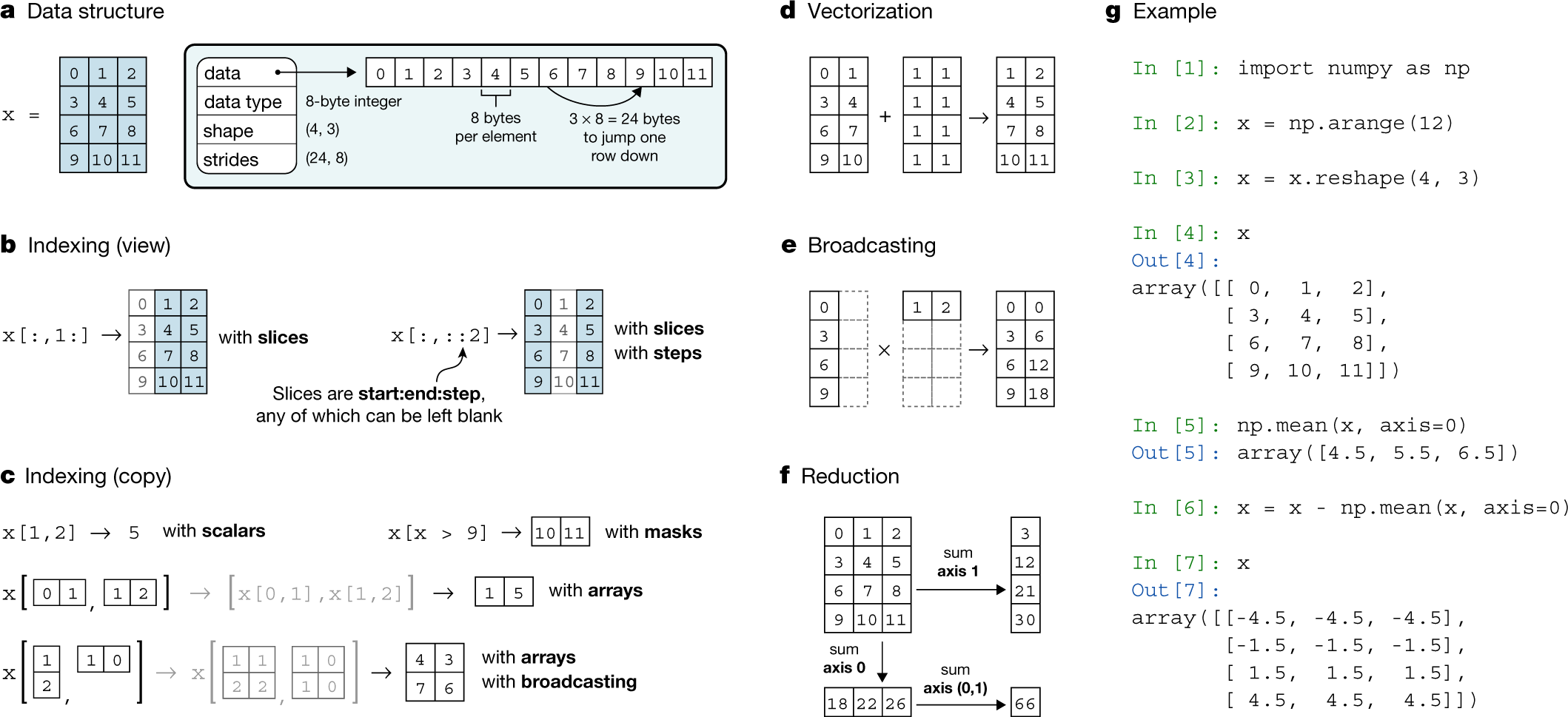
Array programming provides a powerful, compact and expressive syntax for accessing, manipulating and operating on data in vectors, matrices and higher-dimensional arrays. NumPy is the primary array programming library for the Python language. It has an essential role in research analysis pipelines in fields as diverse as physics, chemistry, astronomy, geoscience, biology, psychology, materials science, engineering, finance and economics. For example, in astronomy, NumPy was an important part of the software stack used in the discovery of gravitational waves1 and in the first imaging of a black hole2. Here we review how a few fundamental array concepts lead to a simple and powerful programming paradigm for organizing, exploring and analysing scientific data. NumPy is the foundation upon which the scientific Python ecosystem is constructed. It is so pervasive that several projects, targeting audiences with specialized needs, have developed their own NumPy-like interfaces and array objects. Owing to its central position in the ecosystem, NumPy increasingly acts as an interoperability layer between such array computation libraries and, together with its application programming interface (API), provides a flexible framework to support the next decade of scientific and industrial analysis.
Linking the world's research to the code it runs on - OpenAlex blog
Research relies on software. Software written by scientists, for science, runs through the entire modern research stack: NumPy and SciPy, R and ggplot2, Jupyter, BLAST, ImageJ, AlphaFold. Yet in the scholarly record, that software is nearly invisible. Software is not usually cited formally in publications and is usually just mentioned in the text, which means […]

Pydata Paris Virtual Meetup June 2021
Investing in the Python ecosystem
Vercel welcomes the Gel Data team and deepens support for the Python ecosystem through PSF sponsorships, community funding, and improved Python developer tools.
Jupyter Notebooks – a publishing format for reproducible computational workflows
It is increasingly necessary for researchers in all fields to write computer code, and in order to reproduce research results, it is important that this code is published. We present Jupyter notebooks, a document format for publishing code, results and explanations in a form that is both readable and executable. We discuss various tools and use cases for notebook documents.
The Story of Python and how it took over the world | Python: The Documentary
Data Structures for Statistical Computing in Python
In this paper we are concerned with the practical issues of working with data sets common to finance, statistics, and other related fields. pandas is a new library which aims to facilitate working with these data sets and to provide a set of fundamental building blocks for implementing statistical models.

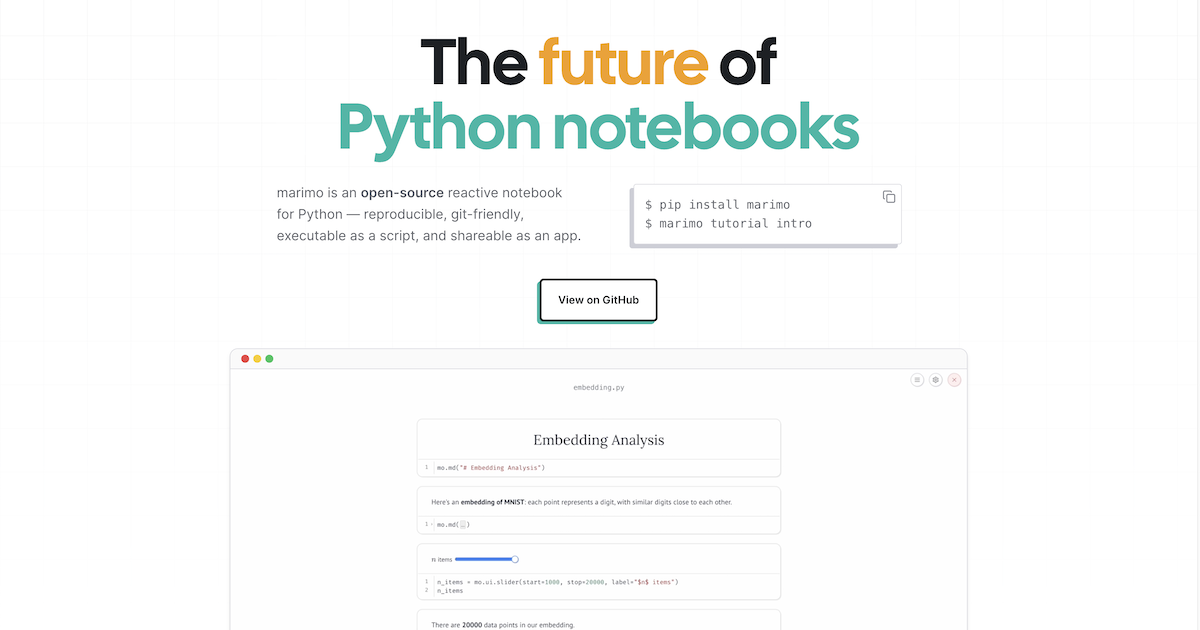
marimo | a next-generation Python notebook
Explore data and build apps seamlessly with marimo, a next-generation Python notebook.
Julia vs. Python: A comprehensive comparison
The debate between Julia and Python sparks intense discussions. Julia, known for its compiled nature, boasts remarkable speed, while…