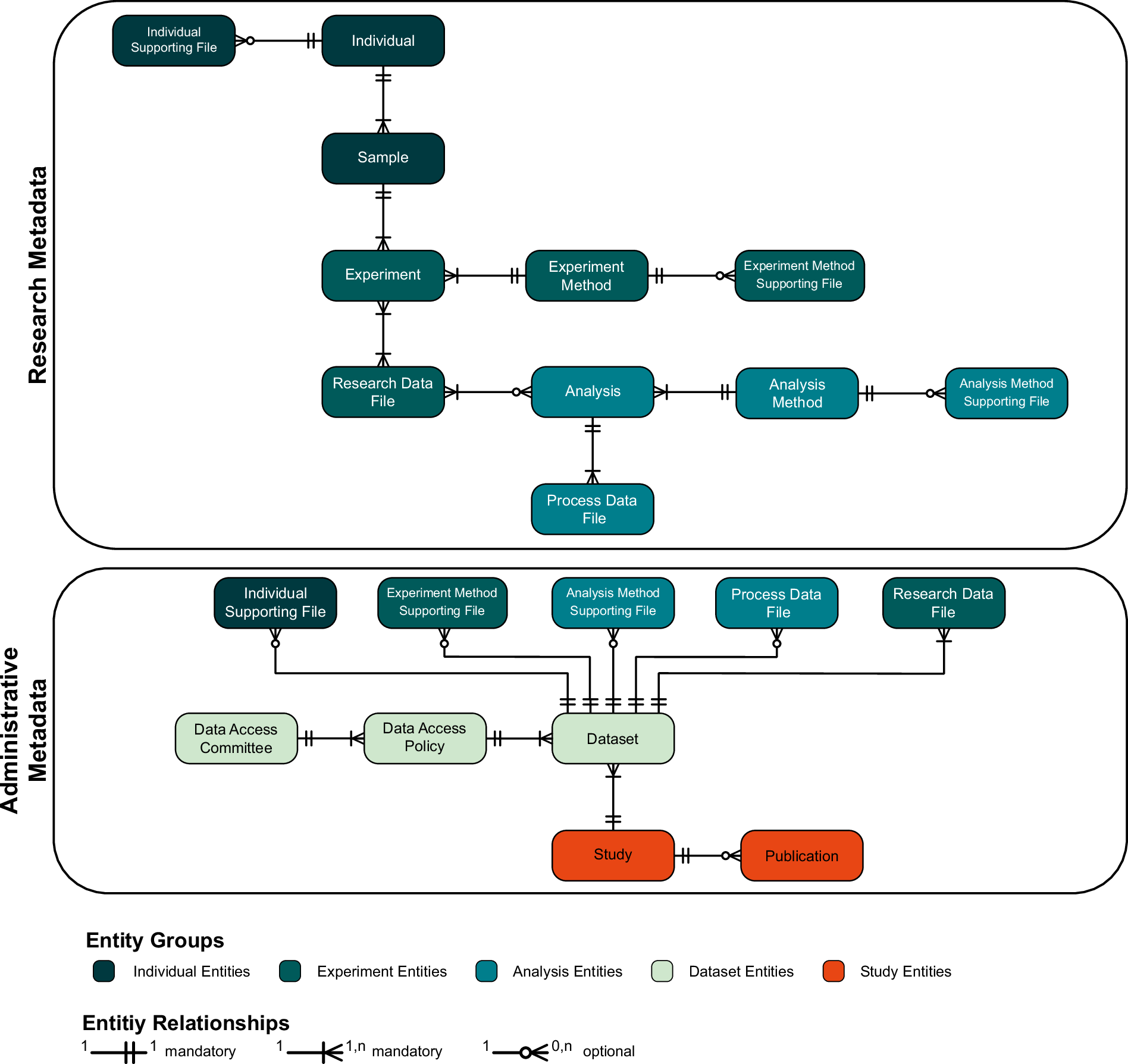
Legal and technical developments drive data sharing via federated infrastructures, especially in the field of human omics. This requires interoperability across technical, syntactic, organizational, and semantic layers. The German Human Genome-Phenome Archive (GHGA) has been building a national, federated infrastructure for secure sharing of human omics data. As part of its mission to enhance interoperability and to promote reliable data sharing, a detailed crosswalk analysis was conducted comparing the GHGA metadata model with four other domain-relevant standards and metadata models: EGA (Submission API and model draft), FAIR Genomes and ISA-tab. The analysis aimed at identifying semantic consensus fields to define datasets in the context of human omics by forward mapping (GHGA model to external models). Backward mapping (external models to GHGA) focused on spotting gaps in GHGA’s semantic metadata representation. Forward mapping showed overall similar property coverage across models, aligning with MINSEQE. Backward mapping showed greater model heterogeneity. None of the identified information gaps spanned across all models. These findings highlight the detail and adaptability of the GHGA metadata model.
Metadata Integration: A Systematic Review on Methods, Challenges and Applications Across Multiple Domains
Metadata contributes to ensuring semantic interoperability, data reuse, and efficient information retrieval across heterogeneous systems. However, existing studies present fragmented approaches and lack a consolidated view of the strategies adopted in different domains. This fragmentation creates a gap in understanding the current state of the art and identifying cross-domain trends and challenges. This systematic review aims to address this gap by analyzing metadata integration practices across multiple domains, including Health and Medicine, Smart Cities and IoT, Data Science, Geosciences, Cultural Heritage, Library and Information Science. This review follows the Kitchenham structure, encompassing the planning, execution, and reporting phases. A total of 81 peer-reviewed articles published between 2014 and 2025 were selected from five major databases, based on the defined inclusion and exclusion criteria and a structured quality assessment process. The results reveal a predominance of the use of ontology, followed by metadata-driven language, standards, processes, and common metadata schema with an emerging trend towards automation through the adoption of AI-based approaches. The identified challenges include semantic heterogeneity, lack of standardization, limited automation, and usability issues in the current tools and platforms. We provide a comprehensive synthesis of existing approaches, highlighting domain-specific and cross-domain trends, and identifying research opportunities to advance metadata integration through automation, semantic enrichment, and standardized practices.
Manuscript submission systems and metadata completeness in Crossref: Patterns and associations
The importance of open research information, particularly publication metadata, is widely recognised. Crossref is one of the most important infrastructures for registering open metadata as part of DOI record registration. It is widely known, however, that the metadata of many publications is far from complete, with many publishers making certain metadata openly available, but failing to do so for other metadata elements. Publishers’ ability to register this metadata with Crossref depends on their capacity to capture and retain this data in their production workflows. Manuscript submission systems are an important, yet largely overlooked, factor in the extent to which publishers make metadata available through Crossref. In this paper, we present the results of an analysis investigating the relation between the level of metadata that publishers deposit with Crossref and the submission systems that they deploy for their journals. We have looked at the 153 publishers with the largest amounts of publications in Crossref and concentrate on the four most commonly used systems: Editorial Manager, ScholarOne, Open Journal Systems (OJS) and eJournalPress. We show that some submission systems appear better suited to capturing certain metadata elements. However, there are always cases where publishers using the same system differ widely in the level of metadata they register, suggesting that technology is not the only prohibiting factor and other considerations are at play.
Evaluating Multilingual Metadata Quality in Crossref
Introduction: Scholarly research spans multiple languages, making multilingual metadata crucial for organizing and accessing knowledge across linguistic boundaries. These multilingual metadata already exist and are propagated throughout scholarly publishing infrastructure, but the extent to which they are correctly recorded, or how they affect metadata quality more broadly is little understood. Methods: Our study quantifies the prevalence of multilingual records across a sample of publisher metadata and offers an understanding of their completeness, quality, and alignment with metadata standards. Utilizing the Crossref API to generate a random sample of 519,665 journal article records, we categorize each record into four distinct language types: English monolingual, non-English monolingual, multilingual, and uncategorized. We then investigate the prevalence of programmatically-detectable errors and the prevalence of multilingual records within the sample to determine whether multilingualism influences the quality of article metadata. Results: We find that English-only records are still in the vast majority among metadata found in Crossref, but that, while non-English and multilingual records present unique challenges, they are not a source of significant metadata quality issues and, in few instances, are more complete or correct than English monolingual records. Discussion & Conclusion: Our findings contribute to discussions surrounding multilingualism in scholarly communication, serving as a resource for researchers, publishers, and information professionals seeking to enhance the global dissemination of knowledge and foster inclusivity in the academic landscape.

You are Crossref - Crossref
Crossref runs open infrastructure to link research objects, entities, and actions—creating a lasting and reusable scholarly record that underpins open science. Together with our >25,000 members in 167 countries, we drive metadata exchange and support 2.1 billion monthly API queries, facilitating global research communication, for the benefit of society.

Crossref: The sustainable source of community-owned scholarly metadata
This paper describes the scholarly metadata collected and made available by Crossref, as well as its importance in the scholarly research ecosystem. Containing over 106 million records and expanding at an average rate of 11% a year, Crossref’s metadata has become one of the major sources of scholarly data for publishers, authors, librarians, funders, and researchers. The metadata set consists of 13 content types, including not only traditional types, such as journals and conference papers, but also data sets, reports, preprints, peer reviews, and grants. The metadata is not limited to basic publication metadata, but can also include abstracts and links to full text, funding and license information, citation links, and the information about corrections, updates, retractions, etc. This scale and breadth make Crossref a valuable source for research in scientometrics, including measuring the growth and impact of science and understanding new trends in scholarly communications. The metadata is available through a number of APIs, including REST API and OAI-PMH. In this paper, we describe the kind of metadata that Crossref provides and how it is collected and curated. We also look at Crossref’s role in the research ecosystem and trends in metadata curation over the years, including the evolution of its citation data provision. We summarize the research used in Crossref’s metadata and describe plans that will improve metadata quality and retrieval in the future.

The Impact of Modern AI in Metadata Management
Metadata management plays a critical role in data governance, resource discovery, and decision-making in the data-driven era. While traditional metadata approaches have primarily focused on organization, classification, and resource reuse, the integration of modern artificial intelligence (AI) technologies has significantly transformed these processes. This paper investigates both traditional and AI-driven metadata approaches by examining open-source solutions, commercial tools, and research initiatives. A comparative analysis of traditional and AI-driven metadata management methods is provided, highlighting existing challenges and their impact on next-generation datasets. The paper also presents an innovative AI-assisted metadata management framework designed to address these challenges. This framework leverages more advanced modern AI technologies to automate metadata generation, enhance governance, and improve the accessibility and usability of modern datasets. Finally, the paper outlines future directions for research and development, proposing opportunities to further advance metadata management in the context of AI-driven innovation and complex datasets.

Self-Driving Datasets: From 20 Million Papers to Nuanced Biomedical Knowledge at Scale
Manually curated biomedical repositories -- spanning bioactivity, genomics, and chemistry -- are expensive to maintain, lag behind primary literature, and discard experimental context, obscuring nuances needed to assess data correctness and coverage. We show that PubMed itself can be autonomously and cost-effectively turned into structured datasets that are larger, more nuanced, and more accurate than the curated databases they replace. We present three coupled contributions: (1) an LLM-based entity-tagging pipeline, grounded in nine biomedical ontologies, that tags 4.5B entities across 19 categories in a 22.5M-paper, 2.5T-token PubMed corpus; (2) hybrid sparse-dense retrieval supporting entity-filtered semantic queries over the tagged corpus; and (3) Starling, a multi-agent deep research system that, given only a natural-language task description, designs precision- and recall-targeted retrieval filters, induces an extraction schema, and emits structured records with nuance-rich fields and supporting passages. Across six tasks -- blood-brain barrier permeability, oral bioavailability, acute toxicity (LD50), gene-disease associations, protein subcellular localization, and chemical reactions -- Starling produces ~6.3M records (91K-3M per task); several are, to our knowledge, the largest public datasets for their property. Frontier-model rejection of our extractions is 0.6-7.7% across tasks, far below error rates we measure on widely used curated counterparts (e.g., 16.5% on BBB_Martins, 7.3% on Bioavailability_Ma). Beyond scale and accuracy, the supporting passages carry nuance tabular databases discard -- e.g., oral bioavailability may depend on fed vs. fasted state. Together, the corpus, retrieval, and agent establish a foundation for AI-driven therapeutic design. Code and datasets: https://github.com/starling-labs/starling.
How Grobid uses Crossref metadata to enrich bibliographic information - Crossref
Crossref members register around 37,000 records daily. All this metadata is openly shared with the global scholarly community through our free APIs. We receive over two billion calls to our API each month, signalling its use by hundreds of tools and services worldwide, supporting the discovery and assessment of scholarly metadata. As part of a new series in our blog, we will spotlight the diversity of tools and integrations that rely on Crossref metadata to serve the scholarly community. In this initial post, we chat to Luca Foppiano, the developer and maintainer of Grobid1, to learn about how Grobid uses Crossref metadata to improve the extraction and enrichment of bibliographic information from scholarly PDFs.

DSWB | Metadata Standards: Selecting and Applying Standards in Research | Webinar Recording
(PDF) Understanding the Nature of Metadata: Systematic Review
PDF | Background Metadata are created to describe the corresponding data in a detailed and unambiguous way and is used for various applications in... | Find, read and cite all the research you need on ResearchGate

A Novel Kuhnian Ontology for Epistemic Classification of STM Scholarly Articles
Despite rapid gains in scale, research evaluation still relies on opaque, lagging proxies. To serve the scientific community, we pursue transparency: reproducible, auditable epistemic classification useful for funding and policy. Here we formalize KGX3 as a scenario-based model for mapping Kuhnian stages from research papers, prove determinism of the classification pipeline, and define the epistemic manifold that yields paradigm maps. We report validation across recent corpora, operational complexity at global scale, and governance that preserves interpretability while protecting core IP. The system delivers early, actionable signals of drift, crisis, and shift unavailable to citation metrics or citations-anchored NLP. KGX3 is the latest iteration of a deterministic epistemic engine developed since 2019—originating as Soph.io (2019–2020), advanced as iKuhn (2020–2024), and field-tested through Preprint Watch.
A large-scale audit of dataset licensing and attribution in AI
The race to train language models on vast, diverse and inconsistently documented datasets raises pressing legal and ethical concerns. To improve data transparency and understanding, we convene a multi-disciplinary effort between legal and machine learning experts to systematically audit and trace more than 1,800 text datasets. We develop tools and standards to trace the lineage of these datasets, including their source, creators, licences and subsequent use. Our landscape analysis highlights sharp divides in the composition and focus of data licenced for commercial use. Important categories including low-resource languages, creative tasks and new synthetic data all tend to be restrictively licenced. We observe frequent miscategorization of licences on popular dataset hosting sites, with licence omission rates of more than 70% and error rates of more than 50%. This highlights a crisis in misattribution and informed use of popular datasets driving many recent breakthroughs. Our analysis of data sources also explains the application of copyright law and fair use to finetuning data. As a contribution to continuing improvements in dataset transparency and responsible use, we release our audit, with an interactive user interface, the Data Provenance Explorer, to enable practitioners to trace and filter on data provenance for the most popular finetuning data collections: www.dataprovenance.org.

Designing a multi-sided data platform: findings from the International Data Spaces case
The paper presents the findings from a 3-year single-case study conducted in connection with the International Data Spaces (IDS) initiative. The IDS represents a multi-sided platform (MSP) for secure and trusted data exchange, which is governed by an institutionalized alliance of different stakeholder organizations. The paper delivers insights gained during the early stages of the platform’s lifecycle (i.e. the platform design process). More specifically, it provides answers to three research questions, namely how alliance-driven MSPs come into existence and evolve, how different stakeholder groups use certain governance mechanisms during the platform design process, and how this process is influenced by regulatory instruments. By contrasting the case of an alliance-driven MSP with the more common approach of the keystone-driven MSP, the results of the case study suggest that different evolutionary paths can be pursued during the early stages of an MSP’s lifecycle. Furthermore, the IDS initiative considers trust and data sovereignty more relevant regulatory instruments compared to pricing, for example. Finally, the study advances the body of scientific knowledge with regard to data being a boundary resource on MSPs.

SemRepo: A Knowledge Graph for Research Software and Its Scholarly Ecosystem
We present SemRepo, an RDF knowledge graph comprising over 81 million triples describing nearly 200,000 GitHub repositories associated with scientific research. SemRepo captures repository-level metadata, such as contributors, issues, and programming languages, and interlinks this information with external scholarly knowledge graphs. In particular, repository authors are linked to their profiles in SemOpenAlex, repositories are connected to scholarly publications in LPWC, and research artifacts, such as datasets and experiments, are linked via MLSea-KG. This integration enables queries that span publications and their scholarly artifacts, which are typically fragmented across separate platforms. SemRepo supports analyses that are difficult to perform with existing resources in isolation, including provenance reconstruction across repositories and publications, as well as the systematic identification of risks to research reproducibility and software sustainability. By unifying research software with its scholarly context in a single graph, SemRepo provides an important infrastructure for large-scale analysis of software within the broader scientific research ecosystem.
OME Project — open-metadata-exchange documentation
OME enables open educational resources to create, publish, and update their metadata on a peer-to-peer network. By solving authoring, publishing, and discovery issues, this network will provide broad visibility to current islands of OER information.
DASL — Data-Addressed Structures & Links
A small set of simple, standard primitives to work on content-addressed data.