

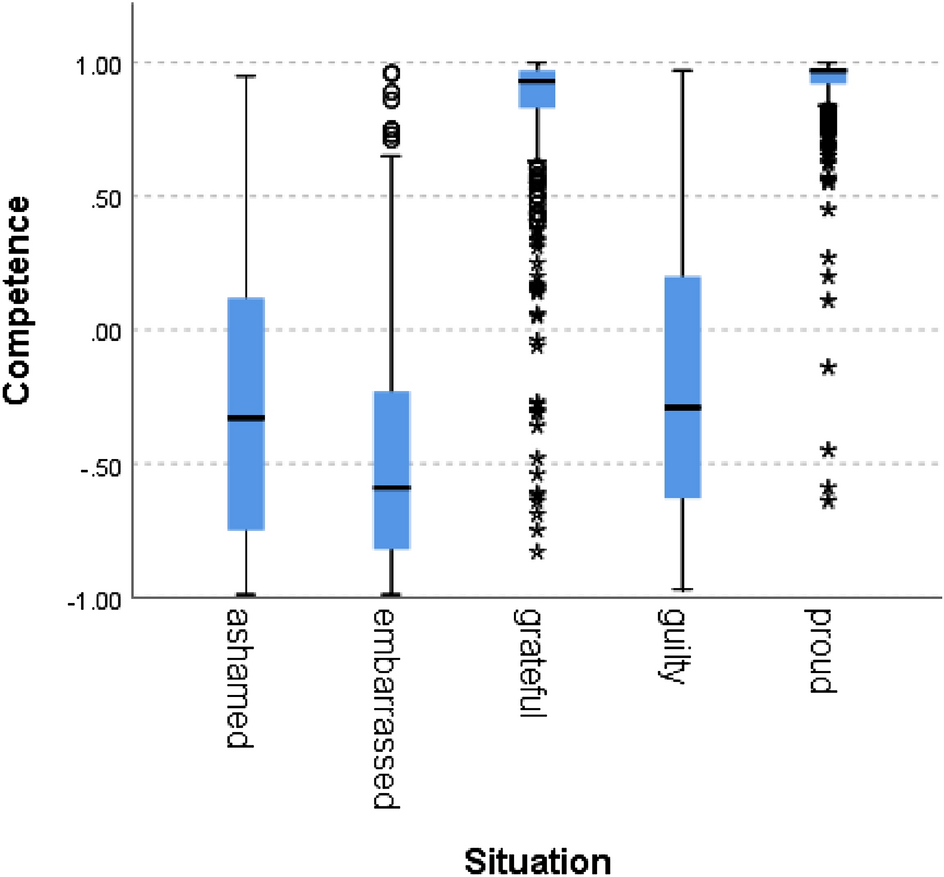
Identifying social norms and their violation is a challenge facing several projects in computational science. This paper presents a novel approach to identifying social norm violations. We used GPT-3, zero-shot classification, and automatic rule discovery to develop simple predictive models grounded in psychological knowledge. Tested on two massive datasets, the models present significant predictive performance and show that even complex social situations can be functionally analyzed through modern computational tools.
AI Models Exceed Individual Human Accuracy in Predicting Everyday Social Norms
A fundamental question in cognitive science concerns how social norms are acquired and represented. While humans typically learn norms through embodied social experience, we investigated whether large language models can achieve sophisticated norm understanding through statistical learning alone. Across two studies, we systematically evaluated multiple AI systems' ability to predict human social appropriateness judgments for 555 everyday scenarios by examining how closely they predicted the average judgment compared to each human participant. In Study 1, GPT-4.5's accuracy in predicting the collective judgment on a continuous scale exceeded that of every human participant (100th percentile). Study 2 replicated this, with Gemini 2.5 Pro outperforming 98.7% of humans, GPT-5 97.8%, and Claude Sonnet 4 96.0%. Despite this predictive power, all models showed systematic, correlated errors. These findings demonstrate that sophisticated models of social cognition can emerge from statistical learning over linguistic data alone, challenging strong versions of theories emphasizing the exclusive necessity of embodied experience for cultural competence. The systematic nature of AI limitations across different architectures indicates potential boundaries of pattern-based social understanding, while the models' ability to outperform nearly all individual humans in this predictive task suggests that language serves as a remarkably rich repository for cultural knowledge transmission.

Norms in the Wild: How to Diagnose, Measure, and Change Social Norms
Abstract. Norms in the Wild takes a unique look at social norms, answering questions about diagnosis (how can we tell that a shared practice is a social no

Bayesian Inference of Social Norms as Shared Constraints on Behavior
People act upon their desires, but often, also act in adherence to implicit social norms. How do people infer these unstated social norms from others' behavior, especially in novel social contexts? We propose that laypeople have intuitive theories of social norms as behavioral constraints shared across different agents in the same social context. We formalize inference of norms using a Bayesian Theory of Mind approach, and show that this computational approach provides excellent predictions of how people infer norms in two scenarios. Our results suggest that people separate the influence of norms and individual desires on others' actions, and have implications for modelling generalizations of hidden causes of behavior.
Social Chemistry 101: Learning to Reason about Social and Moral Norms
Social norms—the unspoken commonsense rules about acceptable social behavior—are crucial in understanding the underlying causes and intents of people's actions in narratives. For example, underlying an action such as “wanting to call cops on my neighbor” are social norms that inform our conduct, such as “It is expected that you report crimes.” We present SOCIAL CHEMISTRY, a new conceptual formalism to study people's everyday social norms and moral judgments over a rich spectrum of real life situations described in natural language. We introduce SOCIAL-CHEM-101, a large-scale corpus that catalogs 292k rules-of-thumb such as “It is rude to run a blender at 5am” as the basic conceptual units. Each rule-of-thumb is further broken down with 12 different dimensions of people's judgments, including social judgments of good and bad, moral foundations, expected cultural pressure, and assumed legality, which together amount to over 4.5 million annotations of categorical labels and free-text descriptions. Comprehensive empirical results based on state-of-the-art neural models demonstrate that computational modeling of social norms is a promising research direction. Our model framework, Neural Norm Transformer, learns and generalizes SOCIAL-CHEM-101 to successfully reason about previously unseen situations, generating relevant (and potentially novel) attribute-aware social rules-of-thumb.
Measuring Social Norms of Large Language Models
We present a new challenge to examine whether large language models understand social norms. In contrast to existing datasets, our dataset requires a fundamental understanding of social norms to solve. Our dataset features the largest set of social norm skills, consisting of 402 skills and 12,383 questions covering a wide set of social norms ranging from opinions and arguments to culture and laws. We design our dataset according to the K-12 curriculum. This enables the direct comparison of the social understanding of large language models to humans, more specifically, elementary students. While prior work generates nearly random accuracy on our benchmark, recent large language models such as GPT3.5-Turbo and LLaMA2-Chat are able to improve the performance significantly, only slightly below human performance. We then propose a multi-agent framework based on large language models to improve the models' ability to understand social norms. This method further improves large language models to be on par with humans. Given the increasing adoption of large language models in real-world applications, our finding is particularly important and presents a unique direction for future improvements.
Human social sensing is an untapped resource for computational social science
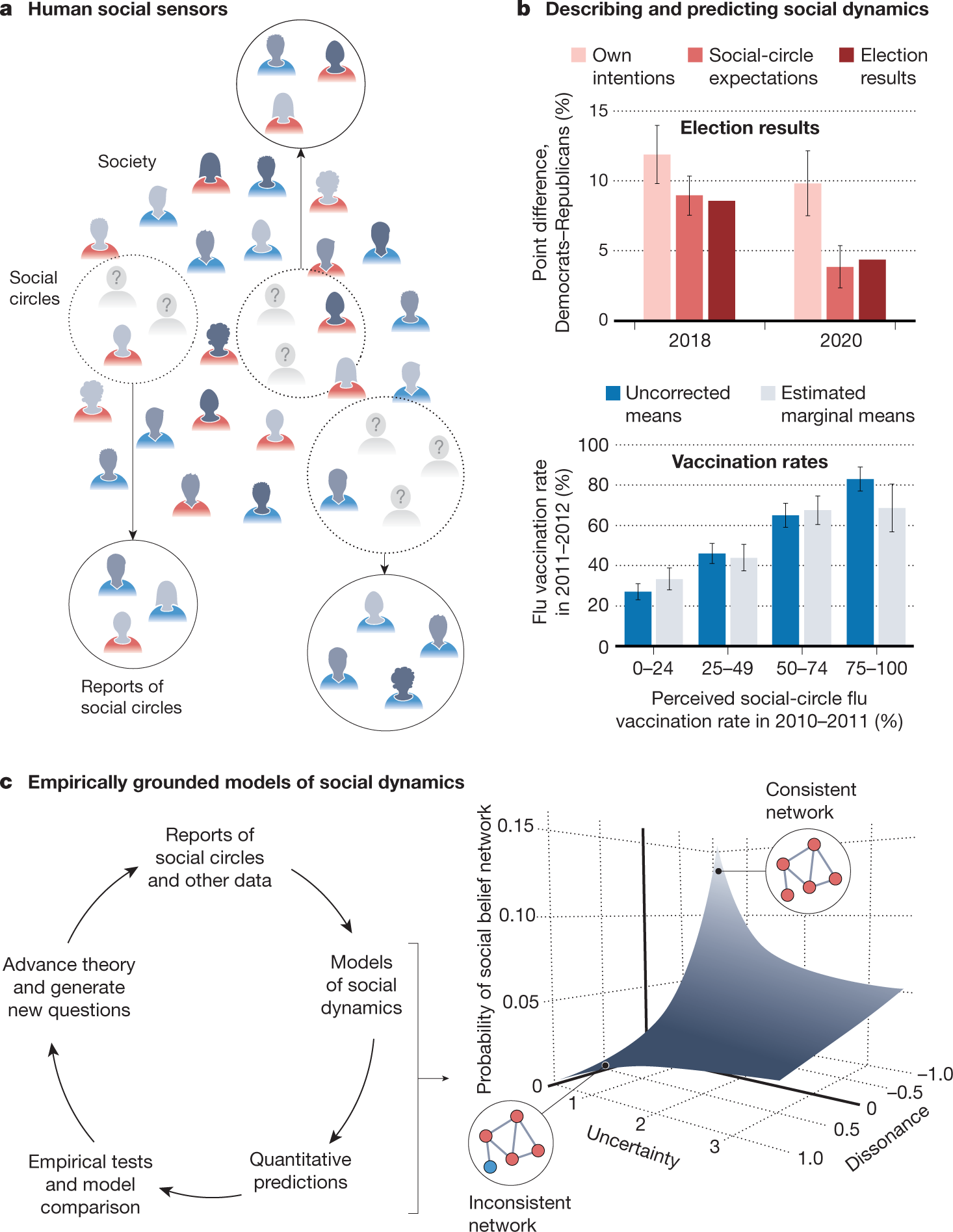
The ability to ‘sense’ the social environment and thereby to understand the thoughts and actions of others allows humans to fit into their social worlds, communicate and cooperate, and learn from others’ experiences. Here we argue that, through the lens of computational social science, this ability can be used to advance research into human sociality. When strategically selected to represent a specific population of interest, human social sensors can help to describe and predict societal trends. In addition, their reports of how they experience their social worlds can help to build models of social dynamics that are constrained by the empirical reality of human social systems.
How we learn social norms: a three-stage model for social norm learning
As social animals, humans are unique to make the world function well by developing, maintaining, and enforcing social norms. As a prerequisite among these norm-related processes, learning social norms can act as a basis that helps us quickly coordinate with others, which is beneficial to social inclusion when people enter into a new environment or experience certain sociocultural changes. Given the positive effects of learning social norms on social order and sociocultural adaptability in daily life, there is an urgent need to understand the underlying mechanisms of social norm learning. In this article, we review a set of works regarding social norms and highlight the specificity of social norm learning. We then propose an integrated model of social norm learning containing three stages, i.e., pre-learning, reinforcement learning, and internalization, map a potential brain network in processing social norm learning, and further discuss the potential influencing factors that modulate social norm learning. Finally, we outline a couple of future directions along this line, including theoretical (i.e., societal and individual differences in social norm learning), methodological (i.e., longitudinal research, experimental methods, neuroimaging studies), and practical issues.

Learning how to behave: cognitive learning processes account for asymmetries in adaptation to social norms
Changes to social settings caused by migration, cultural change or pandemics force us to adapt to new social norms. Social norms provide groups of individuals with behavioural prescriptions and therefore can be inferred by observing their behaviour. This work aims to examine how cognitive learning processes affect adaptation and learning of new social norms. Using a multiplayer game, I found that participants initially complied with various social norms exhibited by the behaviour of bot-players. After gaining experience with one norm, adaptation to a new norm was observed in all cases but one, where an active-harm norm was resistant to adaptation. Using computational learning models, I found that active behaviours were learned faster than omissions, and harmful behaviours were more readily attributed to all group members than beneficial behaviours. These results provide a cognitive foundation for learning and adaptation to descriptive norms and can inform future investigations of group-level learning and cross-cultural adaptation.

The Psychology of Normative Cognition
From an early age, humans exhibit a tendency to identify, adopt, andenforce the norms of their local communities. Norms are the socialrules that mark out what is appropriate, allowed, required, orforbidden in different situations for various community members. Theserules are informal in the sense that although they are sometimesrepresented in formal laws, like the rule governing which side of theroad to drive on, they need not be explicitly codified to effectivelyinfluence behavior. There are rules that forbid theft or the breakingof promises, but also rules that govern how close it is appropriate tostand to someone while talking to them, or how loud one should talkduring the conversation. Thus understood, norms regulate a wide rangeof activity. They exhibit cultural variability in their prescriptionsand proscriptions, but the presence of norms in general appears to beculturally universal. Some norms exhibit characteristics that areoften associated with morality, such as a rule that applies toeveryone and prohibits causing unnecessary harm. Other norms applyonly to certain people, such as those that delimit appropriateclothing for members of different genders, or those concerning theexpectations and responsibilities ascribed to individuals who occupypositions of leadership. The norms that prevail in a community can bemore or less fair, reasonable, or impartial, and can be subject tocritique and change.
Spurious normativity enhances learning of compliance and enforcement behavior in artificial agents
Significance The fact that humans enforce and comply with norms is an important reason why humans enjoy higher levels of cooperation and welfare than other animals. Some norms are relatively easy to explain: They may prohibit obviously harmful or uncooperative actions. But many norms are not easy to explain. For example, most cultures prohibit eating certain kinds of foods, and almost all societies have rules about what constitutes appropriate clothing, language, and gestures. Using a computational model focused on learning shows that apparently pointless rules can have an indirect effect on welfare. They can help agents learn how to enforce and comply with norms in general, improving the group’s ability to enforce norms that have a direct effect on welfare. , How do societies learn and maintain social norms? Here we use multiagent reinforcement learning to investigate the learning dynamics of enforcement and compliance behaviors. Artificial agents populate a foraging environment and need to learn to avoid a poisonous berry. Agents learn to avoid eating poisonous berries better when doing so is taboo, meaning the behavior is punished by other agents. The taboo helps overcome a credit assignment problem in discovering delayed health effects. Critically, introducing an additional taboo, which results in punishment for eating a harmless berry, further improves overall returns. This “silly rule” counterintuitively has a positive effect because it gives agents more practice in learning rule enforcement. By probing what individual agents have learned, we demonstrate that normative behavior relies on a sequence of learned skills. Learning rule compliance builds upon prior learning of rule enforcement by other agents. Our results highlight the benefit of employing a multiagent reinforcement learning computational model focused on learning to implement complex actions.

AI Behavioral Science
We outline a foundation for a new field of ``AI Behavioral Science,'' covering three perspectives. First, as AI becomes ubiquitous and is increasingly proprietary and opaque, it becomes vital to develop techniques for assessing AI behavior. We outline how tools developed to assess people's behaviors by social scientists can be used to assess and infer AI's behaviors biases, tendencies, and heuristics. Second, we also discuss how AI can change the ways in which we learn about human behavior. Beyond its computational power, AI offers new techniques for simulating, inferring, and predicting human behaviors that we outline and discuss. Third, as humans and AI are interacting in increasingly complex and intertwined systems, we need to understand the implications for the resulting economic and political outcomes. We outline issues that are increasingly pressing concerning the future of human-AI interactions and potential changes and disruptions that can ensue.
AI Behavioral Science: A Framework and Agenda
We discuss the challenges and opportunities present in the rapidly emerging area of “AI Behavioral Science.” We frame it via three subfields. First, as AI becomes ubiquitous and is increasingly proprietary and opaque, it becomes vital to develop models of AI and methods for assessing AI behavior. We outline how tools developed to assess people’s behaviors by social scientists can be used to model, assess and infer AI’s behaviors biases, tendencies, and heuristics. Second, we also discuss how AI can change the ways in which we learn about human behavior. Beyond its computational power, AI offers new techniques for simulating, inferring, predicting, and analyzing human behaviors. Third, as humans and AI are interacting in increasingly complex and intertwined systems, we need to analyze and model human-AI interactions including how human and AI behaviors depend on interactions at the individual level, how interacting systems of humans and AI behave, and ultimately how AI’s integration into society affects economic and political outcomes. We discuss current research, questions, agendas, and goals in each of these three subfields and how they depend upon each other.
[Keynote 01] A Theory of Appropriateness: Social Norms for Humans and AIs
Norm Dynamics: Interdisciplinary Perspectives on Social Norm Emergence, Persistence, and Change
Social norms are the glue that holds society together, yet our knowledge of them remains heavily intellectually siloed. This article provides an interdisciplinary review of the emerging field of norm dynamics by integrating research across the social sciences through a cultural-evolutionary lens. After reviewing key distinctions in theory and method, we discuss research on norm psychology—the neural and cognitive underpinnings of social norm learning and acquisition. We then overview how norms emerge and spread through intergenerational transmission, social networks, and group-level ecological and historical factors. Next, we discuss multilevel factors that lead norms to persist, change, or erode over time. We also consider cultural mismatches that can arise when a changing environment leads once-beneficial norms to become maladaptive. Finally, we discuss potential future research directions and the implications of norm dynamics for theory and policy.

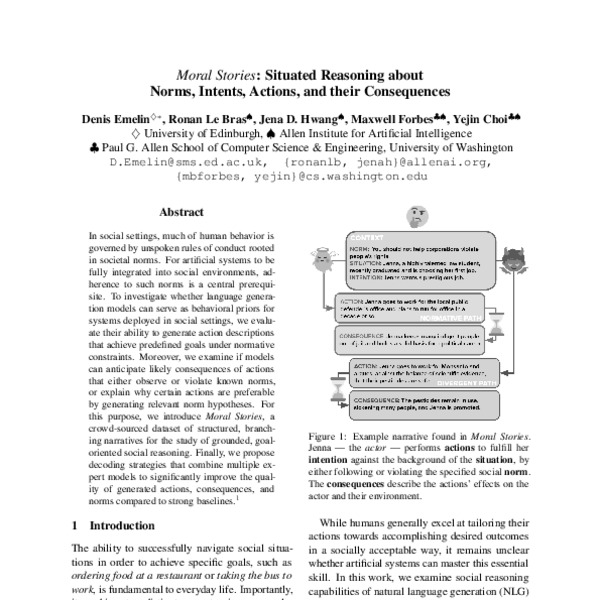
Moral Stories: Situated Reasoning about Norms, Intents, Actions, and their Consequences
In social settings, much of human behavior is governed by unspoken rules of conduct rooted in societal norms. For artificial systems to be fully integrated into social environments, adherence to such norms is a central prerequisite. To investigate whether language generation models can serve as behavioral priors for systems deployed in social settings, we evaluate their ability to generate action descriptions that achieve predefined goals under normative constraints. Moreover, we examine if models can anticipate likely consequences of actions that either observe or violate known norms, or explain why certain actions are preferable by generating relevant norm hypotheses. For this purpose, we introduce Moral Stories, a crowd-sourced dataset of structured, branching narratives for the study of grounded, goal-oriented social reasoning. Finally, we propose decoding strategies that combine multiple expert models to significantly improve the quality of generated actions, consequences, and norms compared to strong baselines.
Social Physics in the Age of Generative AI: How, Exactly, Is Society Complex?
The aspiration for a social physics — a science that would reveal universal laws of social life analogous to those governing the natural world—has haunted the social sciences since Comte. Each new wave of quantitative and computational methods breathes fresh life into this vision. The current moment is no exception: advances in artificial intelligence and large language models have reinvigorated attempts to model society through the methods of social physics. This essay argues that these ambitions rest on a confusion about the nature of social complexity. Drawing a distinction between systems complexity and anthropological complexity, we identify the limitations of analyzing society as a complex system akin to natural systems. One crucial obstacle for social physics is the analysis of meaning and interpretation. Generative artificial intelligence (GenAI) offers important opportunities to model language and reflexivity, inviting and perhaps compelling social physics to confront meaning and interpretation as constitutive features of the social world. At the same time, GenAI leaves untouched and may even aggravate social physics’ failure to grasp power, institutions, and inequality.