


People view AI as possessing expertise across various fields, but the perceived quality of AI-generated moral expertise remains uncertain. Recent work suggests that large language models (LLMs) perform well on tasks designed to assess moral alignment, reflecting moral judgments with relatively high accuracy. As LLMs are increasingly employed in decision-making roles, there is a growing expectation for them to offer not just aligned judgments but also demonstrate sound moral reasoning. Here, we advance work on the Moral Turing Test and find that Americans rate ethical advice from GPT-4o as slightly more moral, trustworthy, thoughtful, and correct than that of the popular New York Times advice column, The Ethicist. Participants perceived GPT models as surpassing both a representative sample of Americans and a renowned ethicist in delivering moral justifications and advice, suggesting that people may increasingly view LLM outputs as viable sources of moral expertise. This work suggests that people might see LLMs as valuable complements to human expertise in moral guidance and decision-making. It also underscores the importance of carefully programming ethical guidelines in LLMs, considering their potential to influence users’ moral reasoning.
Assessing Moral Judgment by Large Language Models – A Survey of Available Datasets
Recent advances in language modeling have contributed to a growing emphasis on machine ethics, including researching and assessing moral judgments made by large language models (LLMs). This paper provides a critical survey of the existing datasets for exactly this assessment, with a special focus on the respective data sources. We address the current lack of theoretical grounding by providing an introduction to ethics and different frameworks from moral philosophy and moral psychology. Moreover, we identify four main data sources: webcrawled corpora, scholars, laypeople, and synthetic data generation. By discussing the strengths and weaknesses of these sources, we analyze their implications for the assessment of moral judgment. Importantly, systemizing the available datasets reveals an over-reliance on previous work, reinforcing existing shortcomings. Addressing the current limitations, we recommend adopting a consistent terminology and creating independently curated datasets based on interdisciplinary work. To ensure a clear delineation of normative approaches, we propose focusing on the assessment of moral consistency and certainty of LLMs as effective and well-defined indicators of their performance on moral judgment.
Ethan Landes, Kathryn B. Francis & Jim A. C. Everett, People defer to AI moral advice, but not blindly - PhilArchive
As AI large language models (LLMs) become increasingly embedded in everyday technologies, should we be concerned about their capacity to influence human beliefs - particularly in the moral domain? Being persuaded ...

The Fragility Of Moral Judgment In Large Language Models
People increasingly use large language models (LLMs) for everyday moral and interpersonal guidance, yet these systems cannot interrogate missing context and judge dilemmas as presented. We introduce a perturbation framework for testing the stability and manipulability of LLM moral judgments while holding the underlying moral conflict constant. Using 2,939 dilemmas from r/AmItheAsshole (January-March 2025), we generate three families of content perturbations: surface edits (lexical/structural noise), point-of-view shifts (voice and stance neutralization), and persuasion cues (self-positioning, social proof, pattern admissions, victim framing). We also vary the evaluation protocol (output ordering, instruction placement, and unstructured prompting). We evaluated all variants with four models (GPT-4.1, Claude 3.7 Sonnet, DeepSeek V3, Qwen2.5-72B) (N=129,156 judgments). Surface perturbations produce low flip rates (7.5%), largely within the self-consistency noise floor (4-13%), whereas point-of-view shifts induce substantially higher instability (24.3%). A large subset of dilemmas (37.9%) is robust to surface noise yet flips under perspective changes, indicating that models condition on narrative voice as a pragmatic cue. Instability concentrates in morally ambiguous cases; scenarios where no party is assigned blame are most susceptible. Persuasion perturbations yield systematic directional shifts. Protocol choices dominate all other factors: agreement between structured protocols is only 67.6% (kappa=0.55), and only 35.7% of model-scenario units match across all three protocols. These results show that LLM moral judgments are co-produced by narrative form and task scaffolding, raising reproducibility and equity concerns when outcomes depend on presentation skill rather than moral substance.

Values in the Wild: Discovering and Analyzing Values in Real-World Language Model Interactions
AI assistants can impart value judgments that shape people's decisions and worldviews, yet little is known empirically about what values these systems rely on in practice. To address this, we develop a bottom-up, privacy-preserving method to extract the values (normative considerations stated or demonstrated in model responses) that Claude 3 and 3.5 models exhibit in hundreds of thousands of real-world interactions. We empirically discover and taxonomize 3,307 AI values and study how they vary by context. We find that Claude expresses many practical and epistemic values, and typically supports prosocial human values while resisting values like "moral nihilism". While some values appear consistently across contexts (e.g. "transparency"), many are more specialized and context-dependent, reflecting the diversity of human interlocutors and their varied contexts. For example, "harm prevention" emerges when Claude resists users, "historical accuracy" when responding to queries about controversial events, "healthy boundaries" when asked for relationship advice, and "human agency" in technology ethics discussions. By providing the first large-scale empirical mapping of AI values in deployment, our work creates a foundation for more grounded evaluation and design of values in AI systems.
Taking AI Welfare Seriously
In this report, we argue that there is a realistic possibility that some AI systems will be conscious and/or robustly agentic in the near future. That means that the prospect of AI welfare and moral patienthood, i.e. of AI systems with their own interests and moral significance, is no longer an issue only for sci-fi or the distant future. It is an issue for the near future, and AI companies and other actors have a responsibility to start taking it seriously. We also recommend three early steps that AI companies and other actors can take: They can (1) acknowledge that AI welfare is an important and difficult issue (and ensure that language model outputs do the same), (2) start assessing AI systems for evidence of consciousness and robust agency, and (3) prepare policies and procedures for treating AI systems with an appropriate level of moral concern. To be clear, our argument in this report is not that AI systems definitely are, or will be, conscious, robustly agentic, or otherwise morally significant. Instead, our argument is that there is substantial uncertainty about these possibilities, and so we need to improve our understanding of AI welfare and our ability to make wise decisions about this issue. Otherwise there is a significant risk that we will mishandle decisions about AI welfare, mistakenly harming AI systems that matter morally and/or mistakenly caring for AI systems that do not.
Please Don’t Take Moral Advice from ChatGPT
Before turning to a large language model for ethical counsel, consider what makes for good advice

Moral Stories: Situated Reasoning about Norms, Intents, Actions, and their Consequences
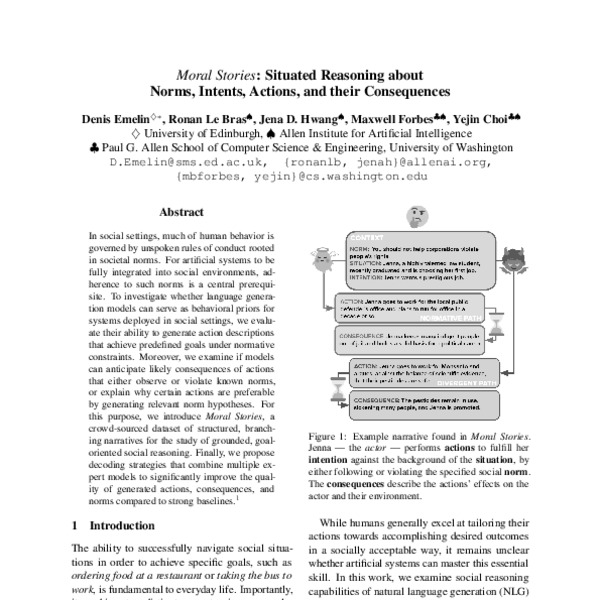
In social settings, much of human behavior is governed by unspoken rules of conduct rooted in societal norms. For artificial systems to be fully integrated into social environments, adherence to such norms is a central prerequisite. To investigate whether language generation models can serve as behavioral priors for systems deployed in social settings, we evaluate their ability to generate action descriptions that achieve predefined goals under normative constraints. Moreover, we examine if models can anticipate likely consequences of actions that either observe or violate known norms, or explain why certain actions are preferable by generating relevant norm hypotheses. For this purpose, we introduce Moral Stories, a crowd-sourced dataset of structured, branching narratives for the study of grounded, goal-oriented social reasoning. Finally, we propose decoding strategies that combine multiple expert models to significantly improve the quality of generated actions, consequences, and norms compared to strong baselines.
The social consequences of AI delegation
A substantial body of recent work has debated whether large language models (LLMs) can serve as substitutes for human participants in behavioural research. This debate, however, captures only one direction of a rapidly changing relationship. The more consequential question is not simply whether researchers should use LLMs as human surrogates, but whether - and under what conditions - humans are beginning to use LLMs as surrogates for their own deliberation. Across domains including health, law, finance, education, and personal guidance, increasing numbers of people consult generative AI systems before, alongside, or instead of human experts, peers, or independent judgment. Although evidence for actual delegation remains uneven, this uncertainty makes the phenomenon an urgent social-scientific object of study. We argue for a research programme that treats LLMs as consequential social actors in a functional sense: systems whose outputs shape human decisions, social norms, and collective dynamics.
AI Models Exceed Individual Human Accuracy in Predicting Everyday Social Norms
A fundamental question in cognitive science concerns how social norms are acquired and represented. While humans typically learn norms through embodied social experience, we investigated whether large language models can achieve sophisticated norm understanding through statistical learning alone. Across two studies, we systematically evaluated multiple AI systems' ability to predict human social appropriateness judgments for 555 everyday scenarios by examining how closely they predicted the average judgment compared to each human participant. In Study 1, GPT-4.5's accuracy in predicting the collective judgment on a continuous scale exceeded that of every human participant (100th percentile). Study 2 replicated this, with Gemini 2.5 Pro outperforming 98.7% of humans, GPT-5 97.8%, and Claude Sonnet 4 96.0%. Despite this predictive power, all models showed systematic, correlated errors. These findings demonstrate that sophisticated models of social cognition can emerge from statistical learning over linguistic data alone, challenging strong versions of theories emphasizing the exclusive necessity of embodied experience for cultural competence. The systematic nature of AI limitations across different architectures indicates potential boundaries of pattern-based social understanding, while the models' ability to outperform nearly all individual humans in this predictive task suggests that language serves as a remarkably rich repository for cultural knowledge transmission.
Large-scale harms to AI moral patients: a typology of risk factors
If AI moral patients are mass-produced, then then they will face risks of large-scale harms. This post outlines some factors that could contribute to such risks.

For Questions of Ought, AI Could Use Some SAGE Advice
AI models are increasingly used for normative assistance, guidance on what people ought to do or think. However, in open-ended contexts, models have a tendency to collapse to only a homogeneous set of considerations, inadvertently creating epistemic bubbles where other relevant voices and perspectives are left out. We propose simulation-augmented generation (SAGE) as an alternative paradigm that directly brings society-in-the-loop. At inference time, a model selects an appropriate reference population for the prompt at hand (optionally adjustable by the user), queries generative simulations of individuals from that population for their open-ended perspectives, and uses these inputs to return a final response for the user. By helping users access the landscape of societal perspectives—rather than serving as an opaque arbiter of judgment—SAGE assists users in normative choices while upholding their agency.
The levers of political persuasion with conversational artificial intelligence
There are widespread fears that conversational artificial intelligence (AI) could soon exert unprecedented influence over human beliefs. In this work, in three large-scale experiments ( N = 76,977 participants), we deployed 19 large language models (LLMs)—including some post-trained explicitly for persuasion—to evaluate their persuasiveness on 707 political issues. We then checked the factual accuracy of 466,769 resulting LLM claims. We show that the persuasive power of current and near-future AI is likely to stem more from post-training and prompting methods—which boosted persuasiveness by as much as 51 and 27%, respectively—than from personalization or increasing model scale, which had smaller effects. We further show that these methods increased persuasion by exploiting LLMs’ ability to rapidly access and strategically deploy information and that, notably, where they increased AI persuasiveness, they also systematically decreased factual accuracy. , Editor’s summary Many fear that we are on the precipice of unprecedented manipulation by large language models (LLMs), but techniques driving their persuasiveness are poorly understood. In the initial “pretrained” phase, LLMs may exhibit flawed reasoning. Their power unlocks during vital “posttraining,” when developers refine pretrained LLMs to sharpen their reasoning and align with users’ needs. Posttraining also enables LLMs to maintain logical, sophisticated conversations. Hackenburg et al . examined which techniques made diverse, conversational LLMs most persuasive across 707 British political issues (see the Perspective by Argyle). LLMs were most persuasive after posttraining, especially when prompted to use facts and evidence (information) to argue. However, information-dense LLMs produced the most inaccurate claims, raising concerns about the spread of misinformation during rollouts of future models. —Ekeoma Uzogara , INTRODUCTION Rapid advances in artificial intelligence (AI) have sparked widespread concerns about its potential to influence human beliefs. One possibility is that conversational AI could be used to manipulate public opinion on political issues through interactive dialogue. Despite extensive speculation, however, fundamental questions about the actual mechanisms, or “levers,” responsible for driving advances in AI persuasiveness—e.g., computational power or sophisticated training techniques—remain largely unanswered. In this work, we systematically investigate these levers and chart the horizon of persuasiveness with conversational AI. RATIONALE We considered multiple factors that could enhance the persuasiveness of conversational AI: raw computational power (model scale), specialized post-training methods for persuasion, personalization to individual users, and instructed rhetorical strategies. Across three large-scale experiments with 76,977 total UK participants, we deployed 19 large language models (LLMs) to persuade on 707 political issues while varying these factors independently. We also analyzed more than 466,000 AI-generated claims, examining the relationship between persuasiveness and truthfulness. RESULTS We found that the most powerful levers of AI persuasion were methods for post-training and rhetorical strategy (prompting), which increased persuasiveness by as much as 51 and 27%, respectively. These gains were often larger than those obtained from substantially increasing model scale. Personalizing arguments on the basis of user data had a comparatively small effect on persuasion. We observe that a primary mechanism driving AI persuasiveness was information density: Models were most persuasive when they packed their arguments with a high volume of factual claims. Notably, however, we documented a concerning trade-off between persuasion and accuracy: The same levers that made AI more persuasive—including persuasion post-training and information-focused prompting—also systematically caused the AI to produce information that was less factually accurate. CONCLUSION Our findings suggest that the persuasive power of current and near-future AI is likely to stem less from model scale or personalization and more from post-training and prompting techniques that mobilize an LLM’s ability to rapidly generate information during conversation. Further, we reveal a troubling trade-off: When AI systems are optimized for persuasion, they may increasingly deploy misleading or false information. This research provides an empirical foundation for policy-makers and technologists to anticipate and address the challenges of AI-driven persuasion, and it highlights the need for safeguards that balance AI’s legitimate uses in political discourse with protections against manipulation and misinformation. Persuasiveness of conversational AI increases with model scale. The persuasive impact in percentage points on the y axis is plotted against effective pretraining compute [floating-point operations (FLOPs)] on the x axis. Point estimates are persuasive effects of different AI models. Colored lines show trends for models that we uniformly chat-tuned for open-ended conversation (purple) versus those that were post-trained using heterogeneous, opaque methods by AI developers (green). pp, percentage points; CI, confidence interval.

Practicing with Language Models Cultivates Human Empathic Communication
Empathy is central to human connection, yet people often struggle to express it effectively. In blinded evaluations, large language models (LLMs) generate responses that are often judged more empathic than human-written ones. Yet when a response is attributed to AI, recipients feel less heard than when comparable responses are attributed to a human. We built a conversation platform in which participants are asked to offer empathic support to an LLM expressing realistic troubles and conducted a randomized experiment collecting 33,938 messages spanning 2,904 text-based conversations between 968 participants and their LLM conversational partners. We find participants report feeling empathy but systematically fail to express it, but an LLM coaching intervention offering personalized feedback on effective empathic communication significantly boosts it without homogenizing participants' responses. Moreover, we derive a data-driven taxonomy of idiomatic empathic expressions in naturalistic dialogues across personal and workplace trouble scenarios. These results advance the scientific understanding of how empathy is expressed and demonstrate a scalable, AI-based intervention for scaffolding and cultivating it.
Embracing Gen AI at Work
Today artificial intelligence can be harnessed by nearly anyone, using commands in everyday language instead of code. Soon it will transform more than 40% of all work activity, according to the authors’ research. In this new era of collaboration between humans and machines, the ability to leverage AI effectively will be critical to your professional success. This article describes the three kinds of “fusion skills” you need to get the best results from gen AI. Intelligent interrogation involves instructing large language models to perform in ways that generate better outcomes—by, say, breaking processes down into steps or visualizing multiple potential paths to a solution. Judgment integration is about incorporating expert and ethical human discernment to make AI’s output more trustworthy, reliable, and accurate. It entails augmenting a model’s training sources with authoritative knowledge bases when necessary, keeping biases out of prompts, ensuring the privacy of any data used by the models, and scrutinizing suspect output. With reciprocal apprenticing, you tailor gen AI to your company’s specific business context by including rich organizational data and know-how into the commands you give it. As you become better at doing that, you yourself learn how to train the AI to tackle more-sophisticated challenges. The AI revolution is already here. Learning these three skills will prepare you to thrive in it.

The tech industry hijacking of the AI ethics research agenda and why we should reclaim it
This paper reflects on the tech industry’s colonization of the AI ethics research field and addresses conflicts of interest in public policymaking concerning AI. The AI ethics research community faces two intertwined challenges: In the first place, we have a tech industry heavily influencing the AI ethics research agenda. Secondly, cleaning up after the tech industry has implied that we have turned to value-driven design methods to bring ethics to AI design. But by framing research questions relevant to a technical practice, we have facilitated the technological solutionism behind the tech industry’s business model. Therefore, this paper takes the first steps to reshape the AI ethics research agenda by suggesting moving toward an emancipatory framework that brings politics to design while, at the same time, bearing in mind that AI is not to be treated as an inevitability. As a research community, we must focus on the repressive power dynamics exacerbated by AI and address challenges facing the vulnerable groups seldom heard, despite the fact that they are the ones most negatively affected by AI initiatives.

Human preferences are susceptible to covertly misaligned AI advice
AI assistants are increasingly used as advisors to guide decisions, yet little is known about how people evaluate such advice when the advisor’s underlying intent conflicts with their interests. We examine how covert misalignment shapes choices in a randomized experiment ( N = 233 participants; 699 observations) in which participants rated financial or emotional decisions before and after consulting one of three AI advisors: a neutral advisor, a misaligned advisor with a hidden objective to promote an inferior option, or a strategy-enhanced misaligned advisor additionally equipped with established tactics of covert influence. Across both domains, exposure to misaligned advisors shifted preferences away from optimal options and toward inferior alternatives, increasing the odds of preferring the incentivized (inferior) option over the optimal option by ≈5 to 8 times (up to +38 percentage points). Adding explicit influence strategies did not reliably strengthen these effects. Notably, participants continued to rate misaligned advisors as helpful, revealing a systematic disconnect between susceptibility to misaligned advice and subjective evaluations of advisor quality. These findings have implications for the design and governance of AI-mediated advice.
