


This cross-national study investigates how psychopathy, narcissism, and fear of missing out (FoMO) influence online political participation, and how cognitive ability moderates these associations. Drawing on data from the United States and seven Asian countries, the findings reveal that individuals high in psychopathy and FoMO are consistently more likely to engage in online political activity. While narcissism is also linked to participation, this relationship emerges in only three of the eight countries. Conversely, higher cognitive ability is uniformly associated with lower levels of online political participation. Notably, the relationship between psychopathy and participation is stronger among individuals with lower cognitive ability in five countries, suggesting that those with both high psychopathy and low cognitive ability are the most actively involved in online political engagement. These findings underscore the nuanced interaction between dark personality traits, FoMO, and cognitive functioning in shaping digital political engagement across diverse socio-political contexts.
Reality Roundtable #19 — Dark Triad Personality Traits: How Psychopathy, Narcissism, and Machiavellianism Impact Our Cultures & Social Systems - The Great Simplification
Psychopathy is often portrayed as a rare and distant phenomenon – something confined to movie villains or prison cells. Yet when psychopathy is combined with narcissism and Machiavellianism to form what psychologists call the Dark Triad, its impact becomes far more immediate. Individuals with these traits can wield disproportionate influence over our culture, institutions, and daily lives. What goes on inside their minds, and how do they shape the world around us?

Members of right-leaning parties prefer leaders with ‘dark triad’ personality traits
The ‘dark triad’ is made up of narcissism, Machiavellianism and psychopathy.

Overperception of moral outrage in online social networks inflates beliefs about intergroup hostility
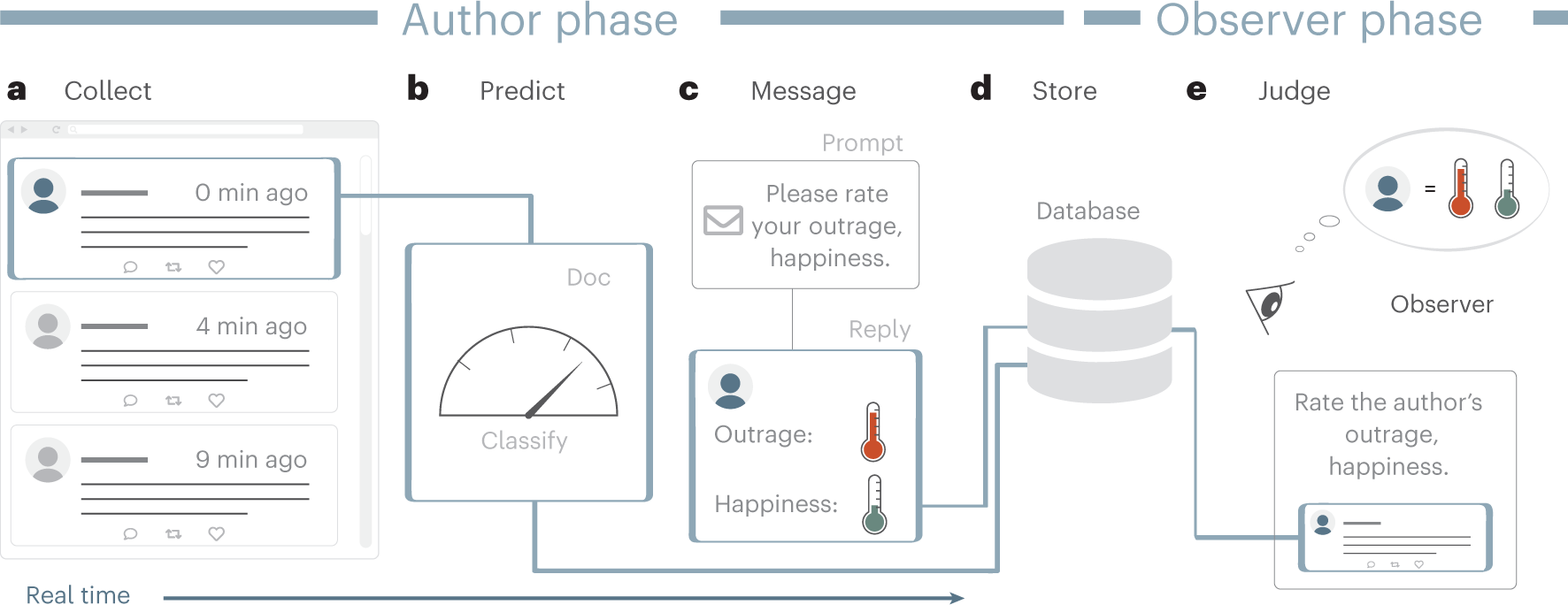
As individuals and political leaders increasingly interact in online social networks, it is important to understand the dynamics of emotion perception online. Here, we propose that social media users overperceive levels of moral outrage felt by individuals and groups, inflating beliefs about intergroup hostility. Using a Twitter field survey, we measured authors’ moral outrage in real time and compared authors’ reports to observers’ judgements of the authors’ moral outrage. We find that observers systematically overperceive moral outrage in authors, inferring more intense moral outrage experiences from messages than the authors of those messages actually reported. This effect was stronger in participants who spent more time on social media to learn about politics. Preregistered confirmatory behavioural experiments found that overperception of individuals’ moral outrage causes overperception of collective moral outrage and inflates beliefs about hostile communication norms, group affective polarization and ideological extremity. Together, these results highlight how individual-level overperceptions of online moral outrage produce collective overperceptions that have the potential to warp our social knowledge of moral and political attitudes.
Digital Social Norm Enforcement: Online Firestorms in Social Media
Actors of public interest today have to fear the adverse impact that stems from social media platforms. Any controversial behavior may promptly trigger temporal, but potentially devastating storms of emotional and aggressive outrage, so called online firestorms. Popular targets of online firestorms are companies, politicians, celebrities, media, academics and many more. This article introduces social norm theory to understand online aggression in a social-political online setting, challenging the popular assumption that online anonymity is one of the principle factors that promotes aggression. We underpin this social norm view by analyzing a major social media platform concerned with public affairs over a period of three years entailing 532,197 comments on 1,612 online petitions. Results show that in the context of online firestorms, non-anonymous individuals are more aggressive compared to anonymous individuals. This effect is reinforced if selective incentives are present and if aggressors are intrinsically motivated.
Digital Social Norm Enforcement: Online Firestorms in Social Media
Actors of public interest today have to fear the adverse impact that stems from social media platforms. Any controversial behavior may promptly trigger temporal, but potentially devastating storms of emotional and aggressive outrage, so called online firestorms. Popular targets of online firestorms are companies, politicians, celebrities, media, academics and many more. This article introduces social norm theory to understand online aggression in a social-political online setting, challenging the popular assumption that online anonymity is one of the principle factors that promotes aggression. We underpin this social norm view by analyzing a major social media platform concerned with public affairs over a period of three years entailing 532,197 comments on 1,612 online petitions. Results show that in the context of online firestorms, non-anonymous individuals are more aggressive compared to anonymous individuals. This effect is reinforced if selective incentives are present and if aggressors are intrinsically motivated.
The Role of Media in Political Polarization| Inoculation Can Reduce the Perceived Reliability of Polarizing Social Media Content
Little research is available on psychological interventions that counter susceptibility to polarizing online content. We conducted 3 studies (n1 = 472, n2 = 193, n3 = 772) to evaluate whether psychological resistance against polarizing social media content can be conferred, using the Bad News game, a “technique-based inoculation” intervention that simulates a social media feed. We investigate (1) whether technique-based inoculation can reduce susceptibility to content designed to fuel intergroup polarization; (2) whether technique-based inoculation can offer cross-protection against misinformation techniques that people were not inoculated against; and (3) whether political ideology plays a role in how people engage with anti-misinformation interventions. In Studies 1 and 3 (but not Study 2), we found that technique-based inoculation significantly reduces the perceived reliability of polarizing content and offers partial cross-protection against untreated misinformation techniques. We found no effect for attitudinal certainty and news-sharing intentions. Finally, we report preliminary evidence that people may choose to engage with politically congruent news topics within the intervention.
The political effects of X’s feed algorithm
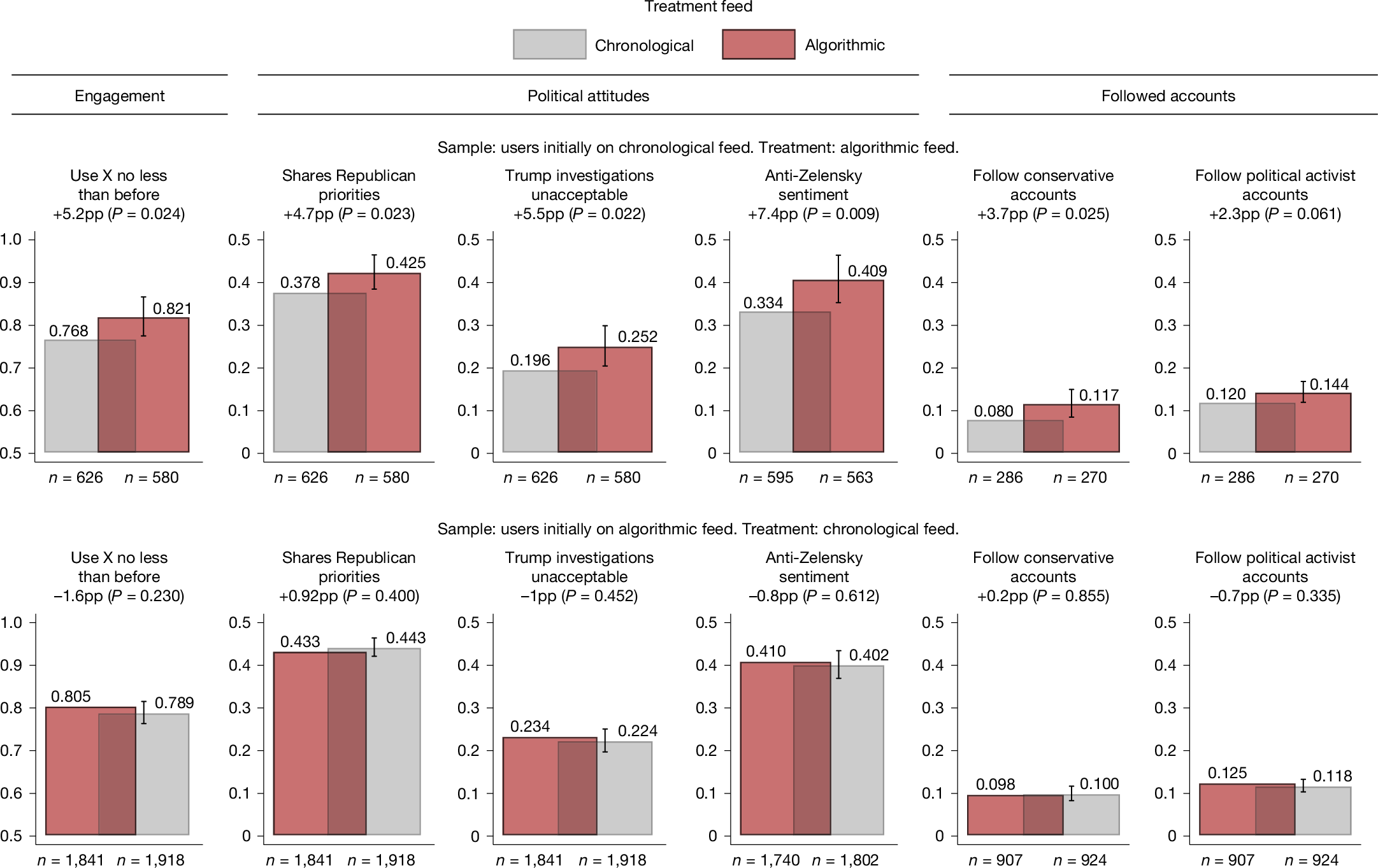
Feed algorithms are widely suspected to influence political attitudes. However, previous evidence from switching off the algorithm on Meta platforms found no political effects1. Here we present results from a 2023 field experiment on Elon Musk’s platform X shedding light on this puzzle. We assigned active US-based users randomly to either an algorithmic or a chronological feed for 7 weeks, measuring political attitudes and online behaviour. Switching from a chronological to an algorithmic feed increased engagement and shifted political opinion towards more conservative positions, particularly regarding policy priorities, perceptions of criminal investigations into Donald Trump and views on the war in Ukraine. In contrast, switching from the algorithmic to the chronological feed had no comparable effects. Neither switching the algorithm on nor switching it off significantly affected affective polarization or self-reported partisanship. To investigate the mechanism, we analysed users’ feed content and behaviour. We found that the algorithm promotes conservative content and demotes posts by traditional media. Exposure to algorithmic content leads users to follow conservative political activist accounts, which they continue to follow even after switching off the algorithm, helping explain the asymmetry in effects. These results suggest that initial exposure to X’s algorithm has persistent effects on users’ current political attitudes and account-following behaviour, even in the absence of a detectable effect on partisanship.
The political effects of X’s feed algorithm
Feed algorithms are widely suspected to influence political attitudes. However, previous evidence from switching off the algorithm on Meta platforms found no political effects1. Here we present results from a 2023 field experiment on Elon Musk’s platform X shedding light on this puzzle. We assigned active US-based users randomly to either an algorithmic or a chronological feed for 7 weeks, measuring political attitudes and online behaviour. Switching from a chronological to an algorithmic feed increased engagement and shifted political opinion towards more conservative positions, particularly regarding policy priorities, perceptions of criminal investigations into Donald Trump and views on the war in Ukraine. In contrast, switching from the algorithmic to the chronological feed had no comparable effects. Neither switching the algorithm on nor switching it off significantly affected affective polarization or self-reported partisanship. To investigate the mechanism, we analysed users’ feed content and behaviour. We found that the algorithm promotes conservative content and demotes posts by traditional media. Exposure to algorithmic content leads users to follow conservative political activist accounts, which they continue to follow even after switching off the algorithm, helping explain the asymmetry in effects. These results suggest that initial exposure to X’s algorithm has persistent effects on users’ current political attitudes and account-following behaviour, even in the absence of a detectable effect on partisanship.
Legally Cognizable Manipulation
Swaths of personal and nonpersonal information collected online about Internet users are increasingly being used in sophisticated ways for online political mani

Shifts in U.S. Social Media Use, 2020–2024: Decline, Fragmentation, and Enduring Polarization
Using nationally representative data from the 2020 and 2024 American National Election Studies (ANES), this paper describes how U.S. social media use has shifted across platforms, demographics, and politics. Overall platform reach declined, driven by growth in the share of Americans — especially the youngest and oldest cohorts — who report using no social media. Visiting and posting activity on Twitter/X and Facebook have fallen by nearly 50% since 2020, with the decline on Twitter/X driven primarily by reduced participation among Democratic users. While Facebook, YouTube, and Twitter/X lost ground, TikTok and Reddit grew modestly, consistent with a more fragmented digital public sphere. Platform audiences aged and became slightly more educated and racially diverse. Politically, most platforms shifted toward Republican users while remaining, on balance, Democratic-leaning. Twitter/X experienced the largest change: among posters, the partisan balance swung over 70 percentage points from Democrats to Republicans. Across platforms, political posting remains closely tied to affective polarization, as the most partisan respondents are also the most active. As casual users disengage while polarized partisans remain vocal, online discourse becomes narrower and more ideologically extreme.
The social media discourse of engaged partisans is toxic even when politics are irrelevant
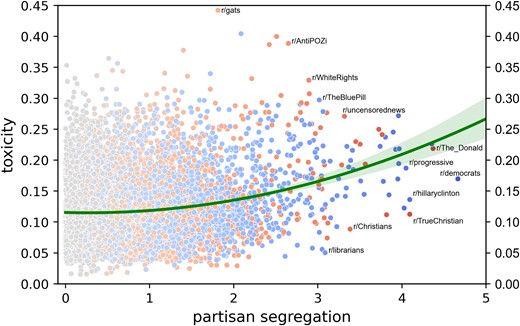
Abstract Prevailing theories of partisan incivility on social media suggest that it derives from disagreement about political issues or from status competition between groups. This study—which analyzes the commenting behavior of Reddit users across diverse cultural contexts (subreddits)—tests the alternative hypothesis that such incivility derives in large part from a selection effect: Toxic people are especially likely to opt into discourse in partisan contexts. First, we examined commenting behavior across over 9,000 unique cultural contexts (subreddits) and confirmed that discourse is indeed more toxic in partisan (e.g. r/progressive, r/conservatives) than in nonpartisan contexts (e.g. r/movies, r/programming). Next, we analyzed hundreds of millions of comments from over 6.3 million users and found robust evidence that: (i) the discourse of people whose behavior is especially toxic in partisan contexts is also especially toxic in nonpartisan contexts (i.e. people are not politics-only toxicity specialists); and (ii) when considering only nonpartisan contexts, the discourse of people who also comment in partisan contexts is more toxic than the discourse of people who do not. These effects were not driven by socialization processes whereby people overgeneralized toxic behavioral norms they had learned in partisan contexts. In contrast to speculation about the need for partisans to engage beyond their echo chambers, toxicity in nonpartisan contexts was higher among people who also comment in both left-wing and right-wing contexts (bilaterally engaged users) than among people who also comment in only left-wing or right-wing contexts (unilaterally engaged users). The discussion considers implications for democratic functioning and theories of polarization.
How do social media feed algorithms affect attitudes and behavior in an election campaign?
We investigated the effects of Facebook’s and Instagram’s feed algorithms during the 2020 US election. We assigned a sample of consenting users to reverse-chronologically-ordered feeds instead of the default algorithms. Moving users out of algorithmic feeds substantially decreased the time they spent on the platforms and their activity. The chronological feed also affected exposure to content: The amount of political and untrustworthy content they saw increased on both platforms, the amount of content classified as uncivil or containing slur words they saw decreased on Facebook, and the amount of content from moderate friends and sources with ideologically mixed audiences they saw increased on Facebook. Despite these substantial changes in users’ on-platform experience, the chronological feed did not significantly alter levels of issue polarization, affective polarization, political knowledge, or other key attitudes during the 3-month study period.

Auditing Political Exposure Bias: Algorithmic Amplification on Twitter/X During the 2024 U.S. Presidential Election
Approximately 50% of tweets in X's user timelines are personalized recommendations from accounts they do not follow. This raises a critical question: What political content are users exposed to beyond their established networks, and what implications does this have for democratic discourse online? In this paper, we present a six-week audit of X's algorithmic content recommendations during the 2024 U.S. Presidential Election by deploying 120 sock-puppet monitoring accounts to capture tweets from their personalized "For You" timelines. Our objective is to quantify out-of-network content exposure for right- and left-leaning user profiles and assess any potential inequalities and biases in political exposure. Our findings indicate that X's algorithm skews exposure toward a few high-popularity accounts across all users, with right-leaning users experiencing the highest level of exposure inequality. Both left- and right-leaning users encounter amplified exposure to accounts aligned with their own political views and reduced exposure to opposing viewpoints. Additionally, we observe that new accounts experience a right-leaning bias in exposure within their default timelines. Our work contributes to understanding how content recommendation systems may induce and reinforce biases while exacerbating vulnerabilities among politically polarized user groups. We underscore the importance of transparency-aware algorithms in addressing critical issues such as safeguarding election integrity and fostering a more informed digital public sphere.

Large language memories: Psychosis and antisocial media
Using the fields of memory studies and digital humanities, this article argues that there has been a shift from more collective and social memory to more personalised and individual memory. This shift, it is argued here, can be conceptualised through the psychoanalytic concept of ‘psychosis’. While the causes of the changes in our patterns of memory have been located in capitalist and neoliberal principles, the effects of the changes in our memory habits might be found in psychosis. From falling in love with machinic AI replicas to indulging in conspiracy theories to acting as if we are social media influencers or backing ourselves to win out in impossible job markets, we are inclined towards personal fantasy, often at the expense of participating in social life. But why do we do this? Why is it easier to believe a farfetched conspiracy theory or wild personal dream than it is to participate socially and collectively in the world we live in? Part of the reason, at least, is found in our increasing habitual reliance on new and emergent technologies. Often presented to us as a brand-new form of Artificial Intelligence, these generative tools are the latest update to a longer pattern in our digital world: the trend of developing ‘relationships’ with algorithms that, to larger and smaller degrees, we come to rely on for habits of cognition and recognition. By affecting our patterns of memory, these technologies produce a kind of isolation that lends itself to individual and fantastical – rather than shared and realist – thinking.

Anti-democratic attitudes are highly contagious, new psychology study finds
The rise of anti-democratic sentiments might be driven by social contagion. Researchers have discovered that citizens often adapt their personal support for authoritarian rule to align with the political views of those around them.
Leveraging Motivations to Curb Misinformation: Self-Affirmation Reduces the Appeal of Political Conspiracy Theories
Abstract: In an era where digital misinformation poses significant challenges to societal well-being, this study explores a novel approach to preserving information integrity by addressing the motivational underpinnings of conspiracy theory engagement. As conspiracy theories proliferate online, traditional fact-checking and debunking strategies often prove ineffective due to the self-reinforcing nature of conspiracy theories. This research investigates whether a priori self-affirmation interventions can reduce individuals’ propensity to engage with conspiracy theories by preemptively fulfilling the ego-protective function these theories often serve. Using a randomized experiment ( N = 451), this study finds that participants who completed a self-affirmation task were less likely to read politicized conspiracy theories, and those who chose to read a conspiracy theory reported greater feelings of affirmation than those who did not. Thus, bolstering individuals’ self-integrity may offer an opportunity to mitigate the appeal of politicized conspiracy theories.
