

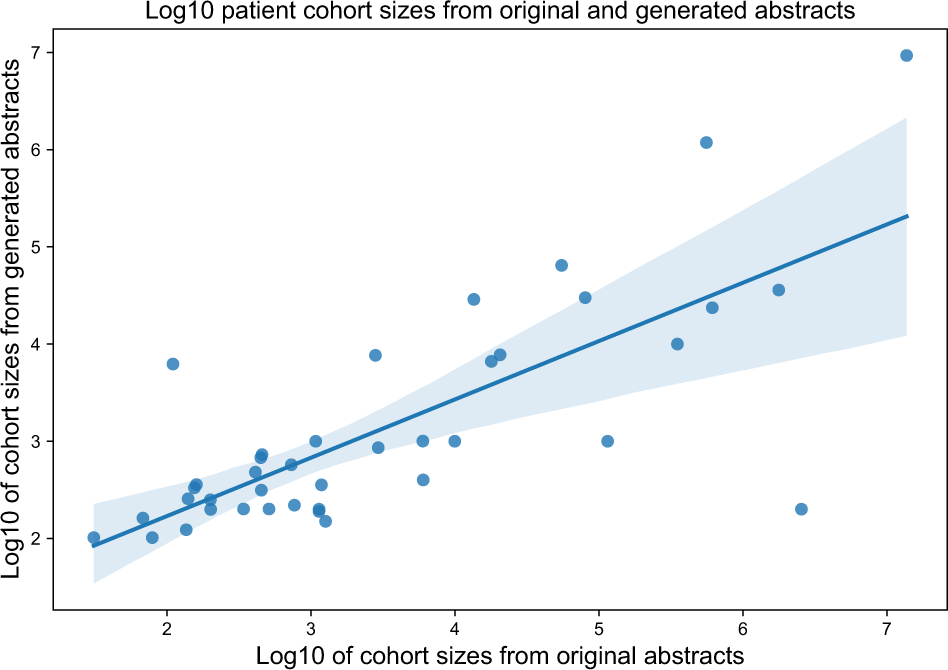
Large language models such as ChatGPT can produce increasingly realistic text, with unknown information on the accuracy and integrity of using these models in scientific writing. We gathered fifth research abstracts from five high-impact factor medical journals and asked ChatGPT to generate research abstracts based on their titles and journals. Most generated abstracts were detected using an AI output detector, ‘GPT-2 Output Detector’, with % ‘fake’ scores (higher meaning more likely to be generated) of median [interquartile range] of 99.98% ‘fake’ [12.73%, 99.98%] compared with median 0.02% [IQR 0.02%, 0.09%] for the original abstracts. The AUROC of the AI output detector was 0.94. Generated abstracts scored lower than original abstracts when run through a plagiarism detector website and iThenticate (higher scores meaning more matching text found). When given a mixture of original and general abstracts, blinded human reviewers correctly identified 68% of generated abstracts as being generated by ChatGPT, but incorrectly identified 14% of original abstracts as being generated. Reviewers indicated that it was surprisingly difficult to differentiate between the two, though abstracts they suspected were generated were vaguer and more formulaic. ChatGPT writes believable scientific abstracts, though with completely generated data. Depending on publisher-specific guidelines, AI output detectors may serve as an editorial tool to help maintain scientific standards. The boundaries of ethical and acceptable use of large language models to help scientific writing are still being discussed, and different journals and conferences are adopting varying policies.
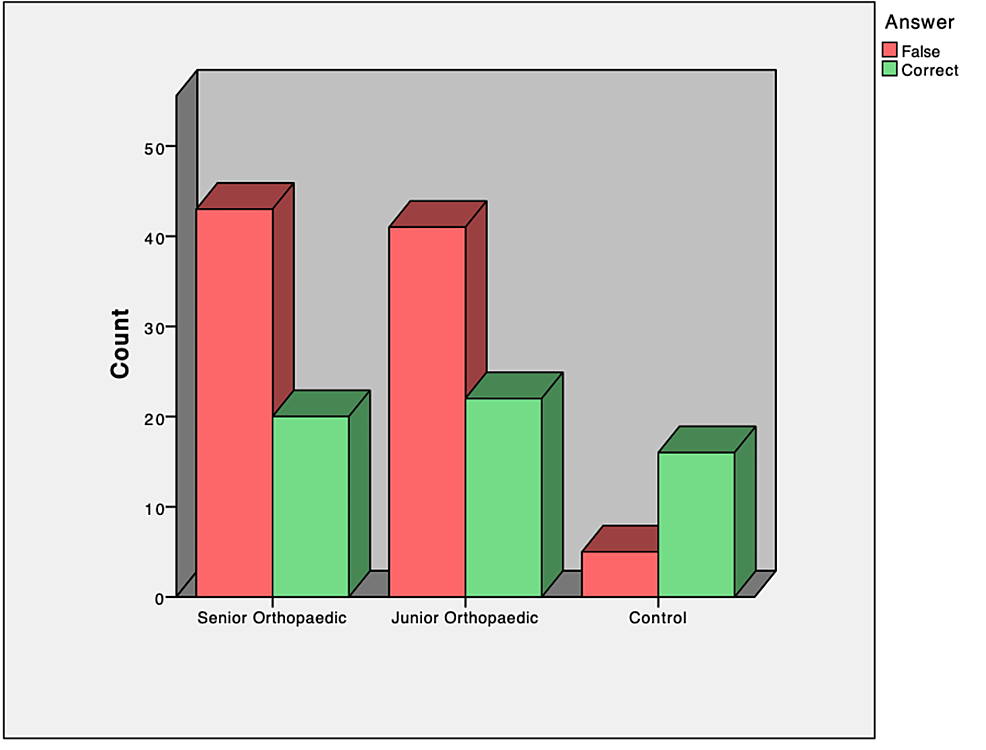
A Study on Distinguishing ChatGPT-Generated and Human-Written Orthopaedic Abstracts by Reviewers: Decoding the Discrepancies
Background: ChatGPT (OpenAI Incorporated, Mission District, San Francisco, United States) is an artificial intelligence (AI)-based language model that generates human-resembling texts. This AI-g...
Testing of detection tools for AI-generated text
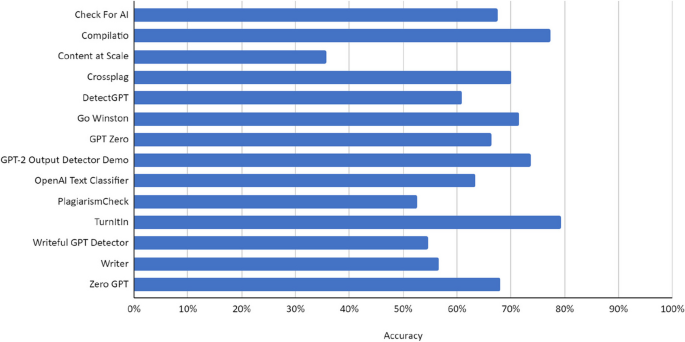
Recent advances in generative pre-trained transformer large language models have emphasised the potential risks of unfair use of artificial intelligence (AI) generated content in an academic environment and intensified efforts in searching for solutions to detect such content. The paper examines the general functionality of detection tools for AI-generated text and evaluates them based on accuracy and error type analysis. Specifically, the study seeks to answer research questions about whether existing detection tools can reliably differentiate between human-written text and ChatGPT-generated text, and whether machine translation and content obfuscation techniques affect the detection of AI-generated text. The research covers 12 publicly available tools and two commercial systems (Turnitin and PlagiarismCheck) that are widely used in the academic setting. The researchers conclude that the available detection tools are neither accurate nor reliable and have a main bias towards classifying the output as human-written rather than detecting AI-generated text. Furthermore, content obfuscation techniques significantly worsen the performance of tools. The study makes several significant contributions. First, it summarises up-to-date similar scientific and non-scientific efforts in the field. Second, it presents the result of one of the most comprehensive tests conducted so far, based on a rigorous research methodology, an original document set, and a broad coverage of tools. Third, it discusses the implications and drawbacks of using detection tools for AI-generated text in academic settings.
Testing of detection tools for AI-generated text
Recent advances in generative pre-trained transformer large language models have emphasised the potential risks of unfair use of artificial intelligence (AI) generated content in an academic environment and intensified efforts in searching for solutions to detect such content. The paper examines the general functionality of detection tools for AI-generated text and evaluates them based on accuracy and error type analysis. Specifically, the study seeks to answer research questions about whether existing detection tools can reliably differentiate between human-written text and ChatGPT-generated text, and whether machine translation and content obfuscation techniques affect the detection of AI-generated text. The research covers 12 publicly available tools and two commercial systems (Turnitin and PlagiarismCheck) that are widely used in the academic setting. The researchers conclude that the available detection tools are neither accurate nor reliable and have a main bias towards classifying the output as human-written rather than detecting AI-generated text. Furthermore, content obfuscation techniques significantly worsen the performance of tools. The study makes several significant contributions. First, it summarises up-to-date similar scientific and non-scientific efforts in the field. Second, it presents the result of one of the most comprehensive tests conducted so far, based on a rigorous research methodology, an original document set, and a broad coverage of tools. Third, it discusses the implications and drawbacks of using detection tools for AI-generated text in academic settings.
People who frequently use ChatGPT for writing tasks are accurate and robust detectors of AI-generated text
In this paper, we study how well humans can detect text generated by commercial LLMs (GPT-4o, Claude, o1). We hire annotators to read 300 non-fiction English articles, label them as either human-written or AI-generated, and provide paragraph-length explanations for their decisions. Our experiments show that annotators who frequently use LLMs for writing tasks excel at detecting AI-generated text, even without any specialized training or feedback. In fact, the majority vote among five such “expert” annotators misclassifies only 1 of 300 articles, significantly outperforming most commercial and open-source detectors we evaluated even in the presence of evasion tactics like paraphrasing and humanization. Qualitative analysis of the experts' free-form explanations shows that while they rely heavily on specific lexical clues (`AI vocabulary'), they also pick up on more complex phenomena within the text (e.g., formality, originality, clarity) that are challenging to assess for automatic detectors. We release our annotated dataset and code to spur future research into both human and automated detection of AI-generated text.
People who frequently use ChatGPT for writing tasks are accurate and robust detectors of AI-generated text
In this paper, we study how well humans can detect text generated by commercial LLMs (GPT-4o, Claude, o1). We hire annotators to read 300 non-fiction English articles, label them as either human-written or AI-generated, and provide paragraph-length explanations for their decisions. Our experiments show that annotators who frequently use LLMs for writing tasks excel at detecting AI-generated text, even without any specialized training or feedback. In fact, the majority vote among five such “expert” annotators misclassifies only 1 of 300 articles, significantly outperforming most commercial and open-source detectors we evaluated even in the presence of evasion tactics like paraphrasing and humanization. Qualitative analysis of the experts' free-form explanations shows that while they rely heavily on specific lexical clues (`AI vocabulary'), they also pick up on more complex phenomena within the text (e.g., formality, originality, clarity) that are challenging to assess for automatic detectors. We release our annotated dataset and code to spur future research into both human and automated detection of AI-generated text.
Evaluating the predictive capacity of ChatGPT for academic peer review outcomes across multiple platforms
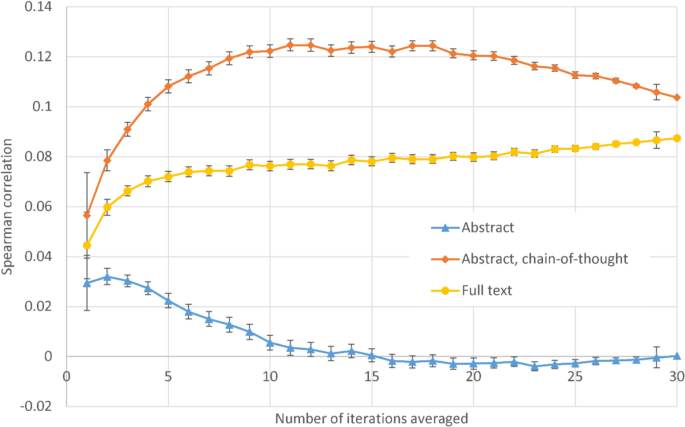
Academic peer review is at the heart of scientific quality control, yet the process is slow and time-consuming. Technology that can predict peer review outcomes may help with this, for example by fast-tracking desk rejection decisions. While previous studies have demonstrated that Large Language Models (LLMs) can predict peer review outcomes to some extent, this paper introduces two new contexts and employs a more robust method—averaging multiple ChatGPT scores. Averaging 30 ChatGPT predictions, based on reviewer guidelines and using only the submitted titles and abstracts failed to predict peer review outcomes for F1000Research (Spearman’s rho = 0.00). However, it produced mostly weak positive correlations with the quality dimensions of SciPost Physics (rho = 0.25 for validity, rho = 0.25 for originality, rho = 0.20 for significance, and rho = 0.08 for clarity) and a moderate positive correlation for papers from the International Conference on Learning Representations (ICLR) (rho = 0.38). Including article full texts increased the correlation for ICLR (rho = 0.46) and slightly improved it for F1000Research (rho = 0.09), with variable effects on the four quality dimension correlations for SciPost LaTeX files. The use of simple chain-of-thought system prompts slightly increased the correlation for F1000Research (rho = 0.10), marginally reduced it for ICLR (rho = 0.37), and further decreased it for SciPost Physics (rho = 0.16 for validity, rho = 0.18 for originality, rho = 0.18 for significance, and rho = 0.05 for clarity). Overall, the results suggest that in some contexts, ChatGPT can produce weak pre-publication quality predictions. However, their effectiveness and the optimal strategies for employing them vary considerably between platforms, journals, and conferences. Finally, the most suitable inputs for ChatGPT appear to differ depending on the platform.
We come to bury ChatGPT, not to praise it.
Large language models (LLMs) like the GPT family learn the statistical structure of language by optimising their ability to predict missing words in sentences (as in ‘The cat sat on the [BLANK]’). Despite the impressive technical ju-jitsu of transformer models and the billions of parameters they learn, it’s still a computational guessing game. ChatGPT is, in technical terms, a ‘bullshit generator’. If a generated sentence makes sense to you, the reader, it means the mathematical model has made sufficiently good guess to pass your sense-making filter. The language model has no idea what it’s talking about because it has no idea about anything at all. It’s more of a bullshitter than the most egregious egoist you’ll ever meet, producing baseless assertions with unfailing confidence because that’s what it’s designed to do. It’s a bonus for the parent corporation when journalists and academics respond by generating acres of breathless coverage, which works as PR even when expressing concerns about the end of human creativity.
Does <span style="font-variant:small-caps;">ChatGPT</span> Ignore Article Retractions and Other Reliability Concerns?
ABSTRACT Large language models (LLMs) like ChatGPT seem to be increasingly used for information seeking and analysis, including to support academic literature reviews. To test whether the results might sometimes include retracted research, we identified 217 retracted or otherwise concerning academic studies with high altmetric scores and asked ChatGPT 4o‐mini to evaluate their quality 30 times each. Surprisingly, none of its 6510 reports mentioned that the articles were retracted or had relevant errors, and it gave 190 relatively high scores (world leading, internationally excellent, or close). The 27 articles with the lowest scores were mostly accused of being weak, although the topic (but not the article) was described as controversial in five cases (e.g., about hydroxychloroquine for COVID‐19). In a follow‐up investigation, 61 claims were extracted from retracted articles from the set, and ChatGPT 4o‐mini was asked 10 times whether each was true. It gave a definitive yes or a positive response two‐thirds of the time, including for at least one statement that had been shown to be false over a decade ago. The results therefore emphasise, from an academic knowledge perspective, the importance of verifying information from LLMs when using them for information seeking or analysis.

Large Language Models and the Analyses of Adherence to Reporting Guidelines in Systematic Reviews and Overviews of Reviews (PRISMA 2020 and PRIOR)
In the context of Evidence-Based Practice (EBP), Systematic Reviews (SRs), Meta-Analyses (MAs) and overview of reviews have become cornerstones for the synthesis of research findings. The Preferred Reporting Items for Systematic Reviews and Meta-Analyses (PRISMA) 2020 and Preferred Reporting Items for Overviews of Reviews (PRIOR) statements have become major reporting guidelines for SRs/MAs and for overviews of reviews, respectively. In recent years, advances in Generative Artificial Intelligence (genAI) have been proposed as a potential major paradigm shift in scientific research. The main aim of this research was to examine the performance of four LLMs for the analysis of adherence to PRISMA 2020 and PRIOR, in a sample of 20 SRs and 20 overviews of reviews. We tested the free versions of four commonly used LLMs: ChatGPT (GPT-4o), DeepSeek (V3), Gemini (2.0 Flash) and Qwen (2.5 Max). Adherence to PRISMA 2020 and PRIOR was compared with scores defined previously by human experts, using several statistical tests. In our results, all the four LLMs showed a low performance for the analysis of adherence to PRISMA 2020, overestimating the percentage of adherence (from 23 to 30%). For PRIOR, the LLMs presented lower differences in the estimation of adherence (from 6 to 14%) and ChatGPT showed a performance similar to human experts. This is the first report of the performance of four commonly used LLMs for the analysis of adherence to PRISMA 2020 and PRIOR. Future studies of adherence to other reporting guidelines will be helpful in health sciences research.

Assessing the methodologic quality of systematic reviews using generative large language models
INTRODUCTION: We aimed to evaluate whether generative large language models (LLMs) can accurately assess the methodologic quality of systematic reviews (SRs). METHODS: A total of 114 SRs from five leading urology journals were included in the study. Human reviewers graded each of the SRs in duplicate, with differences adjudicated by a third expert. We created a customized generative artificial intelligence (generative pretrained transformer [GPT]), “Urology AMSTAR 2 Quality Assessor,” and graded the 114 SRs in three iterations using a zero-shot method. We performed an enhanced trial focusing on critical criteria by giving GPT detailed, step-by-step instructions for each of the SRs using chain-of-thought method. Accuracy, sensitivity, specificity, and F1 score for each GPT trial were calculated against human results. Internal validity among three trials were computed. RESULTS: GPT had an overall congruence of 75%, with 77% in critical criteria and 73% in non-critical criteria when compared to human results. The average F1 score was 0.66. There was a high internal validity at 85% among three iterations. GPT accurately assigned 89% of studies into the correct overall category. When given specific, step-by-step instructions, congruence of critical criteria improved to 91%, and overall quality assessment accuracy to 93%. CONCLUSIONS: GPT showed promising ability to efficiently and accurately assess the quality of SRs in urology.
Artificial Writing and Automated Detection
Artificial intelligence (AI) tools are increasingly used for written deliverables. This has created demand for distinguishing human-generated text from AI-generated text at scale, e.g., ensuring assignments were completed by students, product reviews written by actual customers, etc. A decision-maker aiming to implement a detector in practice must consider two key statistics: the False Negative Rate (FNR), which corresponds to the proportion of AI-generated text that is falsely classified as human, and the False Positive Rate (FPR), which corresponds to the proportion of human-written text that is falsely classified as AI-generated. We evaluate three leading commercial detectors—Pangram, OriginalityAI, GPTZero—and an open-source one —RoBERTa—on their performance in minimizing these statistics using a large corpus spanning genres, lengths, and models. Commercial detectors outperform open-source, with Pangram achieving near-zero FNR and FPR rates that remain robust across models, threshold rules, ultra-short passages, "stubs" (≤ 50 words) and ’humanizer’ tools. A decision-maker may weight one type of error (Type I vs. Type II) as more important than the other. To account for such a preference, we introduce a framework where the decision-maker sets a policy cap—a detector-independent metric reflecting tolerance for false positives or negatives. We show that Pangram is the only tool to satisfy a strict cap (FPR ≤ 0.005) without sacrificing accuracy. This framework is especially relevant given the uncertainty surrounding how AI may be used at different stages of writing, where certain uses may be encouraged (e.g., grammar correction) but may be difficult to separate from other uses.

Citation‐based plagiarism detection: Practicability on a large‐scale scientific corpus
The automated detection of plagiarism is an information retrieval task of increasing importance as the volume of readily accessible information on the web expands. A major shortcoming of current automated plagiarism detection approaches is their dependence on high character‐based similarity. As a result, heavily disguised plagiarism forms, such as paraphrases, translated plagiarism, or structural and idea plagiarism, remain undetected. A recently proposed language‐independent approach to plagiarism detection, C itation‐based P lagiarism D etection ( CbPD ), allows the detection of semantic similarity even in the absence of text overlap by analyzing the citation placement in a document's full text to determine similarity. This article evaluates the performance of CbPD in detecting plagiarism with various degrees of disguise in a collection of 185,000 biomedical articles. We benchmark CbPD against two character‐based detection approaches using a ground truth approximated in a user study. Our evaluation shows that the citation‐based approach achieves superior ranking performance for heavily disguised plagiarism forms. Additionally, we demonstrate CbPD to be computationally more efficient than character‐based approaches. Finally, upon combining the citation‐based with the traditional character‐based document similarity visualization methods in a hybrid detection prototype, we observe a reduction in the required user effort for document verification.

Evaluating large language model performance in Risk of Bias assessments: A cross-sectional validation study
Objective To evaluate the reliability and diagnostic performance of ChatGPT-o3 in conducting Risk of Bias (RoB) assessments of randomized clinical trials (RCTs) using the Cochrane RoB 2.0 tool. Materials and methods This methodological validation study analyzed 50 RCTs sampled from 50 published meta-analyses. Each trial was independently assessed by the original systematic review authors (OSRAs), our masked human panel, and ChatGPT-o3. Structured prompts based on RoB 2.0 guidelines were used to elicit ChatGPT-o3 assessments. Agreement was evaluated using weighted Cohen’s kappa and Gwet’s AC2. Diagnostic performance was measured by sensitivity, specificity, and balanced accuracy, with human ratings as the reference. Results ChatGPT-o3 classified 34% of trials as high risk, compared with 22% by our panel, and 12% by the OSRAs. Agreement was modest (median κ: 0.33 with our panel; 0.14 with OSRAs). Overall Gwet’s AC2 was 0.30. For detecting high-risk trials, ChatGPT-o3 achieved a sensitivity of 0.46, specificity of 0.69, and balanced accuracy of 0.57. For low-risk trials, its sensitivity was 0.47, specificity was 0.86, and balanced accuracy was 0.66. Discussion The results indicate that ChatGPT-o3 produced more conservative RoB ratings than human reviewers, identifying a greater percentage of trials as having a high RoB. Conclusion While unsuitable to be used as a sole assessor, ChatGPT-o3 may serve as an adjunct tool to enhance the efficiency and consistency of RoB assessments in systematic reviews.
SlopShape: Identifying AI-Generated Commercial Web Content
Word-level detectors identify unedited AI-generated text almost perfectly, but the literature documents their brittleness under rewording, and a word-level score neither characterizes a text nor identifies which AI model wrote it. We ask whether AI-generated text can be identified one level deeper, from structural signatures: how information is presented, in what order, with what evidence, and in what voice. We replicate StoryScope (Russell et al., 2026), which showed such patterns for AI-generated fiction, on commercial content: 2,250 pre-ChatGPT human blog posts from 268 company domains against 11,250 AI mirrors from five frontier models. A 203-feature instrument, applied by an LLM and validated in a human gold-annotation session (human-human kappa 0.939, human-model 0.951), detects AI posts from its 176 structural features alone at 97.0 macro-F1 on held-out companies, nearly unchanged (96.1) when every AI post is reworded by its own model. The signal characterizes and attributes: AI posts share a tidy, self-announcing shape, 68.6% are attributed to the correct source against a 16.7% chance rate, and human posts occupy rare structural configurations. All effects replicate StoryScope's, consistent in direction and at least as large in magnitude. We release pipeline, instrument, prompts, code, and aggregate artifacts.