

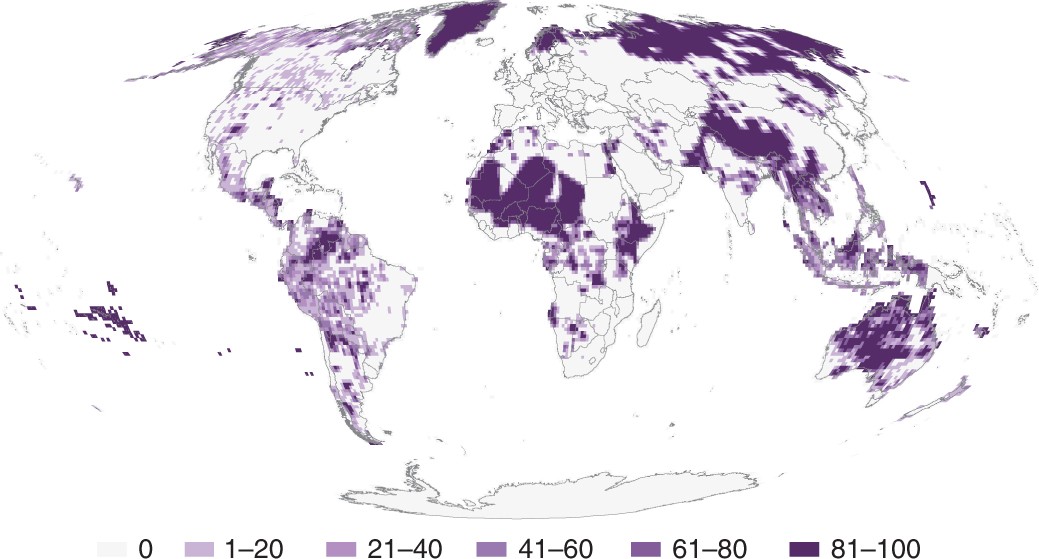
Understanding the scale, location and nature conservation values of the lands over which Indigenous Peoples exercise traditional rights is central to implementation of several global conservation and climate agreements. However, spatial information on Indigenous lands has never been aggregated globally. Here, using publicly available geospatial resources, we show that Indigenous Peoples manage or have tenure rights over at least ~38 million km2 in 87 countries or politically distinct areas on all inhabited continents. This represents over a quarter of the world’s land surface, and intersects about 40% of all terrestrial protected areas and ecologically intact landscapes (for example, boreal and tropical primary forests, savannas and marshes). Our results add to growing evidence that recognizing Indigenous Peoples’ rights to land, benefit sharing and institutions is essential to meeting local and global conservation goals. The geospatial analysis presented here indicates that collaborative partnerships involving conservation practitioners, Indigenous Peoples and governments would yield significant benefits for conservation of ecologically valuable landscapes, ecosystems and genes for future generations.
Importance of Indigenous Peoples’ lands for the conservation of Intact Forest Landscapes
Intact Forest Landscapes ( IFL s) are critical strongholds for the environmental services that they provide, not least for their role in climate protection. On the basis of information about the distributions of IFL s and Indigenous Peoples’ lands, we examined the importance of these areas for conserving the world's remaining intact forests. We determined that at least 36% of IFL s are within Indigenous Peoples’ lands, making these areas crucial to the mitigation action needed to avoid catastrophic climate change. We also provide evidence that IFL loss rates have been considerably lower on Indigenous Peoples’ lands than on other lands, although these forests are still vulnerable to clearing and other threats. World governments must recognize Indigenous Peoples’ rights, including land tenure rights, to ensure that Indigenous Peoples play active roles in decision‐making processes that affect IFL s on their lands. Such recognition is critical given the urgent need to reduce deforestation rates in the face of escalating climate change and global biodiversity loss.

‘It is all about listening and sharing’: Indigenous solutions to the carbon divide
Deforestation rates are much lower on Indigenous land – and there is growing recognition that first peoples have vital role to play
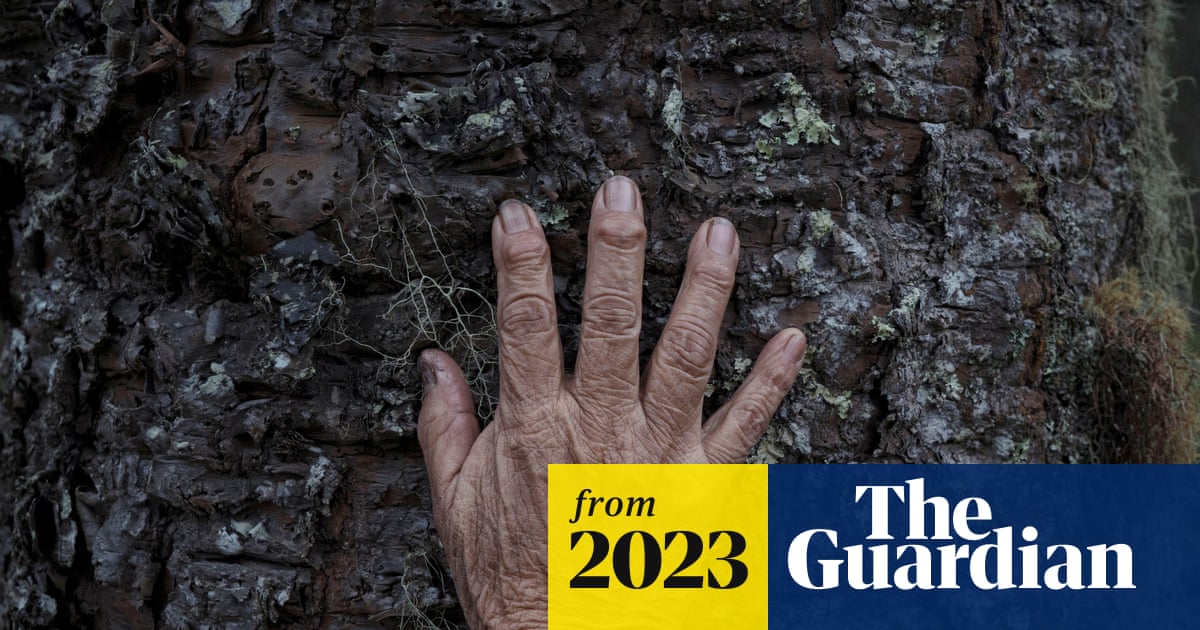
Guardians of the Earth: How Indigenous Peoples can teach the world to safeguard and conserve biodiversity
For hundreds of years, Indigenous Peoples around the world have held integral roles as protectors of their surrounding territories, environment and resources.

Guardians of the Earth: The essential role of Indigenous Peoples in the protection of natural resources - The Global Goals
For Indigenous Peoples, the land is not a resource to exploit, but a living being, a source of identity, spirituality and wellbeing.

Assessing nature's contributions to people
Recognizing culture, and diverse sources of knowledge, can improve assessments , A major challenge today and into the future is to maintain or enhance beneficial contributions of nature to a good quality of life for all people. This is among the key motivations of the Intergovernmental Science-Policy Platform on Biodiversity and Ecosystem Services (IPBES), a joint global effort by governments, academia, and civil society to assess and promote knowledge of Earth's biodiversity and ecosystems and their contribution to human societies in order to inform policy formulation. One of the more recent key elements of the IPBES conceptual framework ( 1 ) is the notion of nature's contributions to people (NCP), which builds on the ecosystem service concept popularized by the Millennium Ecosystem Assessment (MA) ( 2 ). But as we detail below, NCP as defined and put into practice in IPBES differs from earlier work in several important ways. First, the NCP approach recognizes the central and pervasive role that culture plays in defining all links between people and nature. Second, use of NCP elevates, emphasizes, and operationalizes the role of indigenous and local knowledge in understanding nature's contribution to people.

Indigenous Data Sovereignty (DDN3-A11)
This article explores Indigenous data sovereignty, identifies some of the data-related challenges faced by Indigenous Peoples and highlights the work done to overcome these challenges.

Earthy Governance: How to Learn About Democracy From Indigenous Peoples
In light of the planetary polycrisis, it is time to challenge the dominant strand of Western thought that asserts only humans possess rights and that

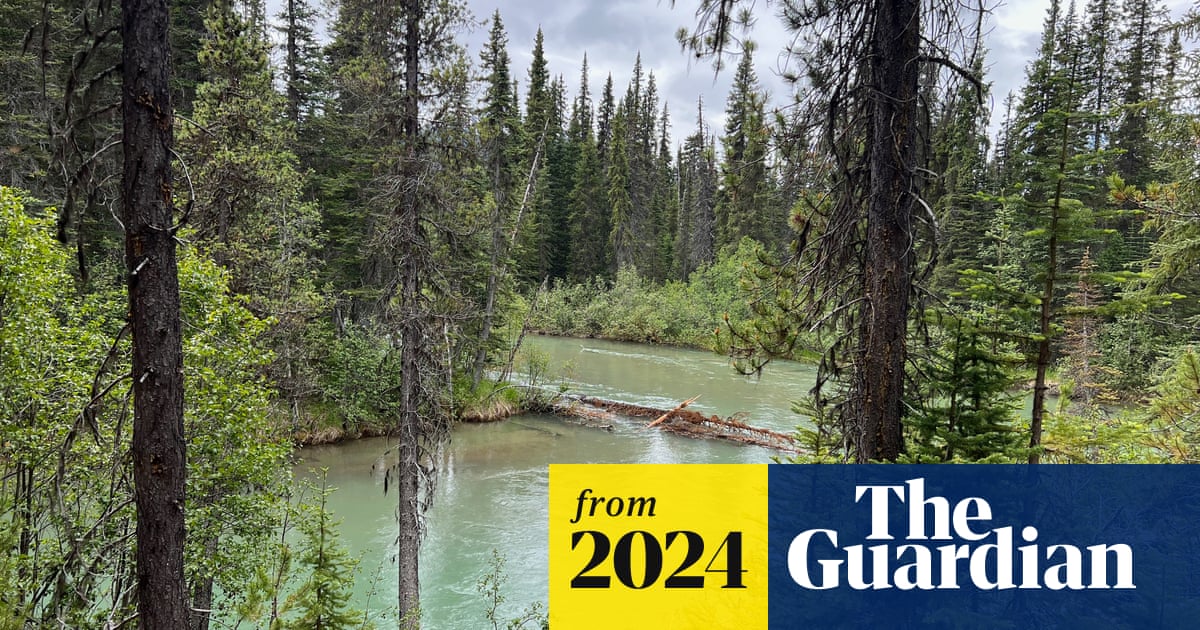
‘We can feel our ancestors’: one First Nation’s fight to save Canada’s old forests
The Wet’suwet’en Nation never signed treaties with the Canadian or provincial governments, yet their land was leased to timber companies
On whose land?
I am once again asking Canadian journalists to ask the most basic-ass question of on whose land will these be built? How is it that every other major industry must consider Indigenous rights but with tech it's like meh.

Who owns nature ?
International policies for the protection of the Environment rest on a very specific conception of nature, which appeared in Europe during the Enlightenment. This conception is far from being shared by all the peoples of the earth, who value different cosmological principles. According to Philippe Descola, the preservation of biodiversity can only become fully effective if it takes into account this plurality in the understanding of nature. At the instigation of international (…)
Supporting Indigenous Food Systems – Upland Agricultural Consulting
Upland Agricultural Consulting is committed to supporting First Nation, Métis, and Inuit Communities. We believe that investing in Indigenous communities leads to the success of British Columbia, and Canada. As Professional Agrologists, we want to see agriculturally-capable land being brought into full production. To meet that goal, we work alongside Indigenous leadership and staff to create agri-food suitability assessments based on the capacity of the land and the community and to meet the desired level of business development.

Metrics for biodiversity and health policy integration
Despite over a decade of progressive commitments from parties to the Convention on Biological Diversity (CBD), integrated biodiversity and health indicators and monitoring mechanisms remain limited, hampering achievement of the sustainable development goals and improvements in health and well-being. Adoption of the Kunming-Montreal Global Biodiversity Framework (2022) and the Global Action Plan on Biodiversity and Health (2024) provide a renewed entry point to shape the way governments approach health and wellbeing and address the environmental burden of disease. This is a critical opportunity that scholars at the health-environment nexus should not miss. This Perspective outlines building blocks to mobilize the field, starting with essential terminology and a scope of metrics needed by governments. We then evaluate elements to be considered in the construction of integrated metrics, including concepts, overarching challenges, a review of scientific hypotheses from an ecological perspective, as well as a set of principles and characteristics for indicators. To raise awareness across parallel communities of practice working at the health-environment nexus, we then briefly examine four approaches to integrated metrics developed by: conservationists, Indigenous scholars, One Health experts, and planetary health experts. We conclude with actionable steps to enhance governance, mobilize funding, and apply integrated indicators in national and global strategies. A broad science community is needed to support national governments to meet global commitments to address biodiversity loss and the environmental burden of disease concurrently. The overall aim of this paper is to contribute to addressing biodiversity loss by effectively linking policy and transdisciplinary practice at the health-environment nexus.
Download the Full Report — Passing the Message Stick
We pay respect to our Elders and acknowledge the Traditional Owners who’ve cared for country since time immemorial. Sovereignty over this land was never ceded - it always was, and always will be, Aboriginal land.
Conservation Evidence - Site
This resource is designed to support anyone making decisions about how to maintain and restore biodiversity.

State of Conservation Technology | WILDLABS
Explore insights from the first community-sourced assessment of the State of Conservation Technology

Native-Land.ca | Our home on native land
Native Land is a resource to learn more about Indigenous territories, languages, lands, and ways of life. We welcome you to our site.