

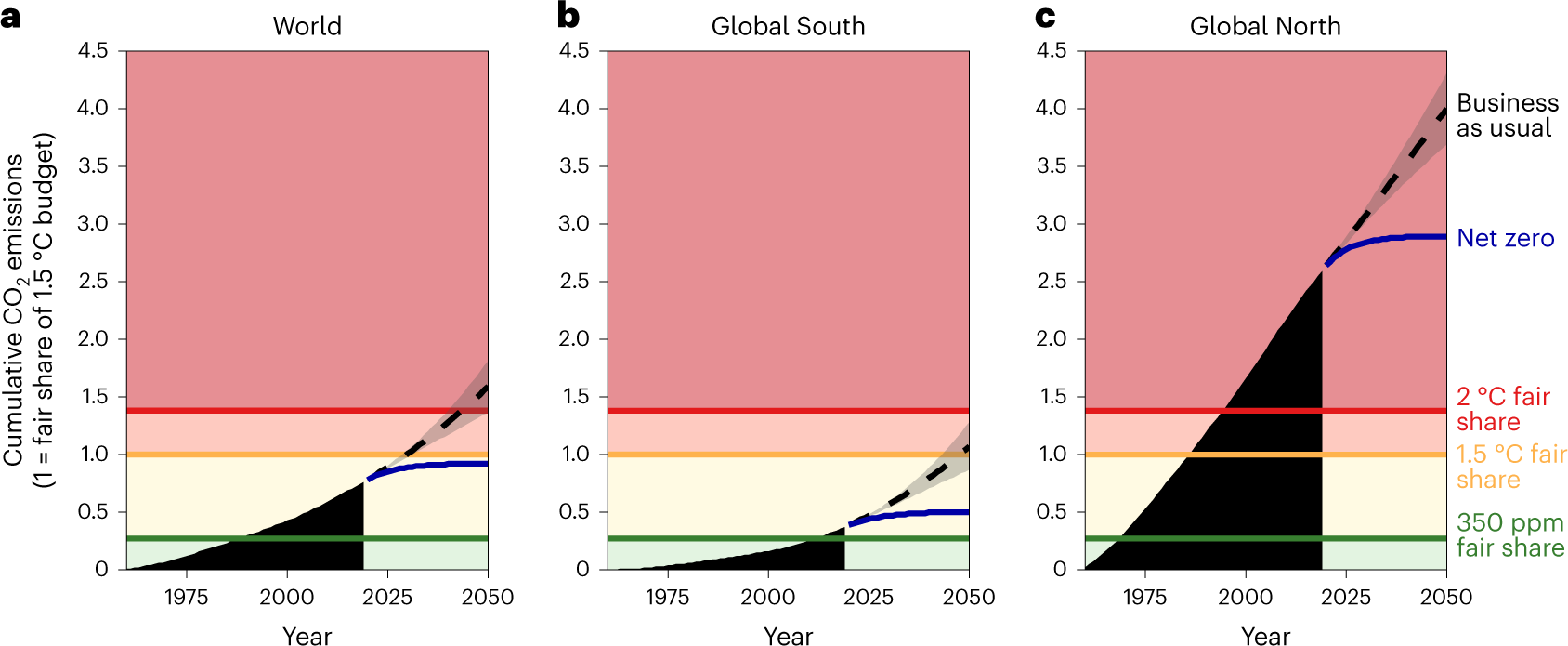
Research on carbon inequalities shows that some countries are overshooting their fair share of the remaining carbon budget and hold disproportionate responsibility for climate breakdown. Scholars argue that overshooting countries owe compensation or reparations to undershooting countries for atmospheric appropriation and climate-related damages. Here we develop a procedure to quantify the level of compensation owed in a ‘net zero’ scenario where all countries decarbonize by 2050, using carbon prices from IPCC scenarios that limit global warming to 1.5 °C and tracking cumulative emissions from 1960 across 168 countries. We find that even in this ambitious scenario, the global North would overshoot its collective equality-based share of the 1.5 °C carbon budget by a factor of three, appropriating half of the global South’s share in the process. We calculate that compensation of US$192 trillion would be owed to the undershooting countries of the global South for the appropriation of their atmospheric fair shares by 2050, with an average disbursement to those countries of US$940 per capita per year. We also examine countries’ overshoot of equality-based shares of 350 ppm and 2 °C carbon budgets and quantify the level of compensation owed using earlier and later starting years (1850 and 1992) for comparison.
Why unilateral decarbonisation can pay for itself
Anthropogenic greenhouse gas emissions are rapidly warming our planet, with potentially severe economic, social, and health consequences. Conventional estimates of climate damages suggest that while coordinated global efforts are desirable, unilateral action is rarely cost-effective due to a classic free-rider problem. Why should a country bear the costs of reducing emissions when the benefits are shared globally? This column re-evaluates this view in light of new climate damage estimates based on global temperature variation, showing that the economic case for unilateral decarbonisation is far stronger than previously thought.

RETRACTED ARTICLE: The economic commitment of climate change
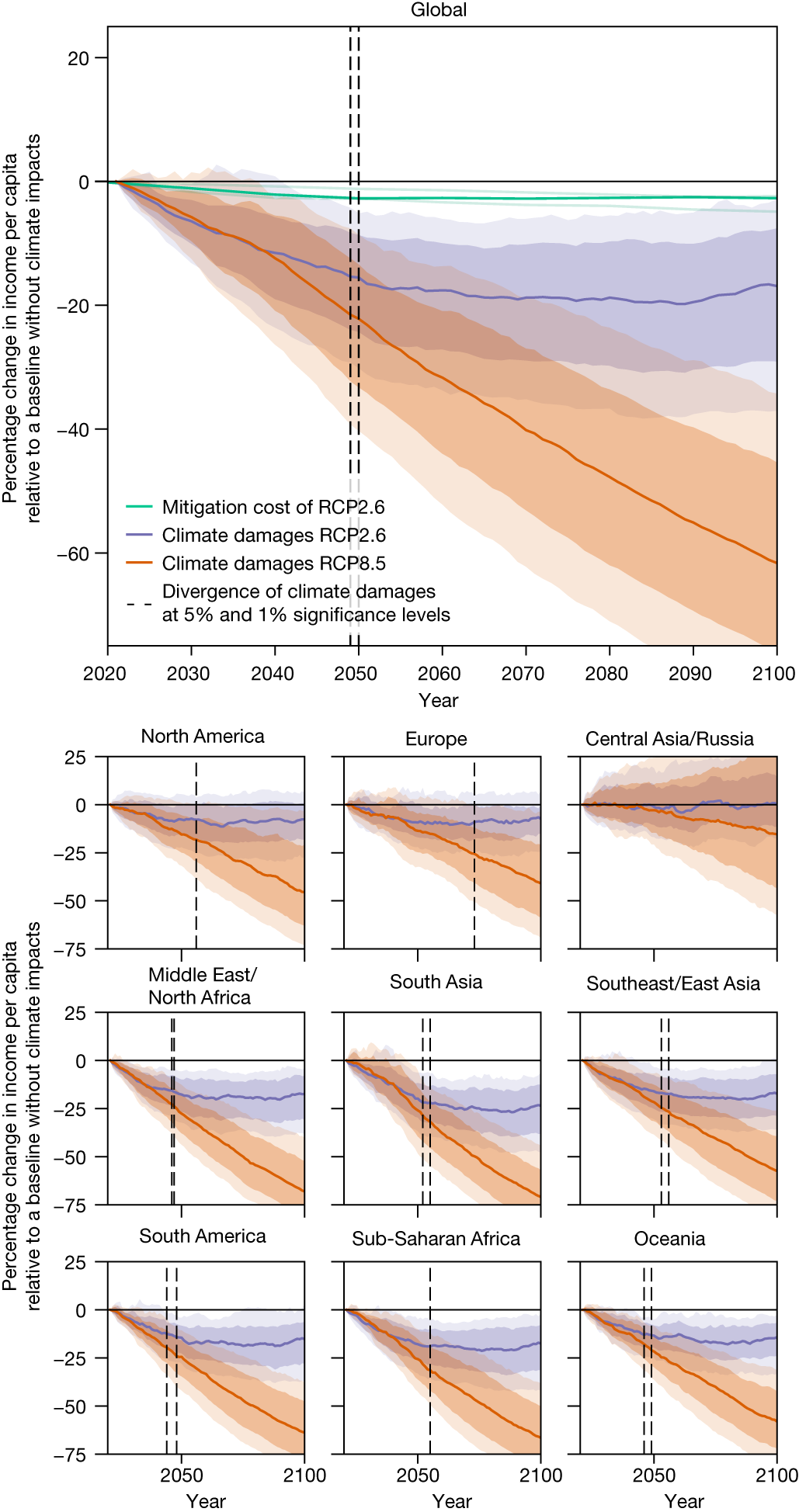
Global projections of macroeconomic climate-change damages typically consider impacts from average annual and national temperatures over long time horizons1–6. Here we use recent empirical findings from more than 1,600 regions worldwide over the past 40 years to project sub-national damages from temperature and precipitation, including daily variability and extremes7,8. Using an empirical approach that provides a robust lower bound on the persistence of impacts on economic growth, we find that the world economy is committed to an income reduction of 19% within the next 26 years independent of future emission choices (relative to a baseline without climate impacts, likely range of 11–29% accounting for physical climate and empirical uncertainty). These damages already outweigh the mitigation costs required to limit global warming to 2 °C by sixfold over this near-term time frame and thereafter diverge strongly dependent on emission choices. Committed damages arise predominantly through changes in average temperature, but accounting for further climatic components raises estimates by approximately 50% and leads to stronger regional heterogeneity. Committed losses are projected for all regions except those at very high latitudes, at which reductions in temperature variability bring benefits. The largest losses are committed at lower latitudes in regions with lower cumulative historical emissions and lower present-day income.
Vast fossil fuel and farming subsidies causing ‘environmental havoc’
World Bank says subsidies costing as much as $23m a minute must be repurposed to fight climate crisis
The Climate Solution Actually Adding Millions of Tons of CO2 Into the Atmosphere — ProPublica
New research shows that California’s climate policy created up to 39 million carbon credits that aren’t achieving real carbon savings. But companies can buy these forest offsets to justify polluting more anyway.

Global Carbon Budget Means Canada’s Fossil Fuels a Risky Investment | The Narwhal
In its latest report the Intergovernmental Panel on Climate Change (IPCC) gave global greenhouse gas emissions a worldwide limit, know as the global

Imperialist appropriation in the world economy: Drain from the global South through unequal exchange, 1990–2015
Unequal exchange theory posits that economic growth in the “advanced economies” of the global North relies on a large net appropriation of resources and labour from the global South, extracted through price differentials in international trade. Past attempts to estimate the scale and value of this drain have faced a number of conceptual and empirical limitations, and have been unable to capture the upstream resources and labour embodied in traded goods. Here we use environmental input-output data and footprint analysis to quantify the physical scale of net appropriation from the South in terms of embodied resources and labour over the period 1990 to 2015. We then represent the value of appropriated resources in terms of prevailing market prices. Our results show that in 2015 the North net appropriated from the South 12 billion tons of embodied raw material equivalents, 822 million hectares of embodied land, 21 exajoules of embodied energy, and 188 million person-years of embodied labour, worth $10.8 trillion in Northern prices – enough to end extreme poverty 70 times over. Over the whole period, drain from the South totalled $242 trillion (constant 2010 USD). This drain represents a significant windfall for the global North, equivalent to a quarter of Northern GDP. For comparison, we also report drain in global average prices. Using this method, we find that the South’s losses due to unequal exchange outstrip their total aid receipts over the period by a factor of 30. Our analysis confirms that unequal exchange is a significant driver of global inequality, uneven development, and ecological breakdown.
Social tipping dynamics for stabilizing Earth’s climate by 2050 | PNAS
Safely achieving the goals of the Paris Climate Agreement requires a worldwide transformation to carbon-neutral societies within the next 30 y. Acc...

In Deep
The numbers are simply mind-blowing: up to £264 billion for a climate “solution” that will increase emissions. Has the government lost its mind?

Carbon Tariffs 101
We evaluate the economic and environmental consequences of taxes on imported goods based on their carbon content. The analysis uses the simplest possible partial equilibrium framework, with one small open economy and a global pollution externality. It relies on graphs of supply and demand, rather than equations or formulas, hoping to reach readers familiar with basic economics. Despite its simplicity, the framework imparts numerous lessons. (1) Absent a domestic price on carbon, a carbon tariff imposes the same costs on domestic consumers as a domestic carbon price, but a carbon tariff also subsidizes domestic pollution. (2) If one small country imposes a carbon tariff, with or without a domestic carbon tax, the economic incidence of the tariff falls on its consumers. (3) If a holdout country joins the rest of the world by enacting its own carbon regulation and consequently imports more from other countries, those increased imports are not “leakage.” They are the cessation of leakage from when the holdout country’s policy was lax. And (4) if other countries do not appropriately regulate emissions, no single small country can use a combination of carbon taxes and carbon tariffs to fully correct the problem caused by its consumers or producers.

The effect of rainfall changes on economic production
Macro-economic assessments of climate impacts lack an analysis of the distribution of daily rainfall, which can resolve both complex societal impact channels and anthropogenically forced changes1–6. Here, using a global panel of subnational economic output for 1,554 regions worldwide over the past 40 years, we show that economic growth rates are reduced by increases in the number of wet days and in extreme daily rainfall, in addition to responding nonlinearly to the total annual and to the standardized monthly deviations of rainfall. Furthermore, high-income nations and the services and manufacturing sectors are most strongly hindered by both measures of daily rainfall, complementing previous work that emphasized the beneficial effects of additional total annual rainfall in low-income, agriculturally dependent economies4,7. By assessing the distribution of rainfall at multiple timescales and the effects on different sectors, we uncover channels through which climatic conditions can affect the economy. These results suggest that anthropogenic intensification of daily rainfall extremes8–10 will have negative global economic consequences that require further assessment by those who wish to evaluate the costs of anthropogenic climate change.

Carbon Removal Technologies | YC Request for Startups
Climate change presents an existential threat to humanity. We are already seeing the effects and they are showing up faster and stronger than anticipated. A report by United Nations' scientific panel on climate change released this month expects the atmosphere-on our current trajectory-to warm up by 1.5 degrees Celsius by 2040. Even the effects of a 0.5 degrees increase will have far-reaching consequences. This research indicates that we are already past the tipping point; even if we significantly reduced emissions, climate change would continue (Source IPCC summary C3 section). We believe there's still time to make a change if we look both to renewal energy and CO2 removal.

Whose growth in whose planetary boundaries? Decolonising planetary justice in the Anthropocene
Abstract This critical analysis examines the geopolitics of planetary environmental injustice and the imperative for systems change to address the intertwined crises of climate breakdown and unsustainable economic growth. Climate breakdown has heightened attention to uneven anthropogenic use and abuse of the planet's biosphere and common pool resources. Recent arguments by climate scholars suggest that various planetary boundaries have already been breached, resulting in dramatic and harmful socio‐ecological consequences. These trends raise crucial questions of equity and justice, especially concerning responsibilities and impacts. By centring Global South perspectives, prevailing ideologies promoting hyperconsumption, overproduction and waste are interrogated. The incommensurability of socioecological justice with ongoing unsustainable extractive and exploitative economic growth paradigms, which contribute to further transgressions of planetary boundaries, underscore the urgency of decolonising underlying colonial‐capitalist ideologies and practices. This entails a fundamental reformulation of paradigms to envision a more just and sustainable future, one that dismantles oppressive systems and advances justice‐oriented praxis. , Short Abstract The geopolitics of planetary environmental injustice demonstrates the need for systems change to address climate breakdown and unsustainable economic growth. By centring Global South perspectives, prevailing ideologies promoting hyperconsumption, overproduction and waste are interrogated, highlighting the incompatibility of socioecological justice with extractive and exploitative growth paradigms. The breaches of planetary boundaries and their harmful socio‐ecological consequences further underscore the urgency of decolonising colonial‐capitalist ideologies and practices, necessitating the fundamental reformulation of paradigms to envision a more just and sustainable future that dismantles oppressive systems and fosters justice‐oriented praxis.

Doughnut of social and planetary boundaries monitors a world out of balance
The doughnut-shaped framework of social and planetary boundaries (the ‘Doughnut’) provides a concise visual assessment of progress towards the goal of meeting the needs of all people within the means of the living planet1–3. Here we present a renewed Doughnut framework with a revised set of 35 indicators that monitor trends in social deprivation and ecological overshoot over the 2000–2022 period. Although global gross domestic product (GDP) has more than doubled, our median results show a modest achievement in reducing human deprivation that would have to accelerate fivefold to meet the needs of all people by 2030. Meanwhile, the increase in ecological overshoot would have to stop immediately and accelerate nearly two times faster towards planetary boundaries to safeguard Earth-system stability by 2050. Disaggregating these global findings shows that the richest 20% of nations, with 15% of the global population, contribute more than 40% of annual ecological overshoot, whereas the poorest 40% of countries, with 42% of the global population, experience more than 60% of the social shortfall. These trends and inequalities reaffirm the case for overcoming the dependence of nations on perpetual GDP growth4,5 and reorienting towards regenerative and distributive economic activity—within and between nations—that assigns priority to human needs and planetary integrity.

A recent doubling of global warming rate signals a 1.5 °C breach by 2028
Timely and accurate projections of when global warming will exceed the Paris Agreement’s 1.5 °C threshold are essential for effective climate policy. Existing estimates place this exceedance in the early 2030 s but carry substantial uncertainty. Here we analyze the latest observational temperature records through 2025 and identify a statistically significant doubling of the global warming rate during 2011–2025 (0.40 °C per decade) compared to 1971–2025 (0.20 °C per decade). Extrapolating this accelerated rate projects a crossing of the 1.5 °C threshold by 2028, nearly a decade earlier than previous estimates. Regional analyses attribute this acceleration primarily to intensified warming over East Asia–the North Pacific, mid-latitude Eurasia, and the South Atlantic–Antarctic regions. The ensemble mean of 26 climate models fails to capture the observed doubling of the warming rate, simulating a rate of only 0.29 °C per decade. These findings suggest a narrower window remains to limit warming to 1.5 °C, underscoring the urgency for rapid and substantial reductions in greenhouse gas emissions.
With four more years like 2023, carbon emissions will blow past 1.5° limit
With each passing year, it gets harder to reach net zero quickly enough.

Inequality can double the energy required to secure universal decent living
Ecological breakdown and economic inequality are among the largest contemporary global challenges, and the issues are thoroughly entangled – as they have been throughout the history of civilisations. Yet, the global economy continues toward ecological crises, and inequalities remain far higher than citizens believe to be fair. Here, we explore the role of inequality, alongside traditional drivers of ecological impacts, in determining global energy requirements for providing universal decent living. We consider scenarios from fair inequality – where inequalities mirror public ideals – through a fairly unequal world, to one with a super-rich global elite. The energy-costs of inequality appear far more significant than population: even fair levels increase the energy required to provide universal decent living by 40%, and a super-rich global 1% could consume as much energy as would providing decent living to 1.7 billion. We finish by arguing that total population remains important nonetheless, but for reasons beyond ecological impacts.
