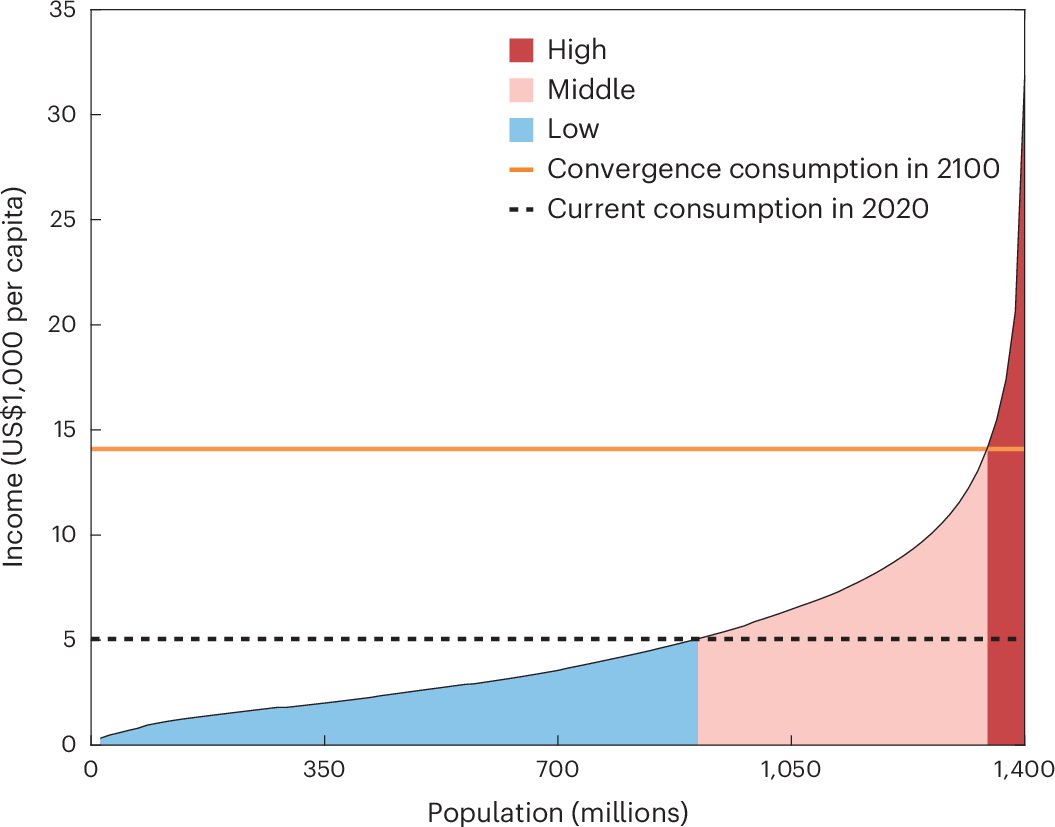
Post-growth refers to approaches prioritizing human well-being and ecological sustainability over gross domestic product expansion as a primary objective of economic policy. While it is widely discussed in the global north and generally targeted at high-income countries, its relevance to China remains underexplored and largely absent from academic discourse. This Perspective discusses China’s position in a possible global post-growth transition and explores convergence and difference between post-growth principles and development priorities in China. We consider how China’s concepts of ‘high-quality development’ and ‘ecological civilization’ could integrate post-growth principles, and vice versa. Understanding China’s context is crucial for a collaborative, effective approach to sustainability and global equity.
Post-growth
Post-growth is an umbrella term that refers to a broad family of economic, ecological, and political perspectives responding to the limits-to-growth dilemma —the recognition that infinite economic growth is biophysically unsustainable on a finite planet. Central to post-growth thinking is the shift of the focus out of GDP growth as the main goal of the economy. Instead, well-being becomes the main objective. Post-growth puts emphasis on decoupling societal well-being from economic growth, advocating for the possibility of prosperity beyond growth.

Post-growth: the science of wellbeing within planetary boundaries
There are increasing concerns that continued economic growth in high-income countries might not be environmentally sustainable, socially beneficial, or economically achievable. In this Review, we explore the rapidly advancing field of post-growth research, which has evolved in response to these concerns. The central idea of post-growth is to replace the goal of increasing GDP with the goal of improving human wellbeing within planetary boundaries. Key advances discussed in this Review include: the development of ecological macroeconomic models that test policies for managing without growth; understanding and reducing the growth dependencies that tie social welfare to increasing GDP in the current economy; and characterising the policies and provisioning systems that would allow resource use to be reduced while improving human wellbeing.

China’s globalisation paradox.
How can China dominate abroad while becoming less export-dependent?
Le paradoxe de la mondialisation de la Chine
Traduction française du billet de blog "China’s globalisation paradox. How can China dominate abroad while becoming less export-dependent?" de Richard

Sustainability is not enough: we need regenerative cultures
By Daniel C. Wahl

Post-Growth - P2P Foundation
"The term postgrowth defines a range of approaches to socioecological challenges. They address these challenges in ways that are diametrically opposed to green-growth, which expresses the belief that society can simultaneously expand economic activity and reduce emissions and the demand for materials. Postgrowth approaches, by contrast, argue that the unlimited expansion of production and consumption is impossible and undesirable on a finite planet.
Le ralentissement de la croissance chinoise dans une perspective historique
Traduction française du billet "How severe is China’s growth slowdown (in historical perspective)?" de Branko Milanovic

How Do We Explain China’s Higher-Than-Expected GDP Growth and Lower-Than-Expected Components of GDP Growth?
On Thursday, April 16, China’s National Bureau of Statistics (NBS) announced that China’s real GDP growth in the first quarter of 2026 was 5.0%.

The world’s renewable-energy superpower
China’s moment for climate leadership has arrived

Doughnut of social and planetary boundaries monitors a world out of balance
The doughnut-shaped framework of social and planetary boundaries (the ‘Doughnut’) provides a concise visual assessment of progress towards the goal of meeting the needs of all people within the means of the living planet1–3. Here we present a renewed Doughnut framework with a revised set of 35 indicators that monitor trends in social deprivation and ecological overshoot over the 2000–2022 period. Although global gross domestic product (GDP) has more than doubled, our median results show a modest achievement in reducing human deprivation that would have to accelerate fivefold to meet the needs of all people by 2030. Meanwhile, the increase in ecological overshoot would have to stop immediately and accelerate nearly two times faster towards planetary boundaries to safeguard Earth-system stability by 2050. Disaggregating these global findings shows that the richest 20% of nations, with 15% of the global population, contribute more than 40% of annual ecological overshoot, whereas the poorest 40% of countries, with 42% of the global population, experience more than 60% of the social shortfall. These trends and inequalities reaffirm the case for overcoming the dependence of nations on perpetual GDP growth4,5 and reorienting towards regenerative and distributive economic activity—within and between nations—that assigns priority to human needs and planetary integrity.

China’s Solar Industry Is in Upheaval—The Effects Will Be Global
Rather than opening space for rivals, China’s solar industry shakeout is forging a more resilient core — embedding deeper into global value chains, securing a technological lead, and reshaping the industry’s future trajectory to its own long-term advantage.

China’s Shift to Clean Energy Is Saving the Paris Climate Accord
Beijing’s massive manufacturing investments have driven the costs of clean energy down.

Sᴜɴʀɪsᴇ Oᴀᴛʜ 十 Tʜᴇ Sʏʟʟᴀʙᴜꜱ (ORI) - CC0 on Twitter / X
I am actually very pessimistic regarding the idea that China could be governed by any structure except the top-down (plus situational anarchic) imperial system it has had for millennia. The Chinese social consciousness is *much* smaller in scope than the Western one.— Sᴜɴʀɪsᴇ Oᴀᴛʜ 十 Tʜᴇ Sʏʟʟᴀʙᴜꜱ (ORI) - CC0 (@sunriseoath) October 14, 2026
Culturalizing sustainability
Policy-makers and scientists dominate high-level sustainability debates but any decision that follows has consequences for ordinary people in their local communities and environments. We asked experts to reflect on the importance of embracing a culturally informed, bottom-up approach to the sustainability discourse and action.

Steward Ownership, Sustainability, and Capitalism: Part 1
What makes people flourish? A new survey of more than 200,000 people across 22 countries looks for global patterns and local differences
A global study seeks insights into what helps people feel happy, healthy and satisfied – and what holds them back.