

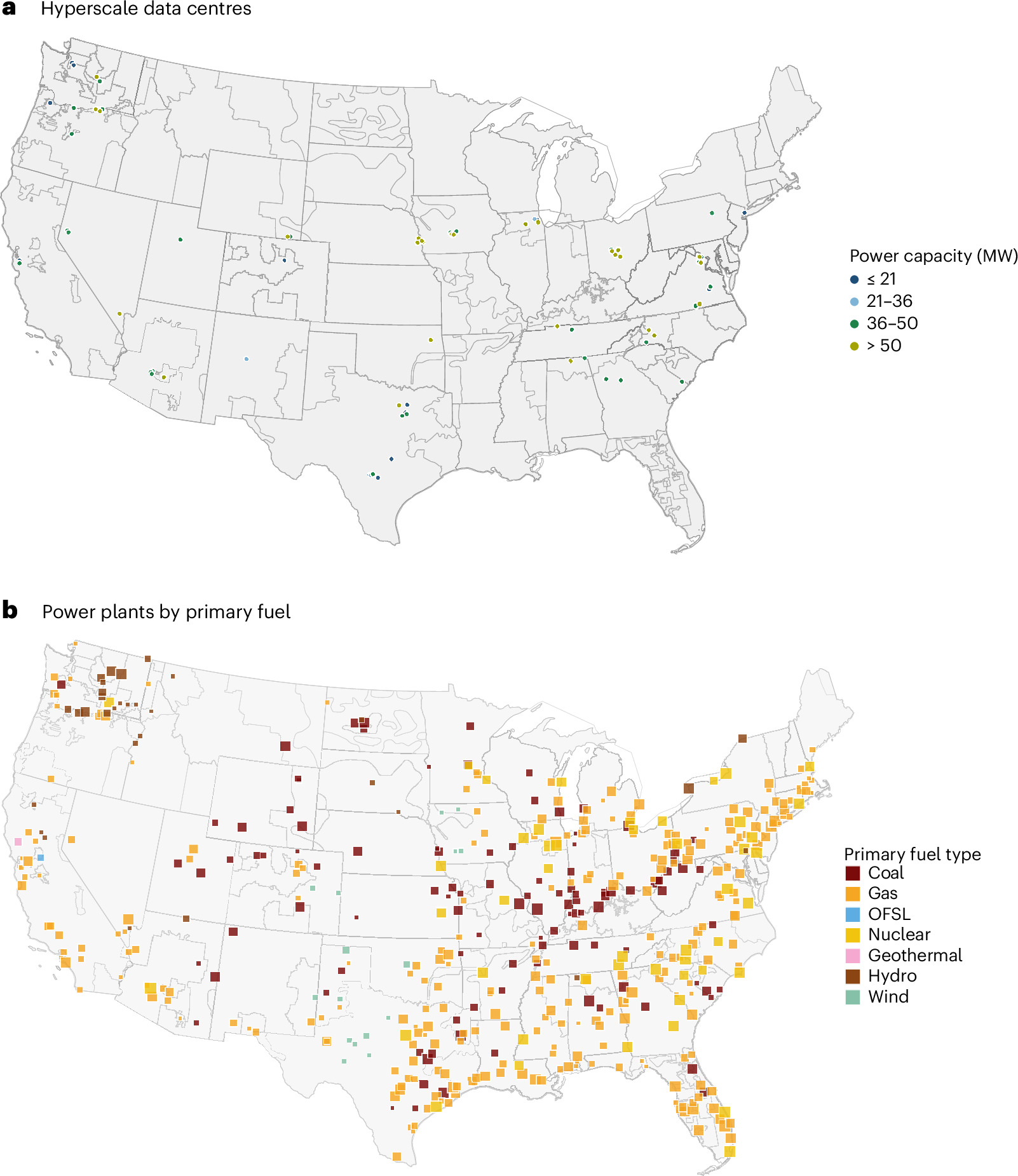
The rapid proliferation of hyperscale data centres (HDCs) in the USA—mainly driven by the adoption of artificial intelligence—has raised concerns about this industry’s carbon footprint. We compiled facility-level information on 403 US hyperscale data centres operating between May 2024 and April 2025 and estimated their electricity consumption, electricity sources and attributable CO2 emissions. Across facility-load scenarios, these HDCs consumed approximately 68–99 TWh of electricity and were associated with approximately 21–31 million metric tons of CO2 under a location-based, total-output balancing-authority attribution method. Under the central scenario, HDC electricity demand was approximately 82 TWh, corresponding to about 1.8% of total US electricity consumption, and attributable CO2 emissions were approximately 25.7 Mt. Roughly 54% of attributed generation was supplied by fossil-fuel sources. The HDC electricity-weighted total-output carbon intensity was approximately 314 gCO2 kWh−1, compared with a US total-output average of approximately 348 gCO2 kWh−1. Our approach provides a facility-resolved attributional framework for assessing the carbon footprint of hyperscale data centres using plant-level electricity-generation and emissions data.
Carbon Emissions of Biggest U.S. Data Centers Already Rival Entire Countries, Study Reveals
Harvard researchers calculated emissions for 403 American data centers. It wasn’t easy.

U.S. data centres now emit more carbon than an entire country | CBC
The 400 largest data centres in the United States put more heat-trapping gases into the atmosphere in one year than the entire nation of Denmark did, and that was before the artificial intelligence boom really got going, according to a Harvard University study published Monday.

US data centers’ energy use amid the artificial intelligence boom
Data centers accounted for 4% of total U.S. electricity use in 2024. Their energy demand is expected to more than double by 2030.

Decoding Europe’s Data Centre Landscape: An Analysis based on the EU EED DC Dashboard
The rapid expansion of digital infrastructure has made data centres a focal point of European energy and climate policy. Under the recast Energy Efficiency Directive (EED), the European Union established a public Data Centre Registry and Dashboard to enforce unprecedented transparency on energy and environmental related performance. However, initial releases of these official datasets present substantial challenges regarding data completeness and reporting anomalies, limiting their immediate usability for empirical policy assessment. This paper presents a comprehensive analysis and systematic refinement of the initial published dataset. We developed an automated data-processing workstream to validate registry disclosures, filter statistical outliers, and resolve data gaps by recalculating core metrics, including calculated average Power Usage Effectiveness (PUE), utilization rates, and data centre capacity relative to national economic indicators. Our findings uncover significant regional variations in energy efficiency and infrastructure density and utilisation across Europe, characterized by a sharp geographic efficiency gradient favoring northern member states. Furthermore, evaluating the framework's effectiveness reveals structural data quality issues, yielding an estimated overall EU data centre coverage rate of just 38 % alongside critical reporting anomalies, such as theoretical utilization rates exceeding 100 % in select member states. Ultimately, this study establishes a highly curated baseline of the current European digital infrastructure landscape and provides a refined, reliable dataset to track the sector's trajectory toward net-zero goals.
Power system costs and emissions from data center and cryptocurrency mining expansion in the United States
Abstract Rapid growth in electricity demand from data centers and cryptocurrency mining could significantly alter the trajectory of the United States’ power sector. We use an energy system optimization model to evaluate how projected demand through 2030 may influence electricity generation, power infrastructure investment, emissions, and costs under a range of scenarios. We model power sector capacity expansion and dispatch decisions across 26 interconnected power regions, incorporating policy constraints and spatial variation in renewable resources and transmission infrastructure. We find that data center and cryptocurrency demand could increase 2030 power sector CO 2 emissions by up to 28% relative to a future with no data center growth, driven by increased generation from natural gas and coal plants. Regional effects vary substantially: coal-fired generation rebounds to meet demand in Northern Virginia, while Texas accommodates growth primarily through natural gas generation. Electricity costs, as measured by demand-weighted locational marginal prices, rise by up to 57% in some regions, with a national average increase of 6%–29% across the modeled scenarios. Outcomes are highly sensitive to natural gas prices. Lower natural gas prices are associated with lower emissions before considering data center demand (with natural gas displacing coal), but result in large incremental emissions attributed to data centers as coal power utilization increases to meet the increased load. In contrast, higher natural gas prices shift a greater share of new demand toward cost-competitive renewable resources, thereby moderating emissions impacts. Reinstating federal incentives for renewable electricity would dampen both the cost and emissions attributable to data center demand. Distributing new data center and cryptocurrency demand more broadly across the grid reduces regional price spikes, but has little effect on national average electricity costs. Overall, these findings highlight the need for proactive planning and targeted policy to ensure that growing data center electricity demand does not strain efforts to achieve near-term climate and affordability goals.
New Gas-Powered Data Centers Could Emit More Greenhouse Gases Than Entire Nations
A WIRED review of permits for data center projects using natural gas and linked to OpenAI, Meta, Microsoft, and xAI shows they could emit more than 129 million tons of greenhouse gases per year.

Data centres in future European energy systems—energy efficiency, integration and policy
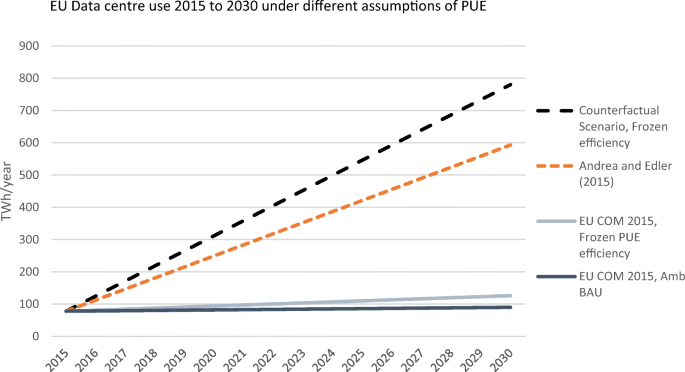
End-use efficiency, demand response and coupling of different energy vectors are important aspects of future renewable energy systems. Growth in the number of data centres is leading to an increase in electricity demand and the emergence of a new electricity-intensive industry. Studies on data centres and energy use have so far focused mainly on energy efficiency. This paper contributes with an assessment of the potential for energy system integration of data centres via demand response and waste heat utilization, and with a review of EU policies relevant to this. Waste heat utilization is mainly an option for data centres that are close to district heating systems. Flexible electricity demand can be achieved through temporal and spatial scheduling of data centre operations. This could provide more than 10 GW of demand response in the European electricity system in 2030. Most data centres also have auxiliary power systems employing batteries and stand-by diesel generators, which could potentially be used in power system balancing. These potentials have received little attention so far and have not yet been considered in policies concerning energy or data centres. Policies are needed to capture the potential societal benefits of energy system integration of data centres. In the EU, such policies are in their nascent phase and mainly focused on energy efficiency through the voluntary Code of Conduct and criteria under the EU Ecodesign Directive. Some research and development in the field of energy efficiency and integration is also supported through the EU Horizon 2020 programme. Our analysis shows that there is considerable potential for demand response and energy system integration. This motivates greater efforts in developing future policies, policy coordination, and changes in regulation, taxation and electricity market design.
Early evidence links data centre exposure to coal power retirement timelines
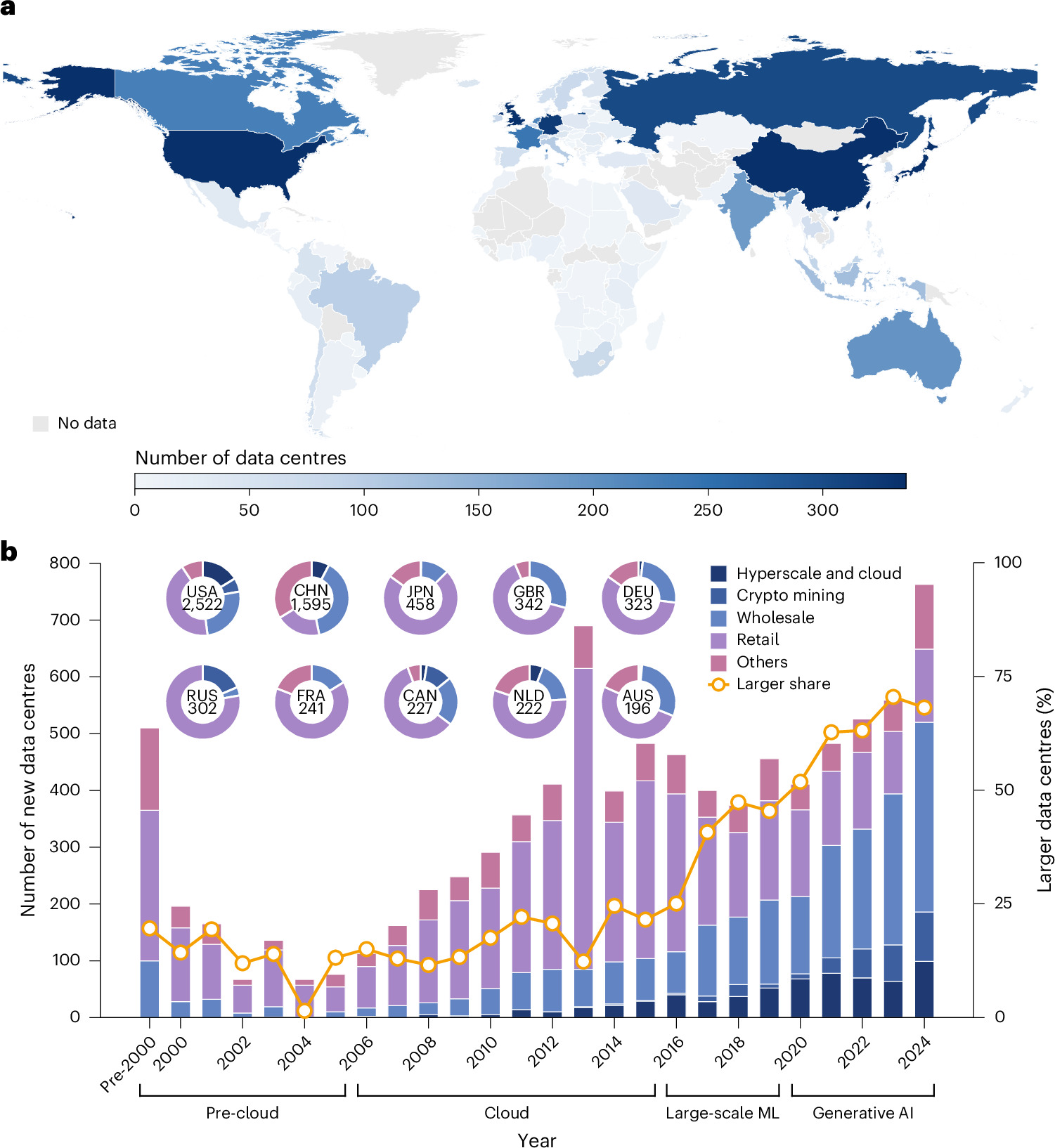
The rapid expansion of artificial intelligence and data centre infrastructure has generated substantial electricity demand and raised concerns about delayed phase-out of coal power, yet this relationship has not been empirically assessed. Here, using global datasets on data centres and coal-fired power plants, our survival analysis shows that coal power plants exposed to data centres built after 2020 exhibit significantly lower retirement risk. This link is more pronounced for plants with lower CO2 emission intensity and higher thermal efficiency. Each standard deviation increase in post-2020 data centre exposure is associated with about 1.7% extension of plant lifespan. Consequently, the 937 exposed coal-fired power generation units are projected to collectively emit an additional 1.96 GtCO2 (95% confidence interval 1.01–2.92) from 2025 until their retirement. Our estimates underscore the need to integrate digital infrastructure considerations into net-zero pathways.
Health-Informed Computing: Estimating and Addressing the Public Health Impact of Data Centers
The surging demand for artificial intelligence (AI) has led to a rapid expansion of energy-intensive data centers, contributing to criteria air pollutant emissions and raising public health concerns that have received comparatively limited attention in sustainability assessments. This paper introduces a principled methodology to model air pollutant emissions for data centers and estimate the public health impacts. Our findings reveal that the growing demand for AI and computing technologies is projected to push the total annual public health burden of U.S. data centers up to more than $20 billion in 2028. Although national-level impacts remain modest, data center health costs are unevenly distributed: in the most affected counties, the estimated per-household health burden can reach about seven times the national average. Next, we propose a health-informed computing framework that explicitly incorporates public health impacts into data center resource management across space and time, mitigating public health costs while supporting environmental sustainability. More broadly, we recommend extended energy reporting to include public health impact of data centers and paying attention to all impacted communities.
We did the math on AI’s energy footprint. Here’s the story you haven’t heard.
The emissions from individual AI text, image, and video queries seem small—until you add up what the industry isn’t tracking and consider where it’s heading next.

Assessment of the energy performance and sustainability of data centres in EU: first technical report.
This document represents the deliverable ‘First Technical Report’ for the project Study on Technical Assistance in support of implementing Article 12(5) of Directive 2023/1791 on the energy performance and sustainability of data centres, and has been produced by EY, AIT and Borderstep for the European Commission. The technical report assesses data centre energy efficiency and sustainability, and the reporting scheme of the Delegated Regulation 2024/1364. It uses reported data, supplemented where necessary, and evaluates energy performance via sustainability and key performance indicators. The report also addresses data quality and completeness and proposes improvements for the reporting scheme, including in terms of the reported information and indicators and user experience.
Assessment of next steps to promote the energy performance and sustainability of data centres in EU, including the establishment of an EU-wide rating scheme
This document represents the deliverable 'Second Technical Report' for the project Study on Technical Assistance in support of implementing Article 12(5) of Directive 2023/1791 on the energy performance and sustainability of data centres, and has been produced by EY, AIT and Borderstep for the European Commission. The technical report assesses data centre energy efficiency and sustainability, and the reporting scheme of the Delegated Regulation 2024/1364. It uses reported data, supplemented where necessary, and evaluates energy performance via sustainability and key performance indicators. The report also addresses data quality/completeness and proposes reporting scheme improvements, including information/indicators and user experience.
US data centers could wipe out 15 years' worth of progress in greenhouse gas emissions, report claims — buildouts could emit as much carbon dioxide as all of Mexico
The path to AI gold is paved with natural gas turbines.

Please consult the official Bloomberg estimate of Scope 1+2+3 combined total GHG emissions for the 500 largest public companies in the US, which I have annotated for helpful context. Microsoft emits slightly more GHG than a toothpaste manufacturer (much more than NFLX), but far less than Pepsi.

Ketan Joshi
For some reason "AI is just like watching Netflix" is back in my feeds so I took that as a sign to update my data tracking for Netflix. The company's energy use rose 1% from 2021 to 2024. Compare that to: Google: 71% Nvidia: 88% Meta: 96% Microsoft: 119%
