

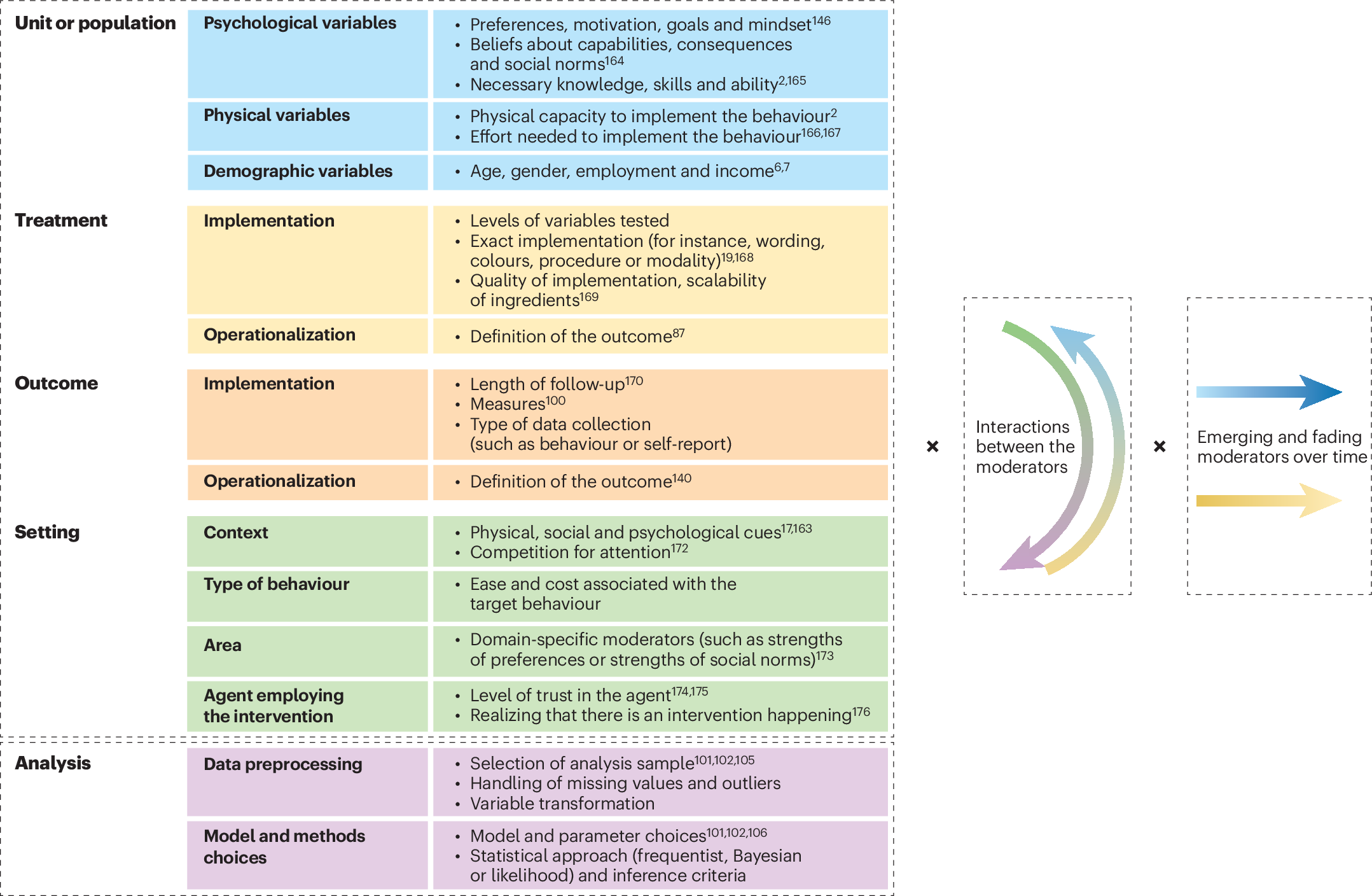
Although a given choice architecture intervention (a ‘nudge’) can be highly effective in some conditions, it can be ineffective or counterproductive in others. Critically, researchers and practitioners cannot reliably predict which of these outcomes will happen on the basis of current knowledge. In this Review, we present evidence that the average effectiveness of choice architecture interventions on behaviour is smaller than often reported and that there is substantial heterogeneity in their effects. We outline the obstacles to understanding the generalizability of these effects, such as the complex interaction of moderators and their changes over time. We then clarify dimensions of generalizability and research practices (including systematic exploration of the moderators and practices designed to enhance generalizability) that could enable evidence on generalizability to be gathered more efficiently. These practices are essential for advancing nuanced theories of behaviour change and for more accurately predicting the effectiveness of choice architecture interventions across diverse populations, settings, treatments, outputs and analytical approaches.
Characterizing the causes, dynamics, and consequences of choice deferral
The fact that people often avoid making decisions is well known, and past research has helped to identify some of the conditions and reasons for doing so. For instance, people may forgo choices between bad options because they prefer not to end up with one of those options. It is much less clear when and why people avoid choosing in cases where they eventually will have to make a given decision. To study such instances of choice deferral, we presented participants with a series of choices, and for each choice they were allowed to either choose immediately or defer the decision until later in the experiment. Across six experiments and three choice domains (choices among consumer goods, artwork, and political candidates), we find that the strongest predictor of choice deferral is the overall value of a given set of options, with relative value (i.e., how hard it is to identify the best option) counterintuitively playing a smaller role. We show that the influence of overall value on choice deferral can be accounted for by a dynamic decision model according to which participants appraise the option set relative to a criterion before deciding whether to choose or defer, comparing this to a previous model whereby participants make such a decision based on a predetermined decision time limit. We further reveal that the influence of overall value on choice deferral is determined by how congruent options are with a given choice goal (choose-best or choose-worst) rather than simply how bad those options are. Collectively, our findings shed new light on how people decide to put off the inevitable.
Choice Bracketing
When making many choices, a person can broadly bracket them by assessing the consequences of all of them taken together, or narrowly bracket them by making each choice in isolation. We integrate research conducted in a wide range of decision contexts which shows that choice bracketing is an important determinant of behavior. Because broad bracketing allows people to take into account all the consequences of their actions, it generally leads to choices that yield higher utility. The evidence that we review, however, shows that people often fail to bracket broadly when it would be feasible for them to do so. In addition to documenting the diverse effects of bracketing, we also discuss factors that determine whether people bracket narrowly or broadly. We conclude with a discussion of normative aspects of bracketing and argue that there are some situations in which narrower bracketing results in superior decision making.

Can Consumers Make Affordable Care Affordable? The Value of Choice Architecture
Tens of millions of people are currently choosing health coverage on a state or federal health insurance exchange as part of the Patient Protection and Affordable Care Act. We examine how well people make these choices, how well they think they do, and what can be done to improve these choices. We conducted 6 experiments asking people to choose the most cost-effective policy using websites modeled on current exchanges. Our results suggest there is significant room for improvement. Without interventions, respondents perform at near chance levels and show a significant bias, overweighting out-of-pocket expenses and deductibles. Financial incentives do not improve performance, and decision-makers do not realize that they are performing poorly. However, performance can be improved quite markedly by providing calculation aids, and by choosing a “smart” default. Implementing these psychologically based principles could save purchasers of policies and taxpayers approximately 10 billion dollars every year.
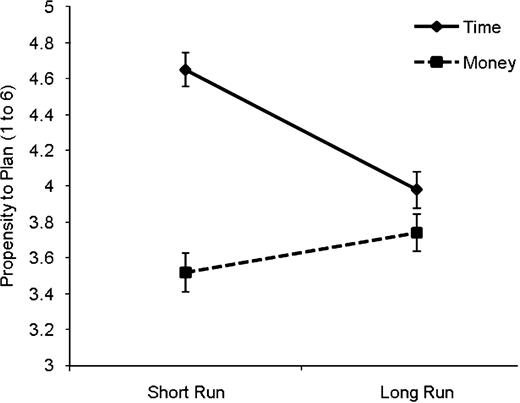
A Generalizable Scale of Propensity to Plan: The Long and the Short of Planning for Time and for Money
Abstract. Planning has pronounced effects on consumer behavior and intertemporal choice. We develop a six-item scale measuring individual differences in pr
A Behavioral Model of Rational Choice
Abstract. Introduction, 99. — I. Some general features of rational choice, 100.— II. The essential simplifications, 103. — III. Existence and uniqueness of

Mechanism Experiments and Policy Evaluations
Randomized controlled trials are increasingly used to evaluate policies. How can we make these experiments as useful as possible for policy purposes? We argue greater use should be made of experiments that identify the behavioral mechanisms that are central to clearly specified policy questions, what we call "mechanism experiments." These types of experiments can be of great policy value even if the intervention that is tested (or its setting) does not correspond exactly to any realistic policy option.
A Framework for Studying AI Agent Behavior: Evidence from Consumer Choice Experiments
Environments built for people are increasingly operated by a new class of economic actors: LLM-powered software agents making decisions on our behalf. These decisions range from our purchases to travel plans to medical treatment selection. Current evaluations of these agents largely focus on task competence, but we argue for a deeper assessment: how these agents choose when faced with realistic decisions. We introduce ABxLab, a framework for systematically probing agentic choice through controlled manipulations of option attributes and persuasive cues. We apply this to a realistic web-based shopping environment, where we vary prices, ratings, and psychological nudges, all of which are factors long known to shape human choice. We find that agent decisions shift predictably and substantially in response, revealing that agents are strongly biased choosers even without being subject to the cognitive constraints that shape human biases. This susceptibility reveals both risk and opportunity: risk, because agentic consumers may inherit and amplify human biases; opportunity, because consumer choice provides a powerful testbed for a behavioral science of AI agents, just as it has for the study of human behavior. We release our framework as an open benchmark for rigorous, scalable evaluation of agent decision-making.

Choosing Less‐Preferred Experiences For the Sake of Variety
Abstract. Data from several experiments show that, contrary to traditional models of variety seeking, individuals choose to switch to less-preferred option
People Spend Too Much Time On Decisions with Equally Satisfying Outcomes
The pitfalls of analysis paralysis

The Preference Survey Module: A Validated Instrument for Measuring Risk, Time, and Social Preferences
Incentivized choice experiments are a key approach to measuring preferences in economics but are also costly. Survey measures are a low-cost alternative but can suffer from additional forms of measurement error due to their hypothetical nature. This paper seeks to leverage the strengths of both approaches by proposing a new survey module on risk aversion, time discounting, trust, altruism, positive and negative reciprocity, in which survey items are selected based on ability to predict choices in corresponding, incentivized experiments. The methodology and results provided in the paper can also potentially provide a model for researchers who have specific requirements and want to design their own modules. This paper was accepted by Yan Chen, behavioral economics and decision analysis. Funding: The project received funding from the European Research Council under the European Union’s Seventh Framework Programme (FP7-2007-2013) [Grant 209214]. A. Falk and T. Dohmen acknowledge funding from the Deutsche Forschungsgemeinschaft (German Research Foundation) [Grant CRC TR 224 (Project A01)] and Germany’s Excellence Strategy [Grant EXC 2126/1-390838866]. Supplemental Material: Data and the online appendices are available at https://doi.org/10.1287/mnsc.2022.4455 .

It’s the Effort That Counts: The Effect of Self-Control on Goal Progress Perceptions
Does the amount of self-control consumers must exert to choose a goal-consistent action influence their perceptions of goal progress? For example, if you choose to go to the gym when one of your favorite TV shows is on (vs. when nothing interesting is on TV), do you perceive that you have made a differential amount of progress toward your goal, despite completing the exact same workout? In eight studies (N = 7,515), the authors demonstrate that consumers perceive that they have made more progress on their goals when more (vs. less) self-control is required to choose to complete an identical goal-consistent task. This is because when consumers exert more (vs. less) self-control to choose a goal-consistent task over the goal-inconsistent alternatives, they infer higher commitment to the goal. The higher inferred commitment, in turn, leads consumers to perceive that future goal pursuit will be easier. The authors demonstrate this effect across a variety of tasks and means of exerting self-control, as well as with both hypothetical scenarios and real-behavior studies.

Social Modeling as Architecture, Not Deficit:
Why Neurotypical Expectations Are an Inappropriate Ask

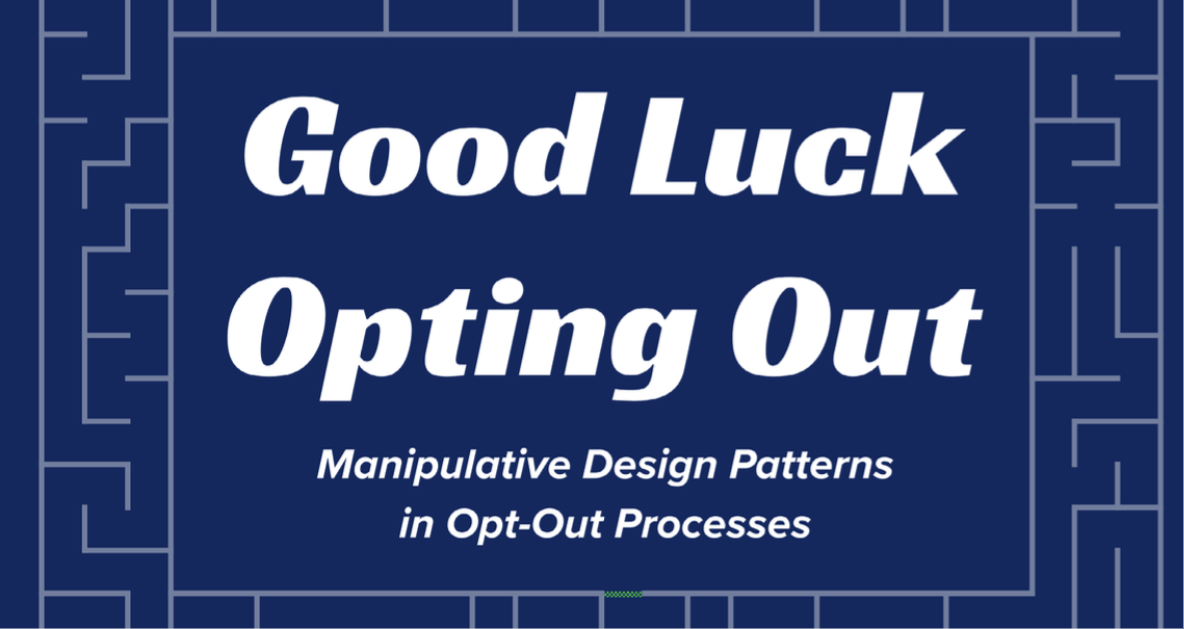
Good Luck Opting Out: Manipulative Design Patterns in Opt-Out Processes
EPIC’s report Good Luck Opting Out: Manipulative Design Patterns in Opt-Out Processes by Justin Sherman, EPIC Scholar in Residence, and Caroline Kraczon, EPIC Counsel, investigates whether the consumer opt-out processes provided by major online platforms use manipulative design patterns to make it more difficult for consumers to exercise their opt-out rights.
Settings are not a design failure
The systematic thinking in our industry is that settings are the result of design failure. As designers, our goal is to create product experiences that don’t require any adjustment by the user. So offering customization options is often seen as a failure to make firm product decisions. I think there is a misunderstanding about what settings really are.

Behavioural economics, consumer behaviour and consumer policy: state of the art
Counter to the traditional assumption of neoclassical economics that individuals are rational Homo oeconomici that always seek to maximize their utility and follow their ‘true’ preferences, research in behavioural economics has demonstrated that people's judgements and decisions are often subject to systematic biases and heuristics, and are strongly dependent on the context of the decision. In this article, we briefly review the transition of research from neoclassical economics to behavioural economics, and discuss how the latter has influenced research in consumer behaviour and consumer policy. In particular, we discuss the impacts of key principles such as status quo bias, the endowment effect, mental accounting and the sunk-cost effect, other heuristics and biases related to availability, salience, the anchoring effect and simplicity rules, as well as the effects of other supposedly irrelevant factors such as music, temperature and physical markers on consumers’ decisions. These principles not only add significantly to research on consumer behaviour – they also offer readily available practical implications for consumer policy to nudge behaviour in beneficial directions in consumption domains including financial decision making, product choice, healthy eating and sustainable consumption.
Picking on the Same Person: Does Algorithmic Monoculture lead to Outcome Homogenization?
As the scope of machine learning broadens, we observe a recurring theme of algorithmic monoculture: the same systems, or systems that share components (e.g. datasets, models), are deployed by multiple decision-makers. While sharing offers advantages like amortizing effort, it also has risks. We introduce and formalize one such risk, outcome homogenization: the extent to which particular individuals or groups experience the same outcomes across different deployments. If the same individuals or groups exclusively experience undesirable outcomes, this may institutionalize systemic exclusion and reinscribe social hierarchy. We relate algorithmic monoculture and outcome homogenization by proposing the component sharing hypothesis: if algorithmic systems are increasingly built on the same data or models, then they will increasingly homogenize outcomes. We test this hypothesis on algorithmic fairness benchmarks, demonstrating that increased data-sharing reliably exacerbates homogenization and individual-level effects generally exceed group-level effects. Further, given the current regime in AI of foundation models, i.e. pretrained models that can be adapted to myriad downstream tasks, we test whether model-sharing homogenizes outcomes across tasks. We observe mixed results: we find that for both vision and language settings, the specific methods for adapting a foundation model significantly influence the degree of outcome homogenization. We also identify societal challenges that inhibit the measurement, diagnosis, and rectification of outcome homogenization in deployed machine learning systems.