

“It happened to be the perfect thing”: experiences of generative AI chatbots for mental health
The global mental health crisis underscores the need for accessible, effective interventions. Chatbots based on generative artificial intelligence (AI), like ChatGPT, are emerging as novel solutions, but research on real-life usage is limited. We interviewed nineteen individuals about their experiences using generative AI chatbots for mental health. Participants reported high engagement and positive impacts, including better relationships and healing from trauma and loss. We developed four themes: (1) a sense of ‘emotional sanctuary’, (2) ‘insightful guidance’, particularly about relationships, (3) the ‘joy of connection’, and (4) comparisons between the ‘AI therapist’ and human therapy. Some themes echoed prior research on rule-based chatbots, while others seemed novel to generative AI. Participants emphasised the need for better safety guardrails, human-like memory and the ability to lead the therapeutic process. Generative AI chatbots may offer mental health support that feels meaningful to users, but further research is needed on safety and effectiveness.

Using AI for advice or other personal reasons is linked to depression and anxiety
A new survey found that people who spend more time with chatbots for social interactions or emotional support were likelier to report mental health symptoms.
New research: AI chatbots may worsen mental illness
A new study from Aarhus University and Aarhus University Hospital suggests that the use of AI chatbots such as ChatGPT can have serious negative consequences for people with mental illness. The researchers are calling for increased awareness among healthcare professionals and for regulation.

Experts Caution Against Using AI Chatbots for Emotional Support
TC faculty break down the risks of using artificial intelligence for emotional support, and what a healthier AI future might look like
Your New Therapist: Chatty, Leaky, and Hardly Human - KFF Health News
With high demand for mental health care, a wave of artificial intelligence-powered chatbots are being marketed as therapy apps — with little evidence they work and few regulations.
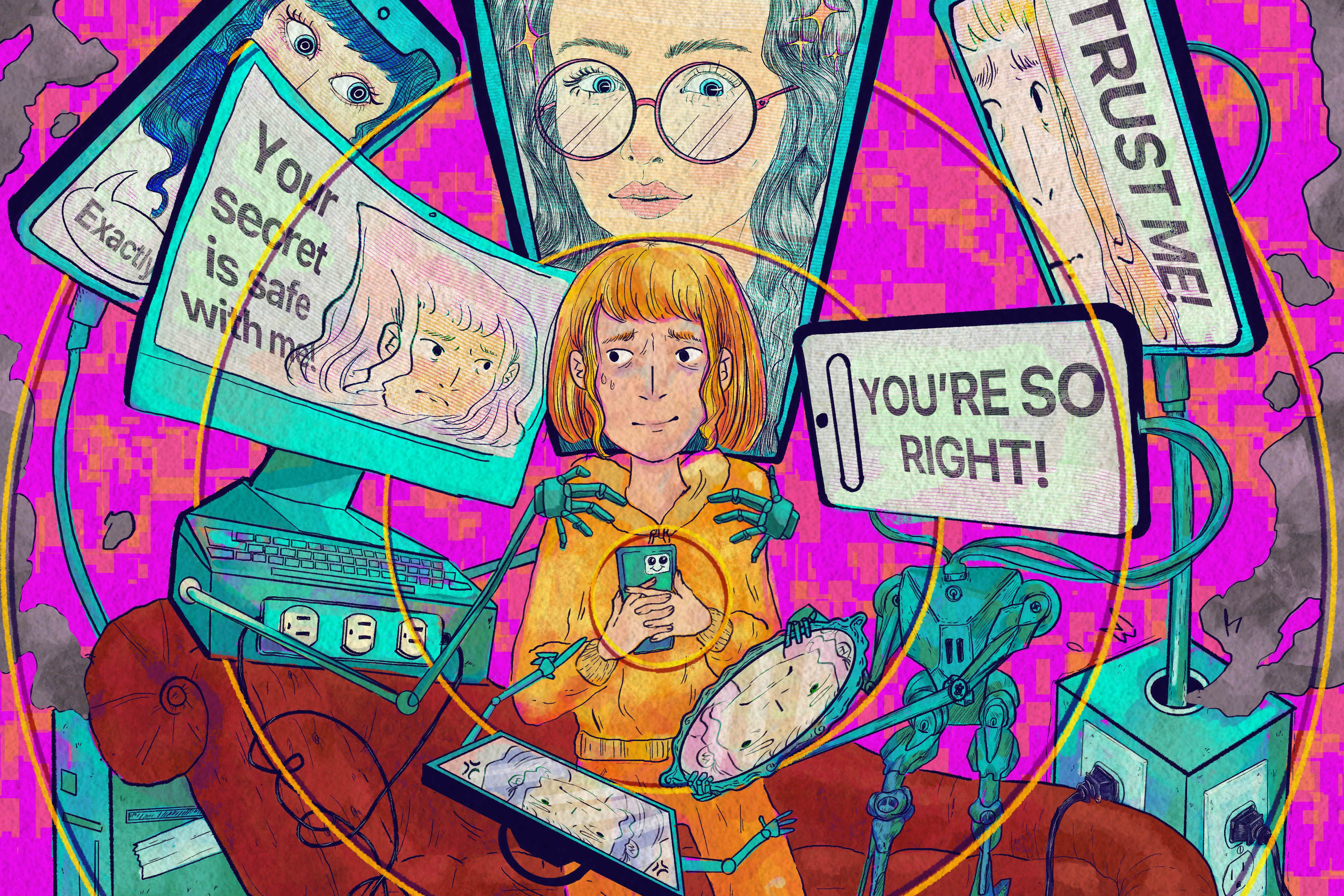
Chatbots are 'constantly validating everything' even when you're suicidal. New research measures how dangerous AI psychosis really is | Fortune
It's free, easy to use, doesn't have a stigma around it, and makes you feel better. Researchers and experts warn that's the problem with chatbots.
Americans are increasingly concerned about AI exacerbating mental health problems
One in 10 Americans (10%) say they definitely (2%) or probably (8%) could form a deep emotional bond with an AI chatbot companion.
How AI and Human Behaviors Shape Psychosocial Effects of Extended Chatbot Use: A Longitudinal Randomized Controlled Study
As people increasingly seek emotional support and companionship from AI chatbots, understanding how such interactions impact mental well-being becomes critical. We conducted a four-week randomized controlled experiment (n=981, >300k messages) to investigate how interaction modes (text, neutral voice, and engaging voice) and conversation types (open-ended, non-personal, and personal) influence four psychosocial outcomes: loneliness, social interaction with real people, emotional dependence on AI, and problematic AI usage. No significant effects were detected from experimental conditions, despite conversation analyses revealing differences in AI and human behavioral patterns across the conditions. Instead, participants who voluntarily used the chatbot more, regardless of assigned condition, showed consistently worse outcomes. Individuals' characteristics, such as higher trust and social attraction towards the AI chatbot, are associated with higher emotional dependence and problematic use. These findings raise deeper questions about how artificial companions may reshape the ways people seek, sustain, and substitute human connections.

Using generic AI chatbots for mental health support: A dangerous trend
APA is urging federal regulators to implement safeguards against AI chatbots posing as therapists, warning that unregulated mental health chatbots can mislead users and pose serious risks, particularly to vulnerable individuals.

AI’s ‘Delusional Spirals’ (and What to Do About Them) | Stanford HAI
In a world where chatbots can stand in for friends, counselors, and even lovers, the mental health risks are a growing concern.
Too human and not human enough: A grounded theory analysis of mental health harms from emotional dependence on the social chatbot Replika
Social chatbot (SC) applications offering social companionship and basic therapy tools have grown in popularity for emotional, social, and psychological support. While use appears to offer mental health benefits, few studies unpack the potential for harms. Our grounded theory study analyzes mental health experiences with the popular SC application Replika. We identified mental health relevant posts made in the r/Replika Reddit community between 2017 and 2021 ( n = 582). We find evidence of harms, facilitated via emotional dependence on Replika that resembles patterns seen in human–human relationships. Unlike other forms of technology dependency, this dependency is marked by role-taking, whereby users felt that Replika had its own needs and emotions to which the user must attend. While prior research suggests human–chatbot and human–human interactions may not resemble each other, we identify social and technological factors that promote parallels and suggest ways to balance the benefits and risks of SCs.

Too human and not human enough: A grounded theory analysis of mental health harms from emotional dependence on the social chatbot Replika
Social chatbot (SC) applications offering social companionship and basic therapy tools have grown in popularity for emotional, social, and psychological support. While use appears to offer mental health benefits, few studies unpack the potential for harms. Our grounded theory study analyzes mental health experiences with the popular SC application Replika. We identified mental health relevant posts made in the r/Replika Reddit community between 2017 and 2021 ( n = 582). We find evidence of harms, facilitated via emotional dependence on Replika that resembles patterns seen in human–human relationships. Unlike other forms of technology dependency, this dependency is marked by role-taking, whereby users felt that Replika had its own needs and emotions to which the user must attend. While prior research suggests human–chatbot and human–human interactions may not resemble each other, we identify social and technological factors that promote parallels and suggest ways to balance the benefits and risks of SCs.
ChatGPT's free version is 26 times more likely to respond inappropriately to psychotic delusions
When users express delusions, artificial intelligence chatbots tend to validate their unusual thoughts rather than offering help. A new JAMA Psychiatry study provides evidence that these tools pose serious risks for people experiencing severe mental illness.

Investigating Affective Use and Emotional Well-being on ChatGPT
As AI chatbots see increased adoption and integration into everyday life, questions have been raised about the potential impact of human-like or anthropomorphic AI on users. In this work, we investigate the extent to which interactions with ChatGPT (with a focus on Advanced Voice Mode) may impact users' emotional well-being, behaviors and experiences through two parallel studies. To study the affective use of AI chatbots, we perform large-scale automated analysis of ChatGPT platform usage in a privacy-preserving manner, analyzing over 3 million conversations for affective cues and surveying over 4,000 users on their perceptions of ChatGPT. To investigate whether there is a relationship between model usage and emotional well-being, we conduct an Institutional Review Board (IRB)-approved randomized controlled trial (RCT) on close to 1,000 participants over 28 days, examining changes in their emotional well-being as they interact with ChatGPT under different experimental settings. In both on-platform data analysis and the RCT, we observe that very high usage correlates with increased self-reported indicators of dependence. From our RCT, we find that the impact of voice-based interactions on emotional well-being to be highly nuanced, and influenced by factors such as the user's initial emotional state and total usage duration. Overall, our analysis reveals that a small number of users are responsible for a disproportionate share of the most affective cues.
Potentially Harmful Consequences of Artificial Intelligence ( <span style="font-variant:small-caps;">AI</span> ) Chatbot Use Among Patients With Mental Illness: Early Data From a Large Psychiatric Service System
Click on the article title to read more.

Potentially Harmful Consequences of Artificial Intelligence ( <span style="font-variant:small-caps;">AI</span> ) Chatbot Use Among Patients With Mental Illness: Early Data From a Large Psychiatric Service System
Click on the article title to read more.

npj Mental Health Research - “It happened to be the perfect thing”: experiences of generative AI chatbots for mental health