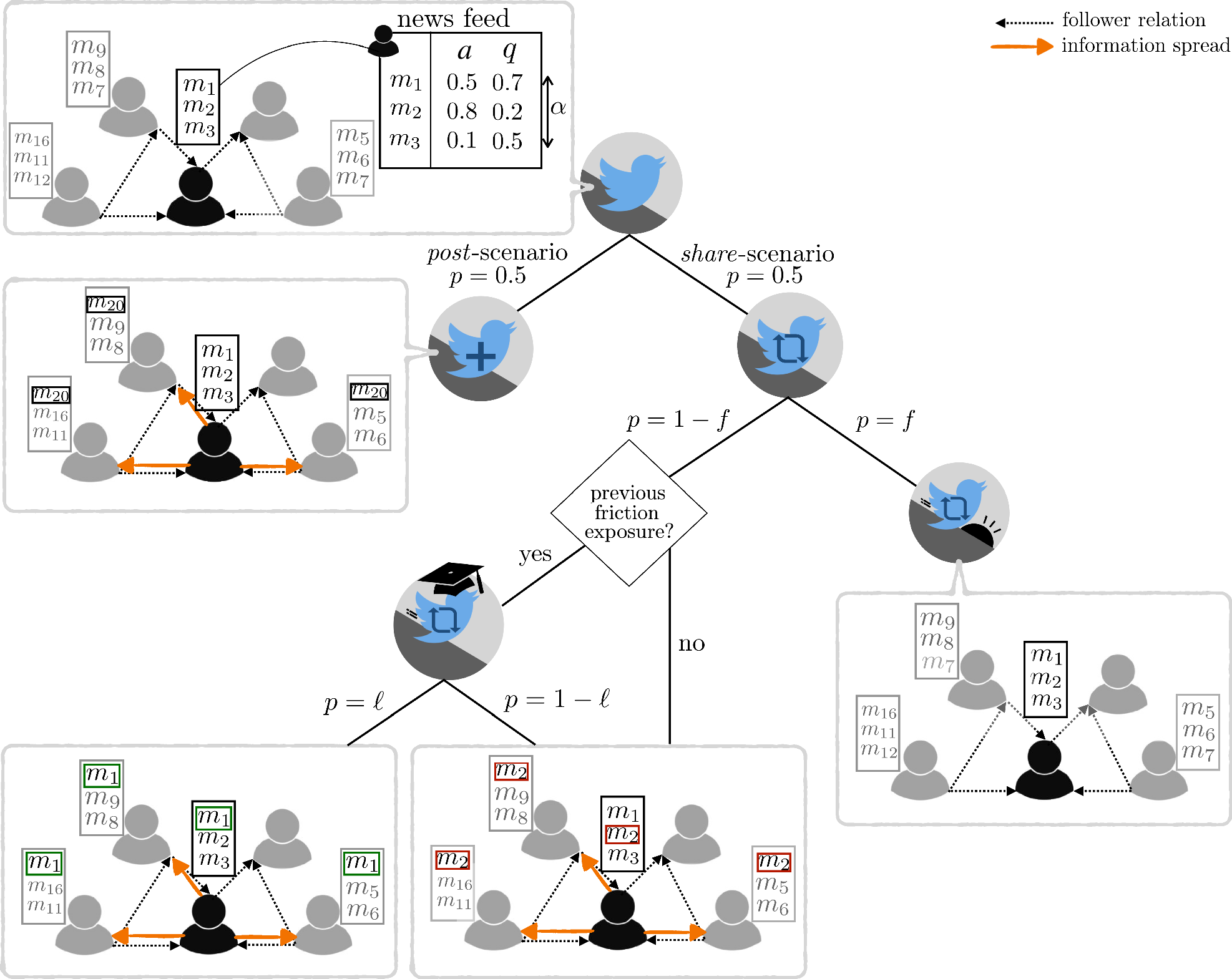
Social media has enabled the spread of information at unprecedented speeds and scales, and with it the proliferation of high-engagement, low-quality content. Friction—behavioral design measures that make the sharing of content more cumbersome—might be a way to raise the quality of what is spread online. In this perspective, we propose a scalable field experiment to study the effects of friction with a learning component to educate users on the platform’s community standards. Preliminary simulations from an agent-based model suggest that while friction alone may decrease the number of posts without improving their quality, it could significantly increase the average quality of posts when combined with learning. The model also suggests that too much friction could be counterproductive. Experimental interventions inspired by these findings would be minimally invasive.
The case against efficiency: friction in social media
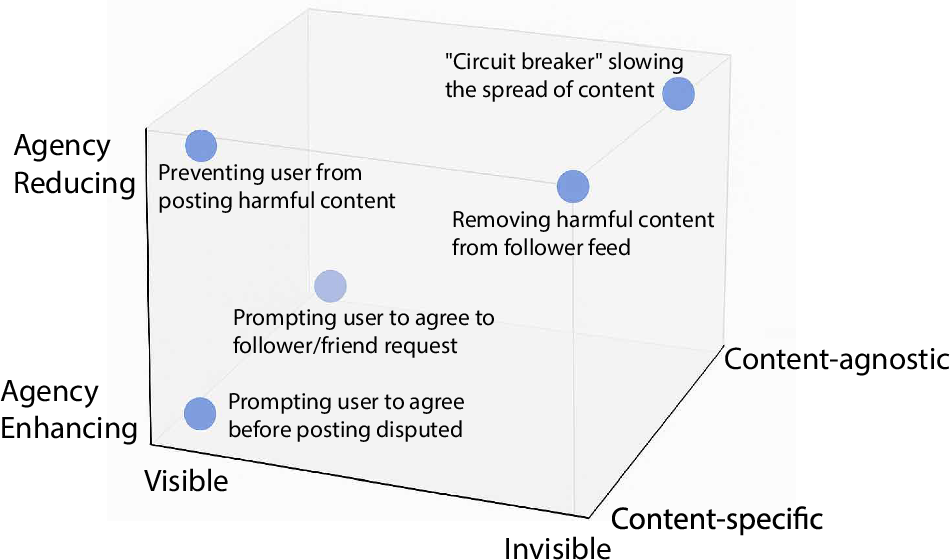
Social media platforms frequently prioritize efficiency to maximize ad revenue and user engagement, often sacrificing deliberation, trust, and reflective, purposeful cognitive engagement in the process. This manuscript examines the potential of friction—design choices that intentionally slow user interactions—as an alternate approach. We present a case against efficiency as the dominant paradigm on social media and advocate for a complex systems approach to understanding and analyzing friction. Drawing from interdisciplinary literature, real-world examples, and industry experiments, we highlight the potential for friction to mitigate issues like polarization, disinformation, and toxic content without resorting to censorship. We propose a state space representation of friction to establish a multidimensional framework and language for analyzing the diverse forms and functions through which friction can be implemented. Additionally, we propose several experimental designs to examine the impact of friction on system dynamics, user behavior, and information ecosystems, each designed with complex systems solutions and perspectives in mind. Our case against efficiency underscores the critical role of friction in shaping digital spaces, challenging the relentless pursuit of efficiency and exploring the potential of thoughtful slowing.
Sharing of misinformation is habitual, not just lazy or biased
Why do people share misinformation on social media? In this research ( N = 2,476), we show that the structure of online sharing built into social platforms is more important than individual deficits in critical reasoning and partisan bias—commonly cited drivers of misinformation. Due to the reward-based learning systems on social media, users form habits of sharing information that attracts others' attention. Once habits form, information sharing is automatically activated by cues on the platform without users considering response outcomes such as spreading misinformation. As a result of user habits, 30 to 40% of the false news shared in our research was due to the 15% most habitual news sharers. Suggesting that sharing of false news is part of a broader response pattern established by social media platforms, habitual users also shared information that challenged their own political beliefs. Finally, we show that sharing of false news is not an inevitable consequence of user habits: Social media sites could be restructured to build habits to share accurate information.

Sharing of misinformation is habitual, not just lazy or biased
Why do people share misinformation on social media? In this research ( N = 2,476), we show that the structure of online sharing built into social platforms is more important than individual deficits in critical reasoning and partisan bias—commonly cited drivers of misinformation. Due to the reward-based learning systems on social media, users form habits of sharing information that attracts others' attention. Once habits form, information sharing is automatically activated by cues on the platform without users considering response outcomes such as spreading misinformation. As a result of user habits, 30 to 40% of the false news shared in our research was due to the 15% most habitual news sharers. Suggesting that sharing of false news is part of a broader response pattern established by social media platforms, habitual users also shared information that challenged their own political beliefs. Finally, we show that sharing of false news is not an inevitable consequence of user habits: Social media sites could be restructured to build habits to share accurate information.
Bonsai: Intentional and Personalized Social Media Feeds
Social media feeds use predictive models to maximize engagement, often misaligning how people consume content with how they wish to. We introduce Bonsai, a system that enables people to build personalized and intentional feeds. Bonsai implements a platform-agnostic framework comprising Planning, Sourcing, Curating, and Ranking modules. This framework allows users to express their intent in natural language and exert fine-grained control over a procedurally transparent feed creation process. We evaluated the system with 15 Bluesky users in a two-phase, multi-week study. We find that participants successfully used our system to discover new content, filter out irrelevant or toxic posts, and disentangle engagement from intent, but curating intentional feeds required more effort than they are used to. Simultaneously, users sought system transparency mechanisms to effectively use (and trust) intentional, personalized feeds. Overall, our work highlights intentional feedbuilding as a viable path beyond engagement-based optimization.

Consequences of Information Feed Integration on User Engagement and Contribution: A Natural Experiment in an Online Knowledge-Sharing Community
Many online communities that rely on effortful, voluntary content contributions offer additional content curation tools to facilitate social interactions and encourage user contributions. Any platform that offers two or more heterogeneous content types (e.g., expert knowledge and social posts) faces a choice about the presentation format: whether to display the content types separately or in an integrated information feed. We leverage a natural experiment on Zhihu, a Q&A platform that offers a social-interaction-oriented functionality called Ideas. Zhihu initially presented answers (expert knowledge content) and ideas (social posts) in two different information feeds, but the platform integrated ideas into the same information feed as answers in June 2019. We find that information feed integration significantly decreased user engagement with and contribution of both ideas and answers. We hypothesize that users decreased their engagement because the juxtaposition of incongruous types of content increased mindset switching and cognitive strain. This hypothesis is supported by an additional laboratory experiment. We also present evidence showing that contributions decreased both because of the decrease in engagement (weaker social recognition incentives) and because integration heightened concerns that posting ideas would dilute the contributor’s professional image. Our findings have important theoretical and practical implications for any platform that hosts heterogeneous content. History: Xiaoquan (Michael) Zhang served as the senior editor and Yili (Kevin) Hong served as associate editor for this article. Funding: Z. Cao acknowledges this research was funded by National Natural Science Foundation of China [Grants 72201238, 72192823]. G. Li acknowledges this research was funded by National Natural Science Foundation of China [Grant 72102047] and Shanghai Pujiang Program [Grant 21PJC006]. Supplemental Material: The e-companion is available at https://doi.org/10.1287/isre.2022.0043.
Trust: Foundation of Human Knowledge yet online Platforms won't allow | David Karger | TEDxMIT Salon
Can We Fix Social Media? Testing Prosocial Interventions using Generative Social Simulation
Social media platforms have been widely linked to societal harms, including rising polarization and the erosion of constructive debate. Can these problems be mitigated through prosocial interventions? We address this question using a novel method - generative social simulation - that embeds Large Language Models within Agent-Based Models to create socially rich synthetic platforms. We create a minimal platform where agents can post, repost, and follow others. We find that the resulting following-networks reproduce three well-documented dysfunctions: (1) partisan echo chambers; (2) concentrated influence among a small elite; and (3) the amplification of polarized voices - creating a 'social media prism' that distorts political discourse. We test six proposed interventions, from chronological feeds to bridging algorithms, finding only modest improvements - and in some cases, worsened outcomes. These results suggest that core dysfunctions may be rooted in the feedback between reactive engagement and network growth, raising the possibility that meaningful reform will require rethinking the foundational dynamics of platform architecture.
Can We Fix Social Media? Testing Prosocial Interventions using Generative Social Simulation
Social media platforms have been widely linked to societal harms, including rising polarization and the erosion of constructive debate. Can these problems be mitigated through prosocial interventions? We address this question using a novel method - generative social simulation - that embeds Large Language Models within Agent-Based Models to create socially rich synthetic platforms. We create a minimal platform where agents can post, repost, and follow others. We find that the resulting following-networks reproduce three well-documented dysfunctions: (1) partisan echo chambers; (2) concentrated influence among a small elite; and (3) the amplification of polarized voices - creating a 'social media prism' that distorts political discourse. We test six proposed interventions, from chronological feeds to bridging algorithms, finding only modest improvements - and in some cases, worsened outcomes. These results suggest that core dysfunctions may be rooted in the feedback between reactive engagement and network growth, raising the possibility that meaningful reform will require rethinking the foundational dynamics of platform architecture.
How cognitive elaboration fosters knowledge acquisition on social media—a field experiment
Abstract. Social media technologies have been criticized as ineffective sources of information because users seem to increase their subjective but not thei
Introducing AI to an Online Petition Platform Changed Outputs but not Outcomes
The rapid integration of AI writing tools into online platforms raises critical questions about their impact on content production and outcomes. We leverage a unique natural experiment on Change$.$org, a leading social advocacy platform, to causally investigate the effects of an in-platform ''write with AI'' tool. To understand the impact of the AI integration, we collected 1.5 million petitions and employed a difference-in-differences analysis. Our findings reveal that in-platform AI access significantly altered the lexical features of petitions and increased petition homogeneity, but did not improve petition outcomes. We confirmed the results in a separate analysis of repeat petition writers who wrote petitions before and after introduction of the AI tool. The results suggest that while AI writing tools can profoundly reshape online content, their practical utility for improving desired outcomes may be less beneficial than anticipated, and introduce unintended consequences like content homogenization.
Beyond the hashtag: Circumventing content moderation on social media
Social media companies make important decisions about what counts as “problematic” content and how they will remove it. Some choose to moderate hashtags, blocking the results for certain tag searches and issuing public service announcements (PSAs) when users search for troubling terms. The hashtag has thus become an indicator of where problematic content can be found, but this has produced limited understandings of how such content actually circulates. Using pro-eating disorder (pro-ED) communities as a case study, this article explores the practices of circumventing hashtag moderation in online pro-ED communities. It shows how (1) untagged pro-ED content can be found without using the hashtag as a search mechanism; (2) users are evading hashtag and other forms of platform policing, devising signals to identify themselves as “pro-ED”; and (3) platforms’ recommendation systems recirculate pro-ED content, revealing the limitations of hashtag logics in social media content moderation.

Agency Among Agents: Designing with Hypertextual Friction in the Algorithmic Web
Today's algorithm-driven interfaces, from recommendation feeds to GenAI tools, often prioritize engagement and efficiency at the expense of user agency. As systems take on more decision-making, users have less control over what they see and how meaning or relationships between content are constructed. This paper introduces "Hypertextual Friction," a conceptual design stance that repositions classical hypertext principles--friction, traceability, and structure--as actionable values for reclaiming agency in algorithmically mediated environments. Through a comparative analysis of real-world interfaces--Wikipedia vs. Instagram Explore, and Are.na vs. GenAI image tools--we examine how different systems structure user experience, navigation, and authorship. We show that hypertext systems emphasize provenance, associative thinking, and user-driven meaning-making, while algorithmic systems tend to obscure process and flatten participation. We contribute: (1) a comparative analysis of how interface structures shape agency in user-driven versus agent-driven systems, and (2) a conceptual stance that offers hypertextual values as design commitments for reclaiming agency in an increasingly algorithmic web.
Agency Among Agents: Designing with Hypertextual Friction in the Algorithmic Web
Today's algorithm-driven interfaces, from recommendation feeds to GenAI tools, often prioritize engagement and efficiency at the expense of user agency. As systems take on more decision-making, users have less control over what they see and how meaning or relationships between content are constructed. This paper introduces "Hypertextual Friction," a conceptual design stance that repositions classical hypertext principles--friction, traceability, and structure--as actionable values for reclaiming agency in algorithmically mediated environments. Through a comparative analysis of real-world interfaces--Wikipedia vs. Instagram Explore, and Are.na vs. GenAI image tools--we examine how different systems structure user experience, navigation, and authorship. We show that hypertext systems emphasize provenance, associative thinking, and user-driven meaning-making, while algorithmic systems tend to obscure process and flatten participation. We contribute: (1) a comparative analysis of how interface structures shape agency in user-driven versus agent-driven systems, and (2) a conceptual stance that offers hypertextual values as design commitments for reclaiming agency in an increasingly algorithmic web.
Illusion of knowledge through Facebook news? Effects of snack news in a news feed on perceived knowledge, attitude strength, and willingness for discussions
Research indicates that using social network sites as a source for news increases perceived knowledge even if, objectively, people fail to acquire knowledge. This might result from the frequent repetition of topics in news posts caused by multiple news outlets posting about the same news topics and the algorithm that favors similar postings. These repeated encounters can have a positive effect on the perception of knowing more, even if actual learning hardly occurs. An experiment (N = 810, representative of German Internet users) tested these assumptions. Participants were assigned to one of four groups and received a news feed with no information, few news posts, many news posts, or a full-length news article. Results indicate that many news posts increased perceived knowledge that is not paralleled by a gain in factual knowledge. Perceived knowledge mediates effects of reading many news posts on more extreme attitudes and the willingness for discussions. Even if participants who read the news article gained factual knowledge, they did not feel more knowledgeable than participants who were exposed to a news feed containing news posts. The results emphasize the meaning of engaging with full news articles, both for learning facts and for more accurate knowledge assessments.
Social Media Is Now Parasocial Media
When practitioners used the term “social media” to describe the internet tools that emerged in the mid-aughts, they were giving a name to the kinds of platforms and protocols that allowed people to socialize with friends and communities of interest by using digital technologies. Twenty years later, users of social media are far more likely to scroll than post – and the content that they consume is often strategically produced and algorithmically curated. In this essay, I argue that the very essence of social media has changed. To more effectively interrogate what we are witnessing, we need to stop presuming that these tools are “social media” and begin recognizing that they are now “parasocial media.” Doing so raises new questions about digitally mediated sociality, not to mention the politics and governance of these platforms.
Introducing a network for thoughtful conversations
The quality of conversations on the Internet is terrible. Most platforms like Twitter, Facebook, Instagram, Reddit, etc. optimize for engagement as their key metric. This spawns and rewards behavior that leads to bragging of gameable metrics such as likes and followers, self-feeding thought bubbles, knee-jerk reactions, “if you’re not on our side, you’re on their side” mentality, and thought policing even by people who think they’re fighting for a good cause. Today’s Internet doesn’t incentiviz