Generative AI deserves scientific attention. But the rush to study it is producing a feedback loop of topical and methodological convergence, flattening scientific imagination and crowding out the pluralism needed to keep research adaptive, resilient, and intellectually generative.
Where does the rigor go? Research software and the future of trustworthy science.
Generative AI now makes it dramatically easier to produce something that looks like research: analysis code, figures, literature reviews, even whole pap…
Will AI spark a scientific renaissance — or a diffuse monoculture?
Artificial intelligence’s ability to enrich science will depend not only on model capability, but also on whether researchers, reviewers and funders reward originality over speed.

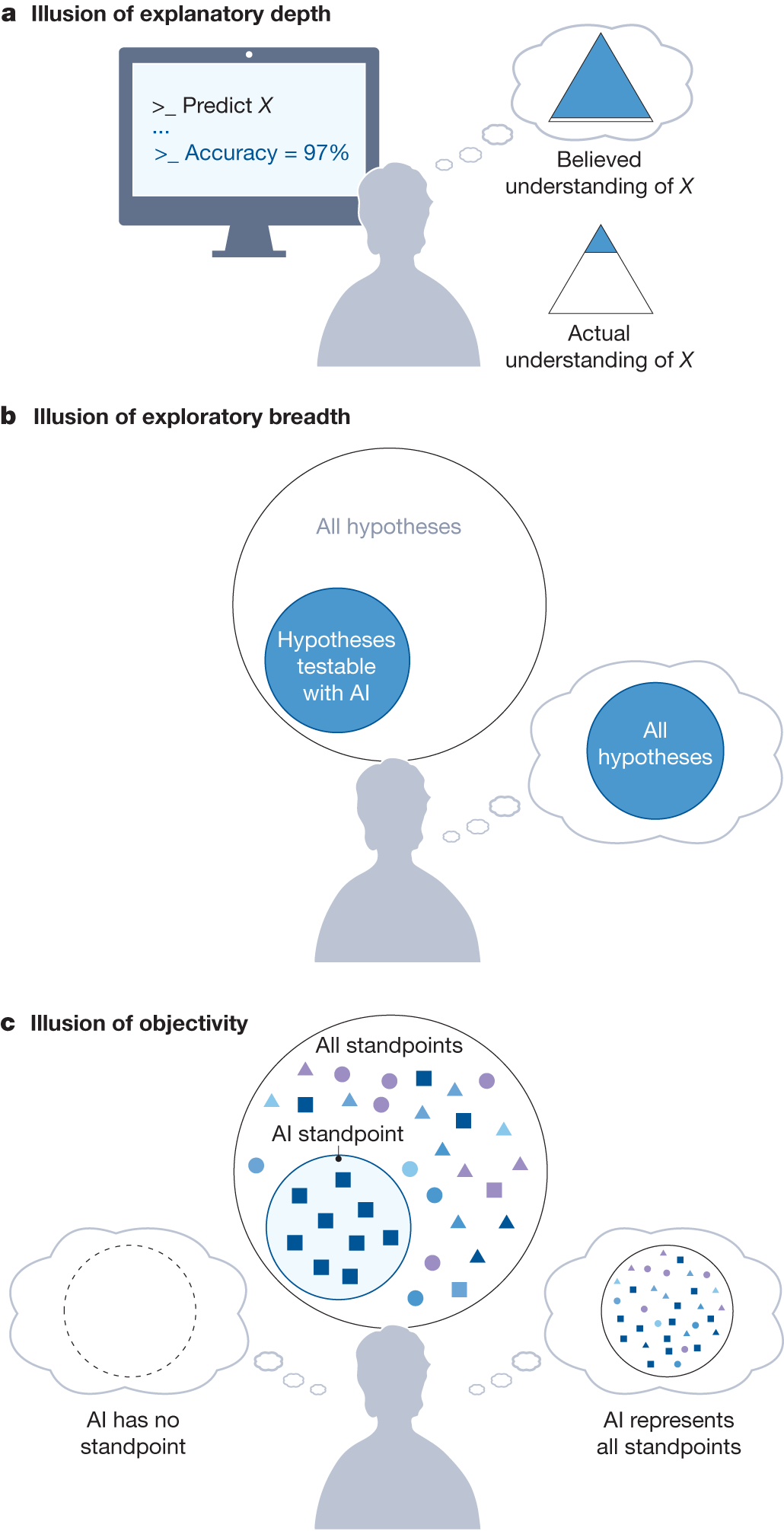
Artificial intelligence and illusions of understanding in scientific research
Scientists are enthusiastically imagining ways in which artificial intelligence (AI) tools might improve research. Why are AI tools so attractive and what are the risks of implementing them across the research pipeline? Here we develop a taxonomy of scientists’ visions for AI, observing that their appeal comes from promises to improve productivity and objectivity by overcoming human shortcomings. But proposed AI solutions can also exploit our cognitive limitations, making us vulnerable to illusions of understanding in which we believe we understand more about the world than we actually do. Such illusions obscure the scientific community’s ability to see the formation of scientific monocultures, in which some types of methods, questions and viewpoints come to dominate alternative approaches, making science less innovative and more vulnerable to errors. The proliferation of AI tools in science risks introducing a phase of scientific enquiry in which we produce more but understand less. By analysing the appeal of these tools, we provide a framework for advancing discussions of responsible knowledge production in the age of AI.
AI has supercharged scientists—but may have shrunk science
Analysis of 41 million papers finds that although AI expands individual impact, it narrows collective scientific exploration
AI Research Agents Narrow Scientific Exploration
AI research agents now support large-scale AI-assisted scientific discovery. We examine whether AI-generated ideas broaden scientific exploration or primarily reinforce existing work. Using five agent frameworks and five large language models, we generate 219,655 ideas for different scientific fields. Across experiments, four consistent patterns emerge. First, AI-generated ideas are more concentrated than human-authored papers within the same research area. Second, they remain much closer to starting literature than later human follow-on work does. Third, AI-generated ideas align less with future human research. Last, AI-generated ideas are located in lower-impact regions of the historical scientific landscape. Overall, current AI research agents appear better suited to local elaboration than to broadening scientific exploration.

No. 010: AutoScientists governance, AI-agent monoculture, nonsense-term retractions - The Hallway Track
The Hallway Track No. 010 - How AI is affecting the practice of science
Deep Research, information vs. insight, and the nature of science
What AI will accelerate in the scientific process, what it cannot do, and how we can prepare for new manners of scientific investigation.
AI as the Catalyst of the New Paradigm of Science? | Cadmus Journal
The rapid advancement of Artificial Intelligence (AI) is reshaping the landscape of scientific inquiry. This article examines the challenges confronting modern science, including knowledge fragmentation, diminishing returns of current paradigms, and the disconnect between science and society. It explores how AI offers solutions enhancing collaboration and integrating knowledge—as well as considers the possible “darker side” of using AI in research. However, the advent of AI in science not only enhances scientific research but also redefines the role of human researchers and fosters a new paradigm of human understanding. By embracing these transformations, a more cohesive and responsive scientific enterprise can emerge.
Artificial intelligence tools expand scientists’ impact but contract science’s focus
Developments in artificial intelligence (AI) have accelerated scientific discovery1. Alongside recent AI-oriented Nobel prizes2–9, these trends establish the role of AI tools in science10. This advancement raises questions about the influence of AI tools on scientists and science as a whole, and highlights a potential conflict between individual and collective benefits11. To evaluate these questions, we used a pretrained language model to identify AI-augmented research, with an F1-score of 0.875 in validation against expert-labelled data. Using a dataset of 41.3 million research papers across the natural sciences and covering distinct eras of AI, here we show an accelerated adoption of AI tools among scientists and consistent professional advantages associated with AI usage, but a collective narrowing of scientific focus. Scientists who engage in AI-augmented research publish 3.02 times more papers, receive 4.84 times more citations and become research project leaders 1.37 years earlier than those who do not. By contrast, AI adoption shrinks the collective volume of scientific topics studied by 4.63% and decreases scientists’ engagement with one another by 22%. By consequence, adoption of AI in science presents what seems to be a paradox: an expansion of individual scientists’ impact but a contraction in collective science’s reach, as AI-augmented work moves collectively towards areas richest in data. With reduced follow-on engagement, AI tools seem to automate established fields rather than explore new ones, highlighting a tension between personal advancement and collective scientific progress.

The Thoughts The Civilized Keep
The hype around a new AI language generator reveals the sterility of mainstream thinking on AI today — and indeed on how we think about thinking itself.

Konrad Hinsen's blog
The advent of AI agents based on large language models (LLMs) has put the idea of automating the intellectual and cognitive work of researchers on the table. A lively, sometimes even heated discussion is already going on. A frequently missing piece in this debate is the question why we, individually and as a society, actually do science. I will examine this question first, and then consider what it implies for introducing automation into science.
Newsweek is making generative AI a fixture in its newsroom
The legacy publication is leaning on AI for video production, a new breaking news team, and first drafts of some stories.

TrendLife Study Shows AI Is Moving Fast, but Consumers and Families are Being Left Behind
New study of over 10,000 consumers across 9 countries reveals worry exceeds excitement about generative AI as most lack the tools and confidence to use it safely TOKYO, May 6, 2026 /PRNewswire/ --...

Science that Compounds: The Need for A New Substrate for Research in the Age of AI
This paper is a perspective from Lightcone Research, an open-source initiative building tooling for scientific research in the age of agentic AI.
AI co-scientists are revolutionizing how research is done
Artificial-intelligence systems can generate hypotheses, design experiments and analyse data — but humans still need to decide what makes sense.
Will AI ruin the social sciences — or revolutionize them?
The technology can whip up spurious findings and pollute survey responses, but it could also make research more rigorous.