


Founded in 1920, the NBER is a private, non-profit, non-partisan organization dedicated to conducting economic research and to disseminating research findings among academics, public policy makers, and business professionals.
Algorithms As a Vehicle to Reflective Equilibrium: Behavioral Economics 2.0
Founded in 1920, the NBER is a private, non-profit, non-partisan organization dedicated to conducting economic research and to disseminating research findings among academics, public policy makers, and business professionals.
Climbing the Ivory Tower: How Socio-Economic Background Shapes Academia
Founded in 1920, the NBER is a private, non-profit, non-partisan organization dedicated to conducting economic research and to disseminating research findings among academics, public policy makers, and business professionals.
Writing Code vs. Shipping Code: Productivity Effects Across Generations of AI Coding Tools
Founded in 1920, the NBER is a private, non-profit, non-partisan organization dedicated to conducting economic research and to disseminating research findings among academics, public policy makers, and business professionals.
The Effects of Mandatory Profit-Sharing on Workers and Firms: Evidence from France
Founded in 1920, the NBER is a private, non-profit, non-partisan organization dedicated to conducting economic research and to disseminating research findings among academics, public policy makers, and business professionals.
The Impact of Unconditional Cash Transfers on Consumption and Household Balance Sheets: Experimental Evidence from Two US States
Founded in 1920, the NBER is a private, non-profit, non-partisan organization dedicated to conducting economic research and to disseminating research findings among academics, public policy makers, and business professionals.
Emergence: A unifying theme for 21st century science
By David Pines, Co-Founder in Residence, Santa Fe Institute

The Minimum Viable Scientific Record
The open science movement does not lack a shared vision. Decades of declarations, statements of principle, and calls to action have failed to put that vision into practice. This essay proposes a minimum viable scientific record (MVR) that would make the open science vision possible, and asks funders to make operating on it a condition of their money.

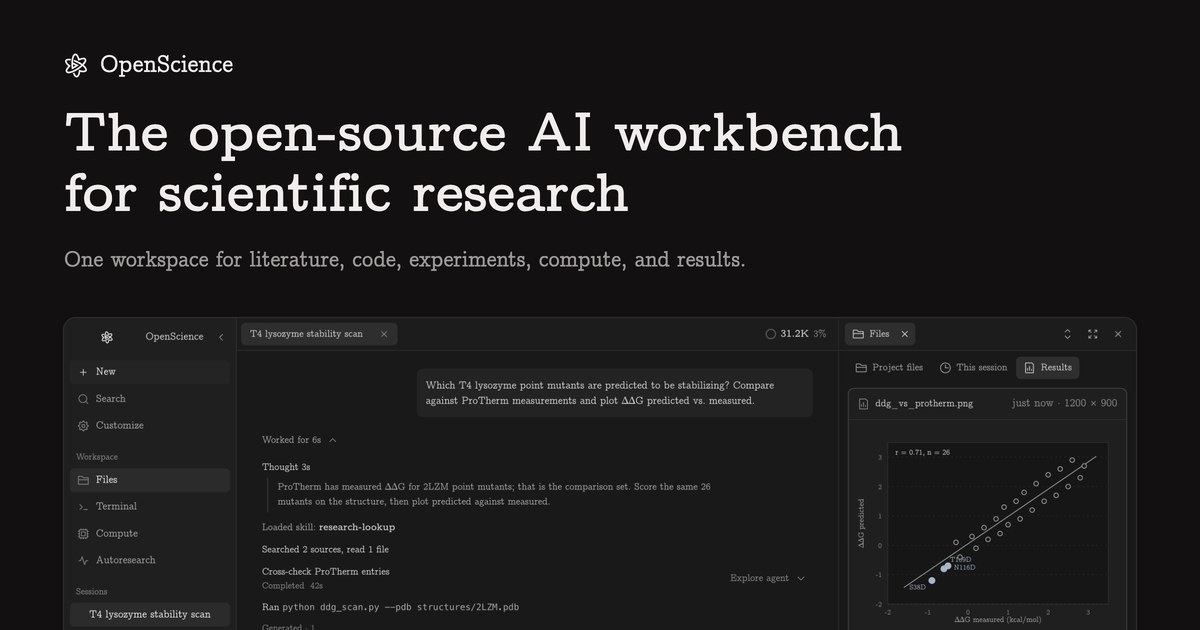
OpenScience | Open-source AI co-scientist for research
OpenScience is the open-source AI co-scientist. Free models included or connect any model from any provider, including Claude, GPT, Gemini and more.
AI Scientists as Engines of Discovery: A Case for Development within Reformed Institutions
Agentic artificial intelligence (AI) systems are beginning to assist, accelerate, and partially automate scientific discovery, performing tasks that span literature synthesis, code generation, data analysis, hypothesis proposal, and model criticism. We argue that this transition is qualitative rather than incremental, and that suitably designed multi-agent systems may evolve from passive computational tools into ``AI scientists'' that can expand the hypothesis-generating and verification capacity of science. Such systems must be developed and deployed within a scientific ecosystem fit for purpose: institutions must be redesigned for verification, accountability, interpretability, and dual-use safety. We sketch how multi-agent architectures, illustrated by the prototype framework \textit{Denario}, accelerate the discovery cycle and traverse model spaces beyond human reach; examine what this implies for authorship, peer review, and the enduring role of human scientists; and close with recommendations for governing AI as an epistemic actor rather than a mere instrument.

The Bazaar of Scientific Knowledge | shishyko!
Is the current form of the scientific paper still optimal in 2025? How do we preserve, and efficiently leverage, the uncut gems of the scientific process?
Reinventing Discovery: The New Era of Networked Science
In Reinventing Discovery, Michael Nielsen argues that w…

Building Collective Intelligence Networks for Flourishing Scientific Communities
Scientific communities are straining under mounting challenges—knowledge fragmentation, outdated publication processes, institutional erosion and funding cuts—that threaten our capacity to address urgent global problems. Traditional scientific process
Infinite Researchers | AI-Powered Scientific Discovery
What happens to the speed of discovery if we have infinite researchers? Explore AI experiments accelerating breakthroughs.

Governing the scholarly AI Commons – Open Future
New report explores how academic communities can shape AI governance in research and publishing, from regulation to community-led approaches.
If you're going to cite that NBER report from OpenAI about "how people use AI," you've got to at least caveat it. We have no way to directly verify most of the report, and we do have at least one good reason, via indirect evidence and quoted below, to not trust it. nber.org/papers/w34255

Maria Antoniak
Not the point of the OP, but I was curious and took a closer look at this 2025 piece from OpenAI. Much could be said, but it fails my go-to test for all of these pieces about "how people actually use AI": the tokens "sex" "erotic" and "NSFW" do not appear in the paper.
Science Nonprofit Leaders

People leading nonprofits involved in the science infrastructure/ecosystem/tool-building
We live in a golden age of biology. So why are people still dying from disease? Because discovery and development move slower than they should. Today, we’re partnering with Incyte to change… | Samuel G. Rodriques | 491 comments

Ronen Tamari
Travis Rich

Kirstie Whitaker
Kari Jordan, Ph.D.
Daniela Saderi