


Does automatic enrollment into retirement saving increase household debt? We study the randomized roll-out of automatic enrollment pensions to 160,000 employers in the United Kingdom with 2-29 employees. We find that the additional savings generated through automatic enrollment are partially offset by increases in unsecured debt. Over the first 41 months after enrollment, each additional month increases the average automatically enrolled employee’s pension savings by £33-£39, unsecured debt (such as personal loans and bank overdrafts) by £7, the likelihood of having a mortgage by 0.05 percentage points, and mortgage balances by £120. Automatic enrollment causes loan defaults to fall and credit scores to rise modestly.
Borrowing to Save? The Impact of Automatic Enrollment on Debt
ABSTRACT Does automatic enrollment into a retirement plan increase financial distress due to increased borrowing outside the plan? We study a natural experiment created when the U.S. Army began automatically enrolling newly hired civilian employees into the Thrift Savings Plan. Four years after hire, automatic enrollmentincreases cumulative contributions to the plan by 4.1% of annual salary, but we find little evidence ofincreased financial distress. Automatic enrollment causes no significant change in credit scores, debt balances excluding auto debt and first mortgages, or adverse credit outcomes, with the possible exception of increasedfirst‐mortgage balances in foreclosure.

Does the Fear of Debt Deter Students from Higher Education?
Concerns over the impact of debt on participation in higher education (HE) have dominated much of the debate surrounding the most recent reforms of financial support for full-time students in England, including the introduction of variable tuition fees. Yet few studies have attempted to explore this issue in a statistically robust manner. This article attempts to fill that gap. It examines the relationship between prospective HE students' attitudes to debt, and their decisions about whether or not to enter HE. Using data derived from a survey of just under 2,000 prospective students, it shows how those from low social classes are more debt averse than those from other social classes, and are far more likely to be deterred from going to university because of their fear of debt, even after controlling for a wide range of other factors. The article concludes that these findings pose a serious policy dilemma for the Westminster government. Their student funding policies are predicated on the accumulation of debt and thus are in danger of deterring the very students at the heart of their widening participation policies.
The Debt Payment Puzzle: An Experimental Investigation
Why do borrowing individuals fail to repay their debt optimally? We design a diagnostic laboratory experiment where we rule out selection into debt and other co

Household Debt: Facts, Puzzles, Theories, and Policies
Borrowing decisions affect most households, with large stakes and implications for research subfields as varied as macroeconomics and industrial organization. I review theoretical and empirical work on household debt: its prevalence, level, growth, and composition, as well as various measures of consumer choice and market (in)efficiency, elasticities, and prices, including new evidence on how borrowing heterogeneity affects the distribution of the opportunity cost of consumption. I also discuss opportunities and challenges in policy evaluation. A key takeaway is that puzzles abound, and I highlight numerous avenues for further research.

Exponential Growth Bias and Household Finance
ABSTRACT Exponential growth bias is the pervasive tendency to linearize exponential functions when assessing them intuitively. We show that exponential growth bias can explain two stylized facts in household finance: the tendency to underestimate an interest rate given other loan terms, and the tendency to underestimate a future value given other investment terms. Bias matters empirically: More‐biased households borrow more, save less, favor shorter maturities, and use and benefit more from financial advice, conditional on a rich set of household characteristics. There is little evidence that our measure of exponential growth bias merely proxies for broader financial sophistication.

Debt Traps? Market Vendors and Moneylender Debt in India and the Philippines
A debt trap occurs when someone takes on a high-interest-rate loan and is barely able to pay back the interest, and thus perpetually finds themselves in debt (often by refinancing). Studying such practices is important for understanding financial decision-making of households in dire circumstances, and also for setting appropriate consumer protection policies. We conduct a simple experiment in three sites in which we paid off high-interest moneylender debt of individuals. Most borrowers returned to debt within six weeks. One to two years after intervention, treatment individuals were borrowing at the same rate as control households.
Liquidity versus Wealth in Household Debt Obligations: Evidence from Housing Policy in the Great Recession
We exploit variation in mortgage modifications to disentangle the impact of reducing long-term obligations with no change in short-term payments ("wealth"), and reducing short-term payments with no change in long-term obligations ("liquidity"). Using regression discontinuity and difference-in-differences research designs with administrative data measuring default and consumption, we find that principal reductions that increase wealth without affecting liquidity have no effect, while maturity extensions that increase only liquidity have large effects. This suggests that liquidity drives default and consumption decisions for borrowers in our sample and that distressed debt restructurings can be redesigned with substantial gains to borrowers, lenders, and taxpayers.
Balancing Savings and Debt: Findings from an Online Experiment
Many consumers have savings and debt at the same time, and so are faced with a trade-off: how much debt to pay down versus how much savings to retain. This brie
The Coholding Puzzle: New Evidence from Transaction-Level Data
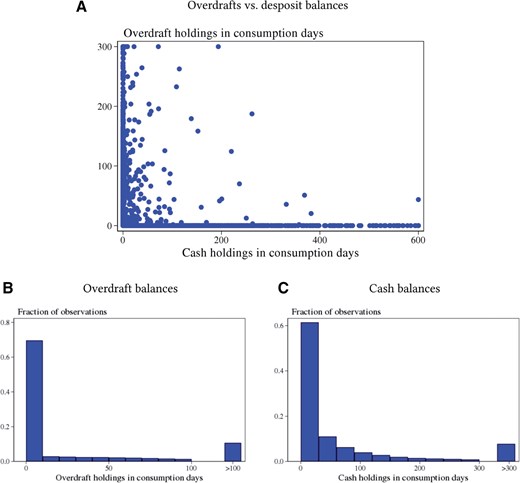
Abstract Why do individuals pay debt interest when they could use their savings to pay down the debt? We explore why individuals “cohold” debt and savings using detailed and highly disaggregated daily-level data on household finances. We find that coholding mostly occurs in short spells within the month and the level of coholding is typically modest. Periods of coholding are not associated with shocks at the individual level. We show that mental accounting has a role to play in explaining coholding, in particular how individuals allocate different categories of expenditure to accounts in credit and debit.
Can Self-Control Explain Avoiding Free Money? Evidence from Interest-Free Student Loans
Abstract This paper uses insights from behavioral economics to explain a particularly surprising borrowing phenomenon: one in six undergraduate students offered interest-free loans turns them down. Models of impulse control predict that students may optimally reject subsidized loans to avoid excessive consumption during school. Using the National Postsecondary Student Aid Study, we investigate students' take-up decisions and identify a group of students for whom the loans create an especially tempting liquidity increase. Students who would receive the loan in cash are significantly more likely to turn it down, suggesting that consumers choose to limit their liquidity in economically meaningful situations.
Does Saving Cause Borrowing? Implications for the Coholding Puzzle
ABSTRACT Using an experiment in which 3.1 million bank customers were encouraged to save, we explore the mechanisms behind coholding liquid savings and credit card debt. Theoretically, we show that the joint responses of spending, saving, and borrowing to the nudge differ across economic models of coholding. Using machine learning techniques, we find that the most responsive individuals reduce spending and increase savings by 4.9% (206 USD PPP per month) while their credit card debt remains unchanged. These individuals' marginal responses to the nudge are consistent with our model of coholding for the purpose of self‐ or partner‐control.

Credit Card Debt and Consumer Payment Choice: What Can We Learn from Credit Bureau Data?
We estimate a two-stage Heckman selection model of credit card adoption and use with a unique dataset that combines administrative data from the Equifax credit bureau and self-reported data from a representative survey of consumers. Higher-income consumers carry higher credit card balances, but they tend to repay those balances each month. Credit card revolvers have lower income and are less educated. Revolvers are twice as likely to use debit cards as credit cards for payments, but they carry much higher balances on their credit cards. The high cost of paying off credit card debt likely exacerbates existing inequalities in disposable income. Unlike the mortgage market, we find no evidence for lenders’ cutoff between subprime and prime consumers in the credit card market.
Household Finance
Household financial decisions are complex, interdependent, and heterogeneous, and central to the functioning of the financial system. We present an overview of the rapidly expanding literature on household finance (with some important exceptions) and suggest directions for future research. We begin with the theory and empirics of asset market participation and asset allocation over the life cycle. We then discuss household choices in insurance markets, trading behavior, decisions on retirement saving, and financial choices by retirees. We survey research on liabilities, including mortgage choice, refinancing, and default, and household behavior in unsecured credit markets, including credit cards and payday lending. We then connect the household to its social environment, including peer effects, cultural and hereditary factors, intra-household financial decision-making, financial literacy, cognition, and educational interventions. We also discuss literature on the provision and consumption of financial advice.
Do Nudges Reduce Borrowing and Consumer Confusion in the Credit Card Market?
We study nudges that turn out to have precise null effects in reducing long‐run credit card debt. We test nudges across two field experiments covering 183,441 UK cardholders. Our first experiment studies nudges added to monthly credit card statements. Our second experiment studies letters and email nudges (separate from monthly statements) sent to cardholders who signed up to automatically pay the minimum required payment. In a follow‐up survey to our second experiment, we find that 96% of respondents underestimate the time it would take to fully repay a debt if the cardholder made only the minimum required payment. The nudges reduce this confusion, but underestimation remains overwhelmingly common.

Revolving versus Convenience Use of Credit Cards: Evidence from U.S. Credit Bureau Data
Credit card payments and revolving debt are important for consumer theory but a key data source — credit bureau records — does not distinguish between current charges and revolving debt from the previous month. We develop a theory-based econometric methodology informed by survey evidence to estimate the likelihood a consumer is revolving each quarter. We validate our approach using a new survey linked to credit bureau data. For likely revolvers: (1) 100 percent of an increase in credit becomes an increase in debt eventually; (2) credit limit changes are half as salient as debt changes; and (3) revolving status is extremely persistent.
The Co-holding Puzzle: New Evidence from Transaction-Level Data
Using detailed and highly disaggregated data on household finances, we examine the<br>tendency of consumers to “co-hold” savings and debt simultaneously. The di