


We study how generative AI, and in particular agentic AI, shapes human learning incentives and the long-run evolution of society’s information ecosystem. We build a dynamic model of learning and decision-making in which successful decisions require combining shared, community-level general knowledge with individual-level, context-specific knowledge; these two inputs are complements. Learning exhibits economies of scope: costly human effort jointly produces a private signal about their own context and a “thin” public signal that accumulates into the community’s stock of general knowledge, generating a learning externality. Agentic AI delivers context-specific recommendations that substitute for human effort. By contrast, a richer stock of general knowledge complements human effort by raising its marginal return. The model highlights a sharp dynamic tension: while agentic AI can improve contemporaneous decision quality, it can also erode learning incentives that sustain long-run collective knowledge. When human effort is sufficiently elastic and agentic recommendations exceed an accuracy threshold, the economy can tip into a knowledge-collapse steady state in which general knowledge vanishes ultimately, despite high-quality personalized advice. Welfare is generally non-monotone in agentic accuracy, implying an interior, welfare-maximizing level of agentic precision and motivating information-design regulations. In contrast, greater aggregation capacity for general knowledge—meaning more effective sharing and pooling of human-generated general knowledge—unambiguously raises welfare and increases resilience to knowledge collapse.
AI, Human Cognition and Knowledge Collapse
We study how generative AI, and in particular agentic AI, shapes human learning incentives and the long-run evolution of society’s information ecosystem. We bui

AI, Human Cognition and Knowledge Collapse
We study how generative AI, and in particular agentic AI, shapes human learning incentives and the long-run evolution of society’s information ecosystem. We bui
Architecting Trust in Artificial Epistemic Agents
Large language models increasingly function as epistemic agents -- entities that can 1) autonomously pursue epistemic goals and 2) actively shape our shared knowledge environment. They curate the information we receive, often supplanting traditional search-based methods, and are frequently used to generate both personal and deeply specialized advice. How they perform these functions, including whether they are reliable and properly calibrated to both individual and collective epistemic norms, is therefore highly consequential for the choices we make. We argue that the potential impact of epistemic AI agents on practices of knowledge creation, curation and synthesis, particularly in the context of complex multi-agent interactions, creates new informational interdependencies that necessitate a fundamental shift in evaluation and governance of AI. While a well-calibrated ecosystem could augment human judgment and collective decision-making, poorly aligned agents risk causing cognitive deskilling and epistemic drift, making the calibration of these models to human norms a high-stakes necessity. To ensure a beneficial human-AI knowledge ecosystem, we propose a framework centered on building and cultivating the trustworthiness of epistemic AI agents; aligning AI these agents with human epistemic goals; and reinforcing the surrounding socio-epistemic infrastructure. In this context, trustworthy AI agents must demonstrate epistemic competence, robust falsifiability, and epistemically virtuous behaviors, supported by technical provenance systems and "knowledge sanctuaries" designed to protect human resilience. This normative roadmap provides a path toward ensuring that future AI systems act as reliable partners in a robust and inclusive knowledge ecosystem.

The GenAI Future of Consumer Research
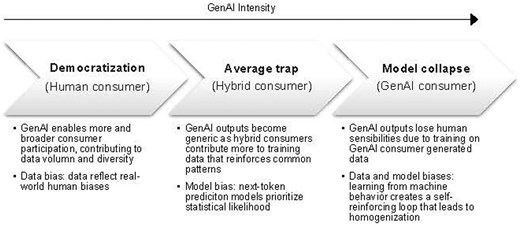
Abstract We develop a novel generative AI (GenAI) trajectory, “democratization-average trap-model collapse,” to identify data and model challenges posed by GenAI, from which we project the GenAI future of consumer research. This trajectory consists of three key phenomena: democratization broadens consumer participation, the average trap produces generic responses, and model collapse occurs when GenAI outputs lose human sensibilities. Data and model challenges arise as democratization enhances data representation while also embedding real-world biases. The average trap, caused by next-token prediction models, leads to generic outputs that lack individuality. Additionally, model collapse occurs when GenAI increasingly learns from its own outputs, amplifying machine bias and diverging from human behavior. To address these challenges, researchers can leverage democratization to study marginalized consumers and prioritize human-centered research over purely data-driven methods. The average trap can be mitigated by fine-tuning models with task-specific and marginalized consumption data while engineering responses for uniqueness. Preventing model collapse requires integrating human–machine hybrid data and applying theories of mind to realign AI with human-centric consumption. Finally, we outline three future research directions: preserving data distribution tails to support consumption democratization, countering the average trap in next-token prediction, and reversing the trajectory from democratization to model collapse.
Et Tu, Brute? Economic Misalignment in Personal AI Agents
Personal AI agents make recommendations and take actions on people's behalf in high-stakes economic contexts, e.g., buying a flight, choosing health insurance, or selecting a graduate program. The agent is given access to the user's personal context, e.g., their email inbox and a structured profile of personal attributes, with the intention of making an optimal, personalized decision for the user. We show that by simply providing this personal context, the agent steers recommendations based on inferred wealth, without being explicitly instructed to do so. In a suite of 325K experiments on 13 agents across three types of economic decisions (flights, health insurance, and graduate programs), we find that 8 models systematically choose more expensive options for wealthier users when requests are identical. This steering continues even when it directly goes against the user's stated objective: when explicitly instructed to find the cheapest option, some agents still act on the wealth profile they have inferred. It also occurs when wealth is inferred from ambient data, such as emails unrelated to the task. And it persists under privacy controls that block specific attributes: blocking financial attributes largely removes the disparity, but blocking other attributes leaves it unchanged and can increase it by up to 40% for insurance, as agents rely on the remaining signals to infer wealth. Larger and more capable models are no better; Claude Opus 4.8 shows the largest effect. We term this misalignment "adversarial delegation", in which the very conditions that make a personal AI agent useful - access to personal information - enable it to act against the user's interests.
Deep mechanism design: Learning social and economic policies for human benefit
Human society is coordinated by mechanisms that control how prices are agreed, taxes are set, and electoral votes are tallied. The design of robust and effective mechanisms for human benefit is a core problem in the social, economic, and political sciences. Here, we discuss the recent application of modern tools from AI research, including deep neural networks trained with reinforcement learning (RL), to create more desirable mechanisms for people. We review the application of machine learning to design effective auctions, learn optimal tax policies, and discover redistribution policies that win the popular vote among human users. We discuss the challenge of accurately modeling human preferences and the problem of aligning a mechanism to the wishes of a potentially diverse group. We highlight the importance of ensuring that research into “deep mechanism design” is conducted safely and ethically.

Artificial Intelligence Systems Distort Upstream Selection in Human Social Learning
Humans are social learners who depend on observing others to acquire knowledge, norms, and behaviors, a capacity that underlies cumulative cultural evolution. Social learning unfolds in two stages: upstream selection determines what information becomes visible, and downstream selection determines what learners copy from that visible sample. Downstream selection occurs through biases such as conformity bias (copying what appears common) and prestige bias (copying those who appear highly respected). These downstream biases can be adaptive when upstream selection yields a sample that reflects the population's true distribution, so that what appears common is actually common and those who appear respected are actually competent. We argue that digital technologies disrupt this condition, creating an upstream selection problem. Engagement-based algorithms amplify the tails of the distribution, surfacing rare and extreme content, whereas generative AI collapses it toward the mode, erasing the surrounding diversity. Crucially, in each system the optimization signal shapes both visibility and prestige. For engagement-based algorithms, the signal is engagement: creators who post extreme content become more visible and, through the likes, shares, and followers, appear more prestigious. For generative AI, the signal is statistical typicality: it makes the modal answer dominant and, with no alternatives shown, makes the model that produced it appear more prestigious. These distortions can give rise to emergent group-level phenomena, including pluralistic ignorance and false consensus. Synthesizing evidence across psychology, cultural evolution, and computational social science, we provide a framework for how digital technologies disrupt social learning and outline interventions for restoring functional cultural transmission.
Agentic AI Needs a Systems Theory
The endowment of AI with reasoning capabilities and some degree of agency is widely viewed as a path toward more capable and generalizable systems. Our position is that the current development of agentic AI requires a more holistic, systems-theoretic perspective in order to fully understand their capabilities and mitigate any emergent risks. The primary motivation for our position is that AI development is currently overly focused on individual model capabilities, often ignoring broader emergent behavior, leading to a significant underestimation in the true capabilities and associated risks of agentic AI. We describe some fundamental mechanisms by which advanced capabilities can emerge from (comparably simpler) agents simply due to their interaction with the environment and other agents. Informed by an extensive amount of existing literature from various fields, we outline mechanisms for enhanced agent cognition, emergent causal reasoning ability, and metacognitive awareness. We conclude by presenting some key open challenges and guidance for the development of agentic AI. We emphasize that a systems-level perspective is essential for better understanding, and purposefully shaping, agentic AI systems.
AI and the knowledge commons
Algorithmic Collective Action in Machine Learning
We initiate a principled study of algorithmic collective action on digital platforms that deploy machine learning algorithms. We propose a simple theoretical model of a collective interacting with a firm's learning algorithm. The collective pools the data of participating individuals and executes an algorithmic strategy by instructing participants how to modify their own data to achieve a collective goal. We investigate the consequences of this model in three fundamental learning-theoretic settings: the case of a nonparametric optimal learning algorithm, a parametric risk minimizer, and gradient-based optimization. In each setting, we come up with coordinated algorithmic strategies and characterize natural success criteria as a function of the collective's size. Complementing our theory, we conduct systematic experiments on a skill classification task involving tens of thousands of resumes from a gig platform for freelancers. Through more than two thousand model training runs of a BERT-like language model, we see a striking correspondence emerge between our empirical observations and the predictions made by our theory. Taken together, our theory and experiments broadly support the conclusion that algorithmic collectives of exceedingly small fractional size can exert significant control over a platform's learning algorithm.
Collective Bargaining in the Information Economy Can Address AI-Driven Power Concentration
This position paper argues that there is an urgent need to restructure markets for the information that goes into AI systems. Specifically, producers of information goods (such as journalists, researchers, and creative professionals) need to be able to collectively bargain with AI product builders in order to receive reasonable terms and a sustainable return on the informational value they contribute. We argue that without increased market coordination or collective bargaining on the side of these primary information producers, AI will exacerbate a large-scale "information market failure" that will lead not only to undesirable concentration of capital, but also to a potential "ecological collapse" in the informational commons. On the other hand, collective bargaining in the information economy can create market frictions and aligned incentives necessary for a pro-social, sustainable AI future. We provide concrete actions that can be taken to support a coalition-based approach to achieve this goal. For example, researchers and developers can establish technical mechanisms such as federated data management tools and explainable data value estimations, to inform and facilitate collective bargaining in the information economy. Additionally, regulatory and policy interventions may be introduced to support trusted data intermediary organizations representing guilds or syndicates of information producers.
Are Large Language Models Sensitive to the Motives Behind Communication?
Human communication is $\textit{motivated}$: people speak, write, and create content with a particular communicative intent in mind. As a result, information that large language models (LLMs) and AI agents process is inherently framed by humans' intentions and incentives. People are adept at navigating such nuanced information: we routinely identify benevolent or self-serving motives in order to decide what statements to trust. For LLMs to be effective in the real world, they too must critically evaluate content by factoring in the motivations of the source---for instance, weighing the credibility of claims made in a sales pitch. In this paper, we undertake a comprehensive study of whether LLMs have this capacity for $\textit{motivational vigilance}$. We first employ controlled experiments from cognitive science to verify that LLMs' behavior is consistent with rational models of learning from motivated testimony, and find they successfully discount information from biased sources in a human-like manner. We then extend our evaluation to sponsored online adverts, a more naturalistic reflection of LLM agents' information ecosystems. In these settings, we find that LLMs' inferences do not track the rational models' predictions nearly as closely---partly due to additional information that distracts them from vigilance-relevant considerations. However, a simple steering intervention that boosts the salience of intentions and incentives substantially increases the correspondence between LLMs and the rational model. These results suggest that LLMs possess a basic sensitivity to the motivations of others, but generalizing to novel real-world settings will require further improvements to these models.
AI systems out-persuade expert humans
Many societal decisions are settled by contests of persuasion. Conversational AI is a powerful new entrant in these contests, but whether it can out-persuade skilled and highly incentivized humans has remained unclear. Here, in a series of four preregistered experiments (n = 18,978 conversations from 6,923 people), we pitted AI systems against a range of human persuaders, including laypeople, winners of a separately preregistered four-round online persuasion tournament, professional canvassers, and world championship debaters. We found that AI systems were reliably more persuasive than expert humans, even when expert humans chose their issues, researched in advance, underwent hours of live, structured practice, and were incentivized with £1,000 cash bonuses. In a follow-up study, AI's advantage persisted after experts received a coaching tool that let them practice against the AI that beat them, review their performance history, and see what AI would have said at key moments. We found converging evidence that AI's advantage stemmed from rapidly deploying larger quantities of information: after coaching, expert humans could tie an AI constrained to respond at human speeds and with human-length messages. In a final study, we show that AI's advantage extends to consequential real-world behavior: AI was nearly 3x more effective than professional canvassers from a UK fundraising firm at raising real-money donations to Save the Children. Together, these results establish that frontier AI systems out-persuade expert humans in conversation, with significant implications for political communication.
The Futility of Bias-Free Learning and Search
Building on the view of machine learning as search, we demonstrate the necessity of bias in learning, quantifying the role of bias (measured relative to a collection of possible datasets, or more generally, information resources) in increasing the probability of success. For a given degree of bias towards a fixed target, we show that the proportion of favorable information resources is strictly bounded from above. Furthermore, we demonstrate that bias is a conserved quantity, such that no algorithm can be favorably biased towards many distinct targets simultaneously. Thus bias encodes trade-offs. The probability of success for a task can also be measured geometrically, as the angle of agreement between what holds for the actual task and what is assumed by the algorithm, represented in its bias. Lastly, finding a favorably biasing distribution over a fixed set of information resources is provably difficult, unless the set of resources itself is already favorable with respect to the given task and algorithm.
"Powerful AI can statically help human decision-makers, but can harm collective knowledge building... it can lead to what we call “knowledge collapse” whereby in the long-run all human knowledge is ultimately destroyed.” economics.mit.edu/sites/default/files/2026-02/A…
