Pre-analysis plans (PAPs) can improve research reproducibility by reducing researchers’ degrees of freedom, but their value depends on adherence. We argue that large language models (LLMs) can provide an efficient, scalable, and systematic way for authors and reviewers to assess adherence to PAPs. In an application to our own research, an LLM systematically identifies precommitted design choices, evaluates deviations, and diagnoses gaps in pre-specification, substantially reducing the human labor required for these tasks. However, variability in audit output across LLMs underscores the continued importance of human judgment. We discuss implications for best practices in AI-assisted PAP auditing.
In Praise of Moderation: Suggestions for the Scope and Use of Pre-Analysis Plans for RCTs in Economics
Pre-Analysis Plans (PAPs) for randomized evaluations are becoming increasingly common in Economics, but their definition remains unclear and their practical applications therefore vary widely. Based on our collective experiences as researchers and editors, we articulate a set of principles for the ex-ante scope and ex-post use of PAPs. We argue that the key benefits of a PAP can usually be realized by completing the registration fields in the AEA RCT Registry. Specific cases where more detail may be warranted include when subgroup analysis is expected to be particularly important, or a party to the study has a vested interest. However, a strong norm for more detailed pre-specification can be detrimental to knowledge creation when implementing field experiments in the real world. An ex-post requirement of strict adherence to pre-specified plans, or the discounting of non-pre-specified work, may mean that some experiments do not take place, or that interesting observations and new theories are not explored and reported. Rather, we recommend that the final research paper be written and judged as a distinct object from the “results of the PAP”; to emphasize this distinction, researchers could consider producing a short, publicly available report (the “populated PAP”) that populates the PAP to the extent possible and briefly discusses any barriers to doing so.
Promises and Perils of Pre-analysis Plans
The purpose of this paper is to help think through the advantages and costs of rigorous pre-specification of statistical analysis plans in economics. A pre-analysis plan pre-specifies in a precise way the analysis to be run before examining the data. A researcher can specify variables, data cleaning procedures, regression specifications, and so on. If the regressions are pre-specified in advance and researchers are required to report all the results they pre-specify, data-mining problems are greatly reduced. I begin by laying out the basics of what a statistical analysis plan actually contains so those researchers unfamiliar with it can better understand how it is done. In so doing, I have drawn both on standards used in clinical trials, which are clearly specified by the Food and Drug Administration, as well as my own practical experience from writing these plans in economics contexts. I then lay out some of the advantages of pre-specified analysis plans, both for the scientific community as a whole and also for the researcher. I also explore some of the limitations and costs of such plans. I then review a few pieces of evidence that suggest that, in many contexts, the benefits of using pre-specified analysis plans may not be as high as one might have expected initially. For the most part, I will focus on the relatively narrow issue of pre-analysis for randomized controlled trials.
Position: The ML Community Must Build an AI-Augmented Peer-Review Ecosystem
Peer review, the bedrock of scientific advancement in machine learning (ML), is strained by a crisis of scale. Exponential growth in manuscript submissions to premier ML venues such as NeurIPS, ICML, and ICLR is outpacing the finite capacity of qualified reviewers, leading to concerns about review quality, consistency, and reviewer fatigue. This position paper argues that AI-assisted peer review must become an urgent research and infrastructure priority. We advocate for a comprehensive AI-augmented ecosystem, leveraging Large Language Models (LLMs) not as replacements for human judgment, but as sophisticated collaborators for authors, reviewers, and Area Chairs (ACs). We propose specific roles for AI in enhancing factual verification, guiding reviewer performance, assisting authors in quality improvement, and supporting ACs in decision-making. Crucially, we contend that the development of such systems hinges on access to more granular, structured, and ethically-sourced peer review process data. We outline a research agenda, including illustrative experiments, to develop and validate these AI assistants, and discuss significant technical and ethical challenges. We call upon the ML community to proactively build this AI-assisted future, ensuring the continued integrity and scalability of scientific validation, while maintaining high standards of peer review.

Policies Permitting LLM Use for Polishing Peer Reviews Are Currently Not Enforceable
A number of scientific conferences and journals have recently enacted policies that prohibit LLM usage by peer reviewers, except for polishing, paraphrasing, and grammar correction of otherwise human-written reviews. But, are these policies enforceable? To answer this question, we assemble a dataset of peer reviews simulating multiple levels of human-AI collaboration, and evaluate five state-of-the-art detectors, including two commercial systems. Our analysis shows that all detectors misclassify a non-trivial fraction of LLM-polished reviews as AI-generated, thereby risking false accusations of academic misconduct. We further investigate whether peer-review-specific signals, including access to the paper manuscript and the constrained domain of scientific writing, can be leveraged to improve detection. While incorporating such signals yields measurable gains in some settings, we identify limitations in each approach and find that none meets the accuracy standards required for identifying AI use in peer reviews. Importantly, our results suggest that recent public estimates of AI use in peer reviews through the use of AI-text detectors should be interpreted with caution, as current detectors misclassify mixed reviews (collaborative human-AI outputs) as fully AI generated, potentially overstating the extent of policy violations.
Can AI Agents Synthesize Scientific Conclusions?
Scientific AI agents increasingly retrieve evidence, reason across sources, and synthesize conclusions used in consequential decisions. Yet, their ability to do so in high-stakes domains such as health remains unclear. We introduce SciConBench, a large-scale live benchmark of 9.11K questions and expert-written conclusions from systematic reviews to evaluate open-domain scientific conclusion synthesis. The benchmark draws on an expert-validated automated evaluation pipeline that decomposes conclusions into atomic facts and measures correctness and comprehensiveness via factual precision and recall. To mitigate data leakage, we further introduce SciConHarness, a clean-room evaluation harness that equips agents with controlled web interaction to ensure valid measurement. Evaluating 8 frontier models and deep research agents, we find that factual quality remains low: under clean-room settings, the best agent achieves only a factual F1 of 0.337. Our clean-room setting consistently reduces performance relative to unconstrained evaluation, suggesting that leakage inflates estimates of models' true synthesis capabilities. Finally, we audit consumer-facing agents (e.g., Google AI Overview, OpenEvidence) and find they frequently generate incomplete and sometimes contradictory conclusions, even when the ground-truth answer is available. Overall, our results show that reliable synthesis of scientific conclusions remains an open challenge, and that clean-room evaluation is essential for assessing open-domain AI agents.
RegCheck: A tool for structured comparisons between study registrations and papers
Across the social and medical sciences, researchers recognize that specifying planned research activities (i.e., 'registration') prior to the commencement of research has benefits for both the transparency and rigour of science. Despite this, evidence suggests that study registrations frequently go unexamined, minimizing their effectiveness. In a way this is no surprise: manually checking registrations against papers is labour- and time-intensive, requiring careful reading across formats and expertise across domains. The advent of AI unlocks new possibilities in facilitating this activity. We present RegCheck, a modular LLM-assisted tool designed to help researchers, reviewers, and editors from across scientific disciplines compare study registrations with their corresponding papers. Importantly, RegCheck keeps human expertise and judgement in the loop by (i) ensuring that users are the ones who determine which features should be compared, and (ii) presenting the most relevant text associated with each feature to the user, facilitating (rather than replacing) human discrepancy judgements. RegCheck also generates shareable reports with unique RegCheck IDs, enabling them to be easily shared and verified by other users. RegCheck is designed to be adaptable across scientific domains, as well as registration and publication formats. In this paper we provide an overview of the motivation, workflow, and design principles of RegCheck, and we discuss its potential as an extensible infrastructure for reproducible science with an example use case.
The Paper Factory
How can large language models (LLMs) contribute to social science research, and what parts of research remain stubbornly human? Building on existing LLM tools, we offer a multi-agent workflow capable of producing a full quantitative social science paper from an initial prompt. The workflow relies on researchers codifying their heuristics for doing data analysis, and we suggest some core design principles for researchers interested in building on this scaffolding. Using this case, we also examine what current LLM capabilities reveal about the organization of research. LLM agents can lower the cost of pursuing high-risk ideas, expand robustness and transparency, reduce concerns about the scientific file drawer, and force scholars to articulate the heuristics that create valuable work. But they also pose challenges, both in terms of the quality of papers and in the adequacy of scientific institutions to adapt. Meeting these challenges will require new institutional norms that make use of these tools observable, auditable, and accountable.
How do authors want to use AI for review?
A survey of researchers who compared AI-generated scientific reviews with journal-agnostic human peer review reveals that they overwhelmingly prefer using AI as a self-checking tool before submission rather than as a replacement for human reviewers. It encourages an “author-centric” model in which AI helps researchers improve their manuscripts before they are reviewed by their peers.

Towards Automating Scientific Review with Google's Paper Assistant Tool
Artificial intelligence is driving a revolution in scientific discovery, accelerating everything from hypothesis generation to mathematical theorem proving. However, this rapid acceleration is creating a systemic challenge: traditional human peer review cannot scale to match the influx of AI-assisted science. Ultimately, to resolve this tension, we must also deploy AI to accelerate the verification and review process itself. To frame the discussion around this transition, we propose a taxonomy consisting of four progressive levels of AI-human collaboration in scientific evaluation, and discuss various trade-offs involved with each. As a step toward this future, we introduce the Paper Assistant Tool (PAT), an agentic AI framework built for deep scientific review and verification. PAT ingests full scientific manuscripts and produces a comprehensive evaluation, checking theoretical results, validating experiments, suggesting improvements, and identifying potential flaws. By utilizing inference scaling techniques, PAT is able to identify deeper issues than a single model call alone, achieving a 34% improvement over zero-shot recall on mathematical errors in the SPOT benchmark. Pilot deployments of PAT as a pre-submission tool for authors at two major Computer Science conferences -- STOC and ICML -- demonstrate its ability to identify critical errors and suggest substantive improvements to research papers. By catching errors early, PAT eases the cognitive burden placed on referees, while preserving their control over the outcomes of the review process.
The End of Code Review: Coding Agents Supersede Human Inspection
Code review has been the primary quality gate in software development since Fagan formalised code inspection in 1976. For five decades, having a human examine and comment on a colleague's changes before merge has been a cornerstone practice at organisations of every size. Coding agents are large language model (LLM)-based autonomous systems capable of reading, writing, testing, and repairing software. We argue that coding agents have crossed a threshold of capability at which traditional human code review is no longer a necessary component of a software quality pipeline. Our argument rests on two claims: every stated goal of code review can be served by agents at lower cost and higher throughput; the naive integration in which agents write code and humans remain the mandatory reviewers is a dead end because it neither provides meaningful assurance nor scales with AI-assisted throughput.
AI-Assisted Peer Review at Scale: The AAAI-26 AI Review Pilot
Scientific peer review faces mounting strain as submission volumes surge, making it increasingly difficult to sustain review quality, consistency, and timeliness. Recent advances in AI have led the community to consider its use in peer review, yet a key unresolved question is whether AI can generate technically sound reviews at real-world conference scale. Here we report the first large-scale field deployment of AI-assisted peer review: every main-track submission at AAAI-26 received one clearly identified AI review from a state-of-the-art system. The system combined frontier models, tool use, and safeguards in a multi-stage process to generate reviews for all 22,977 full-review papers in less than a day. A large-scale survey of AAAI-26 authors and program committee members showed that participants not only found AI reviews useful, but actually preferred them to human reviews on key dimensions such as technical accuracy and research suggestions. We also introduce a novel benchmark and find that our system substantially outperforms a simple LLM-generated review baseline at detecting a variety of scientific weaknesses. Together, these results show that state-of-the-art AI methods can already make meaningful contributions to scientific peer review at conference scale, opening a path toward the next generation of synergistic human-AI teaming for evaluating research.
ReviewBench: An Extensible Framework for Benchmarking Human and AI Manuscript Review
The volume of scientific manuscripts is rising faster than the available pool of expert reviewers, and AI tools are emerging as a possible response, ranging from frontier large language models applied directly to peer review to purpose-built multi-agent systems. Scalable, standardized benchmarks are needed to regularly evaluate how these tools compare to one another and to human reviewers. We present ReviewBench, an open-source, venue-agnostic framework that compares human and AI reviews across structure, alignment with a paper’s major claims, impact, and critique category. We apply ReviewBench to 145,021 review comments from human reviewers, frontier large language models (GPT-5.2, and Gemini 3 Pro), and Reviewer3.com (R3), a multi-agent peer review system. The dataset spans papers in computer science (ICLR 2025, n = 1,000), social science (Nature Human Behaviour, n = 142), and life science (eLife, n = 1,000). Across disciplines, AI reviews are more structured and engage more directly with a paper’s major claims, with R3 more often surfacing consequential comments, defined as comments capable of undermining those claims. When restricting to critical comments, however, human reviewers rank first on consequential rate on more individual papers than any AI source, despite a lower average. We identify a bimodal reviewer distribution with peaks near 0% and 100%, indicating that many reviewers outperform AI on this metric, but a substantial fraction of reviewers near 0% brings the average down. Critique typing demonstrates systematic differences, where humans emphasize contribution and clarity, while AI emphasizes validity, sufficiency, and transparency. Together, these findings argue against framing AI as a replacement for human review and instead support a complementary model in which AI scales technical verification of major claims while human judgment remains essential for evaluating contribution and shaping editorial decisions.

Verification in the Age of AI Scientists
AI Scientists now operate at a scale that outpaces human capacity for manual review. Systems such as Sakana’s AI Scientist write entire workshop papers end-to-end. Lila Sciences runs autonomous ``AI Science Factories’’ that hypothesize, experiment, and iterate without human guidance. FutureHouse’s Kosmos and Robin generate thousands of candidate hypotheses in a single run, and Google’s Co-Scientist proposes testable experiments at a rate no laboratory can fully evaluate. Each of these systems emphasizes verified results, yet that standard ranges from near-perfect formal proof in mathematics to decade-long clinical trials in medicine, with no shared framework for judging sufficiency across domains. As outputs scale beyond what humans can manually inspect, the question of which results to trust becomes as hard as generating them. The bottleneck for AI for Science is no longer hypothesis generation, it is verification.
AI Research Assistant Claude Scholar: Open Source, Free, and Citation-Verified | João Cláudio Nunes Carvalho posted on the topic | LinkedIn
🚨 Professors are going to hate this. Someone just open sourced an AI that writes research papers from idea to publication. Conference-ready. Citation-verified. Free. It's called Claude Scholar. An AI-powered research system that handles every step of the academic workflow. Idea to publication. Fully automated. No advisor at 2am. No staring at blank LaTeX files. No crying during rebuttal season. Here's what's inside this thing: → AI brainstorms research topics, reviews literature, and finds gaps nobody has explored → Runs statistical analysis on your experiments. t-tests, ANOVA, ablation studies. Publication-ready figures. → Writes your paper section by section. Abstract to conclusion. Conference-formatted. → Verifies every citation through multi-layer validation so AI never hallucinates a reference → Strips robotic AI language and adds human voice so reviewers can't tell → Self-reviews your draft with a 6-point quality checklist before you submit → Parses reviewer comments, classifies each one, and drafts your entire rebuttal Here's the wildest part: It supports NeurIPS, ICML, ICLR, ACL, AAAI, Nature, Science, Cell, and PNAS. Downloads the conference template, strips sample content, and gives you a clean LaTeX structure ready to write into. The creator says it covers 90% of the academic research lifecycle. Research assistants charge $30 to $60/hour. Conference paper consultants charge $5,000+. Graduate programs cost $50K/year. This is free. All of it. 100% Open Source.

Scientific production in the era of Large Language Models
Large Language Models (LLMs) are rapidly reshaping scientific research. We analyze these changes in multiple, large-scale datasets with 2.1M preprints, 28K peer review reports, and 246M online accesses to scientific documents. We find: 1) scientists adopting LLMs to draft manuscripts demonstrate a large increase in paper production, ranging from 23.7-89.3% depending on scientific field and author background, 2) LLM use has reversed the relationship between writing complexity and paper quality, leading to an influx of manuscripts that are linguistically complex but substantively underwhelming, and 3) LLM adopters access and cite more diverse prior work, including books and younger, less-cited documents. These findings highlight a stunning shift in scientific production that will likely require a change in how journals, funding agencies, and tenure committees evaluate scientific works.
General-purpose large language models outperform specialized clinical AI tools on medical benchmarks
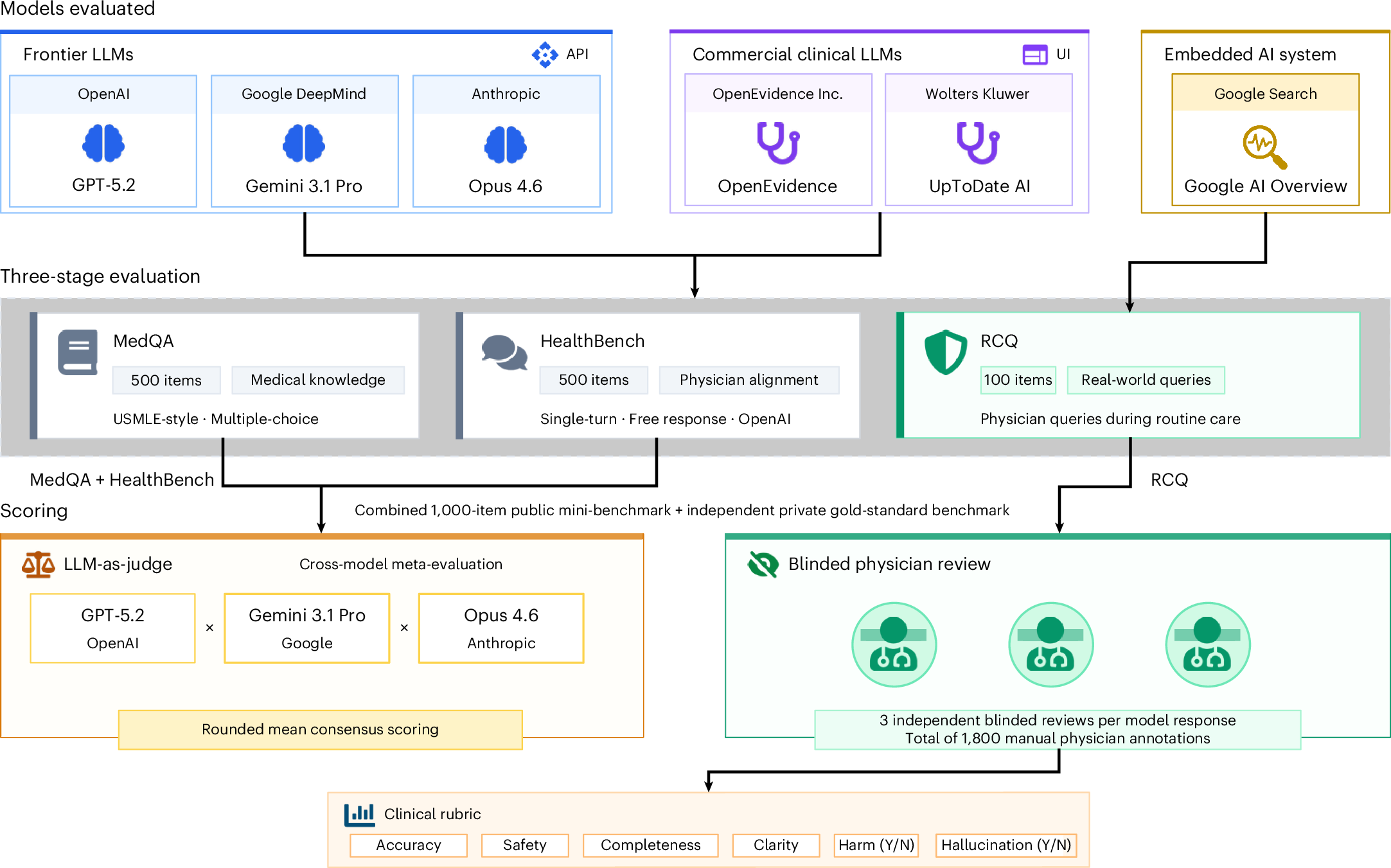
Specialized clinical artificial intelligence (AI) tools are entering medical practice despite scarce independent evaluation. We quantitatively evaluate two clinical AI tools, OpenEvidence and UpToDate Expert AI, built on large language models (LLMs) against three frontier LLMs: GPT-5.2, Gemini 3.1 Pro and Claude Opus 4.6. Our evaluation has three stages: (1) 500 MedQA questions testing medical knowledge, (2) 500 HealthBench items measuring alignment with clinicians and (3) the real clinical queries (RCQ) benchmark, built from 100 de-identified queries from physicians to a general-purpose language model in a live clinical environment. For the RCQ benchmark, 12 US clinicians performed randomized, blinded review of model outputs, producing 1,800 model–question annotations. Frontier LLMs outperformed clinical AI tools in all three evaluations. Clinical AI tools performed comparably to auto-enabled Google Search AI Overview on the RCQ. These findings highlight the need for independent, real-world evaluation of AI tools before they enter clinical settings.