Reusing filtering facepiece respirators (FFRs) has been suggested as a strategy to conserve available supplies for home and healthcare environments during an influenza pandemic. For reuse to be possible, used FFRs must be decontaminated before redonning to reduce the risk of virus transmission; however, there are no approved methods for FFR decontamination. An effective method must reduce the microbial threat, maintain the function of the FFR, and present no residual chemical hazard. The method should be readily available, inexpensive and easily implemented by healthcare workers and the general public. Many of the general decontamination protocols used in healthcare and home settings are unable to address all of the desired qualities of an efficient FFR decontamination protocol. The goal of this study is to evaluate the use of two commercially available steam bags, marketed to the public for disinfecting infant feeding equipment, for FFR decontamination. The FFRs were decontaminated with microwave generated steam following the manufacturers' instructions then evaluated for water absorption and filtration efficiency for up to three steam exposures. Water absorption of the FFR was found to be model specific as FFRs constructed with hydrophilic materials absorbed more water. The steam had little effect on FFR performance as filtration efficiency of the treated FFRs remained above 95%. The decontamination efficacy of the steam bag was assessed using bacteriophage MS2 as a surrogate for a pathogenic virus. The tested steam bags were found to be 99.9% effective for inactivating MS2 on FFRs; however, more research is required to determine the effectiveness against respiratory pathogens.
Masks and respirators for prevention of respiratory infections: a state of the science review
SUMMARY This narrative review and meta-analysis summarizes a broad evidence base on the benefits—and also the practicalities, disbenefits, harms and personal, sociocultural and environmental impacts—of masks and masking. Our synthesis of evidence from over 100 published reviews and selected primary studies, including re-analyzing contested meta-analyses of key clinical trials, produced seven key findings. First, there is strong and consistent evidence for airborne transmission of severe acute respiratory syndrome coronavirus 2 (SARS-CoV-2) and other respiratory pathogens. Second, masks are, if correctly and consistently worn, effective in reducing transmission of respiratory diseases and show a dose-response effect. Third, respirators are significantly more effective than medical or cloth masks. Fourth, mask mandates are, overall, effective in reducing community transmission of respiratory pathogens. Fifth, masks are important sociocultural symbols; non-adherence to masking is sometimes linked to political and ideological beliefs and to widely circulated mis- or disinformation. Sixth, while there is much evidence that masks are not generally harmful to the general population, masking may be relatively contraindicated in individuals with certain medical conditions, who may require exemption. Furthermore, certain groups (notably D/deaf people) are disadvantaged when others are masked. Finally, there are risks to the environment from single-use masks and respirators. We propose an agenda for future research, including improved characterization of the situations in which masking should be recommended or mandated; attention to comfort and acceptability; generalized and disability-focused communication support in settings where masks are worn; and development and testing of novel materials and designs for improved filtration, breathability, and environmental impact.
Airport air sampling captures COVID, influenza viruses
Researchers say air monitoring complements wastewater testing in detecting respiratory pathogens from diverse populations, including asymptomatic or pre-symptomatic people.

Low-cost measurement of face mask efficacy for filtering expelled droplets during speech
A simple method was developed for evaluating the efficacy of face masks to reduce respiratory droplet emission during speaking. , Mandates for mask use in public during the recent coronavirus disease 2019 (COVID-19) pandemic, worsened by global shortage of commercial supplies, have led to widespread use of homemade masks and mask alternatives. It is assumed that wearing such masks reduces the likelihood for an infected person to spread the disease, but many of these mask designs have not been tested in practice. We have demonstrated a simple optical measurement method to evaluate the efficacy of masks to reduce the transmission of respiratory droplets during regular speech. In proof-of-principle studies, we compared a variety of commonly available mask types and observed that some mask types approach the performance of standard surgical masks, while some mask alternatives, such as neck gaiters or bandanas, offer very little protection. Our measurement setup is inexpensive and can be built and operated by nonexperts, allowing for rapid evaluation of mask performance during speech, sneezing, or coughing.
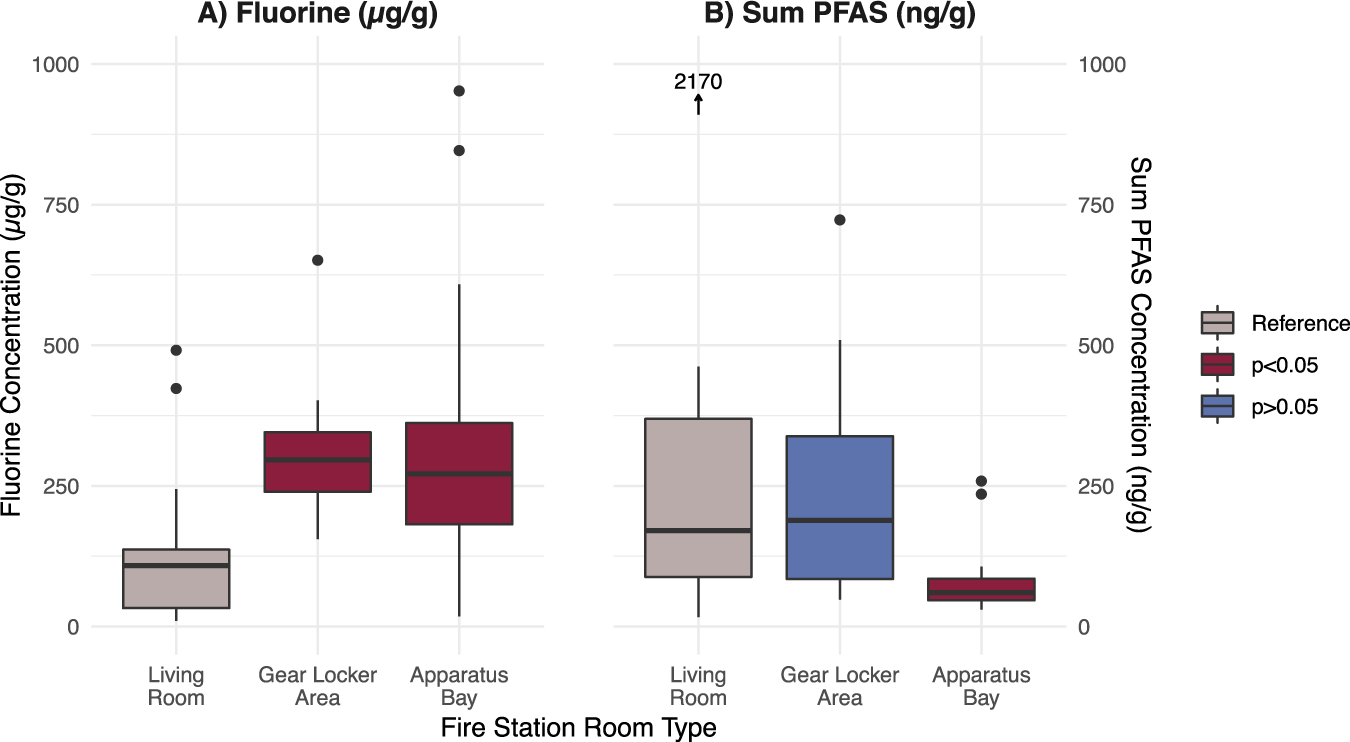
Per- and polyfluoroalkyl substances (PFAS) and total fluorine in fire station dust
Per- and polyfluoroalkyl substances (PFAS) are a class of over 4700 fluorinated compounds used in industry and consumer products. Studies have highlighted the use of aqueous film-forming foams (AFFFs) as an exposure source for firefighters, but little is known about PFAS occurrence inside fire stations, where firefighters spend most of their shifts. In this study, we aimed to characterize PFAS concentrations and sources inside fire stations. We measured 24 PFAS (using LC–MS/MS) and total fluorine (using particle-induced gamma ray emission) in dust from multiple rooms of 15 Massachusetts stations, many of which (60%) no longer use PFAS-containing AFFF at all and the rest of which only use it very rarely. Compared to station living rooms, turnout gear locker rooms had higher dust levels of total fluorine (p < 0.0001) and three PFAS: perfluorohexanoate (PFHxA), perfluoroheptanoate (PFHpA), and perfluorodecanoate (PFDoDA) (p < 0.05). These PFAS were also found on six wipes of station turnout gear. By contrast, the dominant PFAS in living rooms was N-ethyl perfluorooctane sulfonamidoacetic acid (N-MeFOSAA), a precursor to perfluorooctane sulfonate (PFOS) that still persists despite phase-outs almost two decades ago. The Σ24 PFAS accounted for less than 2% of fluorine in dust (n = 39), suggesting the potential presence of unknown PFAS. Turnout gear may be an important PFAS source in stations due to intentional additives and/or contamination from firefighting activities.
Uptake of Per- and Polyfluoroalkyl Substances by Fish, Mussel, and Passive Samplers in Mobile-Laboratory Exposures Using Groundwater from a Contamination Plume at a Historical Fire Training Area, Cape Cod, Massachusetts
Abstract. Aqueous film-forming foams historically were used during fire training activities on Joint Base Cape Cod, Massachusetts, and created an extensive
Air Pollution Mask
Reusable urban air pollution mask with certified 99.99% PM2.5 filtration against traffic fumes, road dust and smog. Breathable, washable, built for daily city wear.

We Need a Revolution in Clean Indoor Air | The Tyee
Why it will take re-engineering, not just medicine, to close the door on COVID.

TrifluoroaceticAcid (TFA) Exceeds All Other ExtractableOrganofluorine in Drinking Water from Eastern Massachusetts, UnitedStates
Abstract Per- and polyfluoroalkyl substances (PFAS) are present in drinking water consumed by ∼200 million United States (US) residents, but many are not detected by routine monitoring methods. Here, we aimed to better characterize the organofluorine mass budget in US drinking water samples from 19 sites in eastern Massachusetts. Extractable organofluorine (EOF) was detected at 16/17 sites served by community water systems (CWS) using conventional treatment techniques (coagulation, flocculation, clarification, and filtration). At these sites, a suite of 37 targeted PFAS accounted for 6–68% of the EOF and suspect screening identified fluorinated agrochemicals in almost all samples. High EOF concentrations in untreated source waters for two CWS that used granular activated carbon (GAC) and ion-exchange (IX) treatment, were reduced below detection in finished drinking water samples. Our EOF measurements were not selective for trifluoroacetic acid (TFA), so we measured concentrations in triplicate samples at one conventional treatment site and from the IX and GAC sites. At these sites, TFA concentrations were higher than those of EOF and were unaffected by the treatment type. Results of this pilot study show GAC and IX treatment removed virtually all organofluorine in drinking water other than TFA.

Nitrifying Microorganisms Linked to Biotransformation of Perfluoroalkyl Sulfonamido Precursors from Legacy Aqueous Film-Forming Foams
Abstract. Drinking water supplies across the United States have been contaminated by firefighting and fire-training activities that use aqueous film-formin
Potted plants do not improve indoor air quality: a review and analysis of reported VOC removal efficiencies
Potted plants have demonstrated abilities to remove airborne volatile organic compounds (VOC) in small, sealed chambers over timescales of many hours or days. Claims have subsequently been made suggesting that potted plants may reduce indoor VOC concentrations. These potted plant chamber studies reported outcomes using various metrics, often not directly applicable to contextualizing plants’ impacts on indoor VOC loads. To assess potential impacts, 12 published studies of chamber experiments were reviewed, and 196 experimental results were translated into clean air delivery rates (CADR, m3/h), which is an air cleaner metric that can be normalized by volume to parameterize first-order loss indoors. The distribution of single-plant CADR spanned orders of magnitude, with a median of 0.023 m3/h, necessitating the placement of 10–1000 plants/m2 of a building’s floor space for the combined VOC-removing ability by potted plants to achieve the same removal rate that outdoor-to-indoor air exchange already provides in typical buildings (~1 h−1). Future experiments should shift the focus from potted plants’ (in)abilities to passively clean indoor air, and instead investigate VOC uptake mechanisms, alternative biofiltration technologies, biophilic productivity and well-being benefits, or negative impacts of other plant-sourced emissions, which must be assessed by rigorous field work accounting for important indoor processes.

The Air That We Breathe: Neutral and Volatile PFAS in Indoor Air
Abstract. Sources of exposure to per- and polyfluorinated alkyl substances (PFAS) include food, water, and, given that humans spend typically 90% of their

Field Validation of a Novel Passive Sampler for Dissolved PFAS in Surface Waters
Abstract Numerous per- and polyfluoroalkyl substances (PFAS) are of growing concern worldwide due to their ubiquitous presence, bioaccumulation and adverse effects. Surface waters in the United States have displayed elevated concentrations of PFAS, but so far discrete water sampling has been the commonly applied sampling approach. In the present study we field-tested a novel integrative passive sampler, a microporous polyethylene tube, and derived sampling rates (Rs) for nine PFAS in surface waters. Three sampling campaigns were conducted, deploying polyethylene tube passive samplers in the effluent of two wastewater treatment plant (WWTP) effluents and across Narragansett Bay (Rhode Island, USA) for 1 month each in 2017 and 2018. Passive samplers exhibited linear uptake of PFAS in the WWTP effluents over 16–29 days, with in situ Rs for nine PFAS ranging from 10 ml day−1 (perfluoropentanoic acid) to 29 ml day−1 (perfluorooctanesulfonic acid). Similar sampling rates of 19 ± 4.8 ml day−1 were observed in estuarine field deployments. Applying these Rs values in a different WWTP effluent predicted dissolved PFAS concentrations mostly within 50% of their observations in daily composite water samples, except for perfluorobutanoic acid (where predictions from passive samplers were 3 times greater than measured values), perfluorononanoic acid (1.9 times), perfluorodecanoic acid (1.7 times), and perfluoropentanesulfonic acid (0.1 times). These results highlight the potential use of passive samplers as measurement and assessment tools of PFAS in dynamic aquatic environments. Environ Toxicol Chem 2022;41:2375–2385. © 2022 SETAC Abstract A novel integrative passive sampler was field-tested and sampling rates derived for nine per- and polyfluoroalkyl substances in two wastewater treatment plant effluents and in Narragansett Bay surface waters.

Centurial Persistence of Forever Chemicals at Military Fire Training Sites
Abstract. Drinking water contamination by per- and polyfluoroalkyl substances (PFAS) is widespread near more than 300 United States (U.S.) military bases t