


What began as a National Geographic expedition, lead by Dan Buettner, to uncover the secrets of longevity, evolved into the discovery of the 5 places around the world where people consistently live over 100 years old, dubbed the Blue Zones. Dan and his team of demographers, scientist and anthropologists were able to distill the evidence-based common denominators of these Blue Zones into 9 commonalities that they call the Power 9. They have since taken these principles into communities across the United States working with policy makers, local businesses, schools and individuals to shape the environments of the Blue Zones Project Communities. What has been found is that putting the responsibility of curating a healthy environment on an individual does not work, but through policy and environmental changes the Blue Zones Project Communities have been able to increase life expectancy, reduce obesity and make the healthy choice the easy choice for millions of Americans.
Fill The Sky
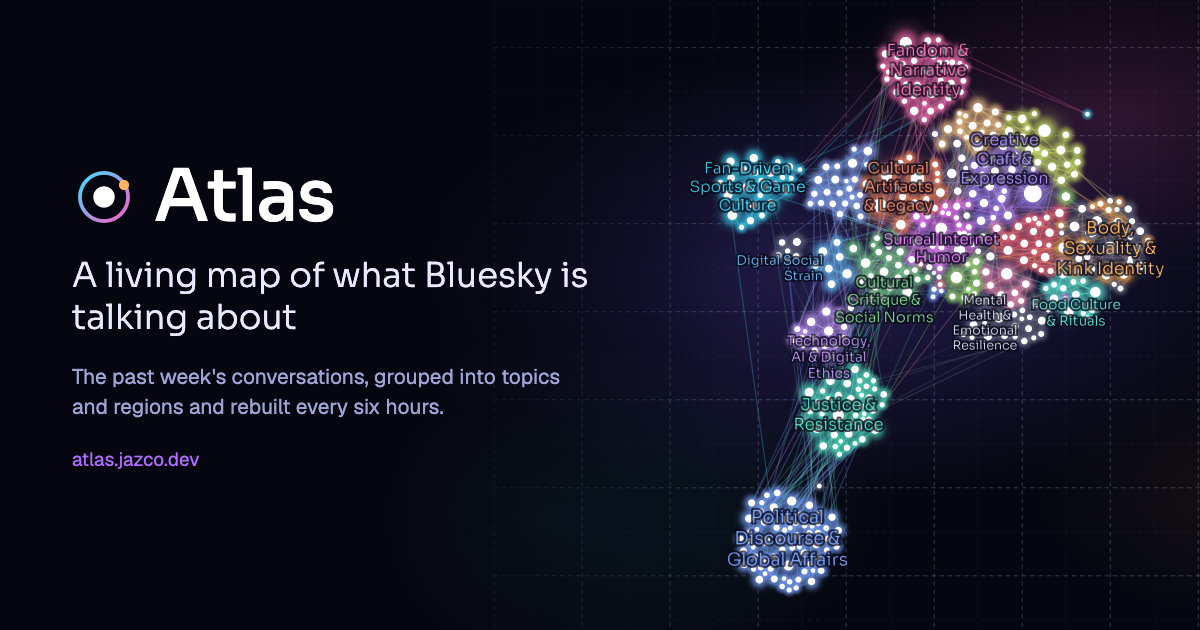
An interactive map of Bluesky communities — 545K people, 418 communities, discovered by graph analysis.
Assessing nature's contributions to people
Recognizing culture, and diverse sources of knowledge, can improve assessments , A major challenge today and into the future is to maintain or enhance beneficial contributions of nature to a good quality of life for all people. This is among the key motivations of the Intergovernmental Science-Policy Platform on Biodiversity and Ecosystem Services (IPBES), a joint global effort by governments, academia, and civil society to assess and promote knowledge of Earth's biodiversity and ecosystems and their contribution to human societies in order to inform policy formulation. One of the more recent key elements of the IPBES conceptual framework ( 1 ) is the notion of nature's contributions to people (NCP), which builds on the ecosystem service concept popularized by the Millennium Ecosystem Assessment (MA) ( 2 ). But as we detail below, NCP as defined and put into practice in IPBES differs from earlier work in several important ways. First, the NCP approach recognizes the central and pervasive role that culture plays in defining all links between people and nature. Second, use of NCP elevates, emphasizes, and operationalizes the role of indigenous and local knowledge in understanding nature's contribution to people.

Ecocivilization: making a world that works for all
""One of the greatest thinkers of our age" (The Guardian) presents a new way of living-one modeled on nature's design instead of capitalism's-for fans of Guns, Germs, and Steel and Doughnut Economics It has often been said that it is easier to imagine the end of the world than it is to imagine the end of capitalism-and yet that is what the historical moment urgently calls for. Climate change has reached an emergency state, inequality continues to grow, and, for many, the future has never seemed more bleak. Incremental policy improvements are no longer enough-we need a deep transformation of our current civilization to continue to survive. In Ecocivilization, leading thinker Jeremy Lent reimagines the basis of our civilization, and argues for a new global system of living, one based on life-affirming principles modeled after nature's own design. What enfolds is a robust framework incorporating Lent's own expertise, and the lived experiences of those on the ground already putting ecological civilization's core tenants into practice-justice, mutuality, diversity, and symbiosis. From the global economy to universal housing and income, from infrastructure to agriculture, every major aspect of our society could be redesigned to work together as a coherent whole, setting the conditions for all people to flourish. Ecocivilization shows how this future on a regenerated Earth is not only desirable, but entirely feasible"--

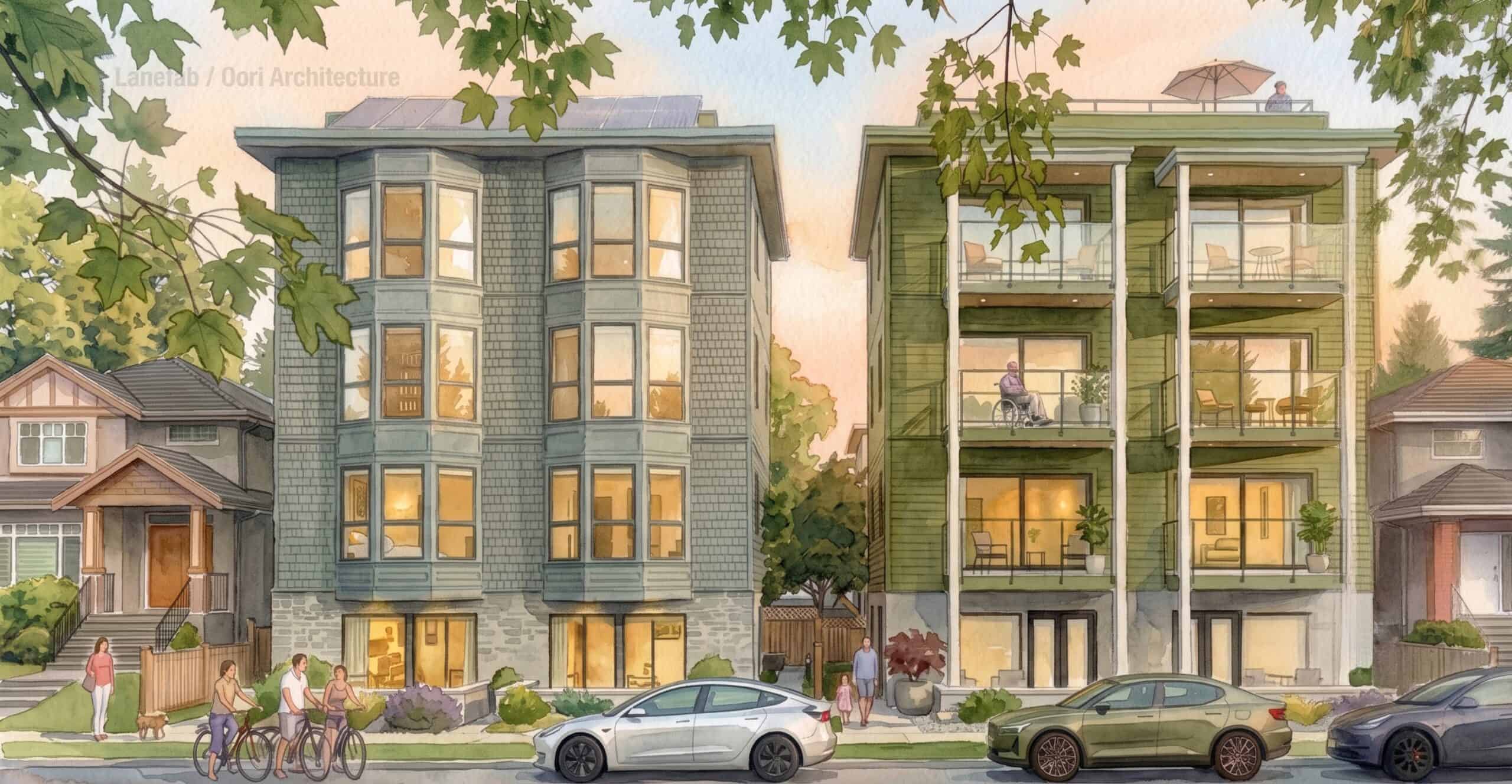
In Pictures: The Possibilities of Vancouver’s New Villages Plan | Sightline Institute
The Four/Five design prioritizes green space, daylight, affordability, and accessibility—all for greater connection and community.
Metrics for biodiversity and health policy integration
Despite over a decade of progressive commitments from parties to the Convention on Biological Diversity (CBD), integrated biodiversity and health indicators and monitoring mechanisms remain limited, hampering achievement of the sustainable development goals and improvements in health and well-being. Adoption of the Kunming-Montreal Global Biodiversity Framework (2022) and the Global Action Plan on Biodiversity and Health (2024) provide a renewed entry point to shape the way governments approach health and wellbeing and address the environmental burden of disease. This is a critical opportunity that scholars at the health-environment nexus should not miss. This Perspective outlines building blocks to mobilize the field, starting with essential terminology and a scope of metrics needed by governments. We then evaluate elements to be considered in the construction of integrated metrics, including concepts, overarching challenges, a review of scientific hypotheses from an ecological perspective, as well as a set of principles and characteristics for indicators. To raise awareness across parallel communities of practice working at the health-environment nexus, we then briefly examine four approaches to integrated metrics developed by: conservationists, Indigenous scholars, One Health experts, and planetary health experts. We conclude with actionable steps to enhance governance, mobilize funding, and apply integrated indicators in national and global strategies. A broad science community is needed to support national governments to meet global commitments to address biodiversity loss and the environmental burden of disease concurrently. The overall aim of this paper is to contribute to addressing biodiversity loss by effectively linking policy and transdisciplinary practice at the health-environment nexus.

Bioregionalism, Commoning, and Relationalized Finance | David Bollier
Have you noticed how the term “bioregional” is becoming a new eco-buzzword and greenwashing term? At the same time, many ordinary people are genuinely excited about the idea of bioregionalism as a constructive way to focus activism and socioeconomic innovation. Bioregionalism offers a practical, politically accessible space for addressing climate change, social inequality, the eclipse of democracy, out-of-control oligarchs, and capitalist growth.
BBC Earth | Environment, Climate Change, AI, Food, Health, Social, & Technology
As we face the world’s greatest environmental challenges, BBC Earth brings you solutions in psychology, food, climate change, health, social trends, and technology that can make the world a more sustainable place.
BBC Earth | Environment, Climate Change, AI, Food, Health, Social, & Technology
As we face the world’s greatest environmental challenges, BBC Earth brings you solutions in psychology, food, climate change, health, social trends, and technology that can make the world a more sustainable place.
BBC Earth | Environment, Climate Change, AI, Food, Health, Social, & Technology
As we face the world’s greatest environmental challenges, BBC Earth brings you solutions in psychology, food, climate change, health, social trends, and technology that can make the world a more sustainable place.
Future Thinkers Smart Village
A vision for a living lab for regenerative civilization redesign in the Interior of British Columbia, Canada.
Excited to share our new research demo, where you can freely traverse the world of Bluesky through 20,000 interconnected trails, spanning “analysis of fictional tropes” to “rotisserie chicken” to “zoning and land use policy.” Try it out, and let us know what you think!

skytrails · 20,000 trails through Bluesky
www.skytrails.org