


Why and how city governments are taking a more responsible approach to the collection and use of personal data.
Common Knowledge: Citizen-led data governance for better cities
Key lessons from the DECODE pilots and tips on how other cities and governments can apply the technologies and methods.

A City Is Not a Computer: Other Urban Intelligences
<strong>A bold reassessment of "smart cities" that reveals what is lost when we conceive of our urban spaces as computers</strong> Computational models of urbanism—smart cities that use data-driven planning and algorithmic administration—promise to deliver new urban efficiencies and conveniences. Yet these models limit our understanding of what we can know about a city. <i>A City Is Not a Computer</i> reveals how cities encompass myriad forms of local and indigenous intelligences and knowledge institutions, arguing that these resources are a vital supplement and corrective to increasingly prevalent algorithmic models. Shannon Mattern begins by examining the ethical and ontological implications of urban technologies and computational models, discussing how they shape and in many cases profoundly limit our engagement with cities. She looks at the methods and underlying assumptions of data-driven urbanism, and demonstrates how the "city-as-computer" metaphor, which undergirds much of today's urban policy and design, reduces place-based knowledge to information processing. Mattern then imagines how we might sustain institutions and infrastructures that constitute more diverse, open, inclusive urban forms. She shows how the public library functions as a steward of urban intelligence, and describes the scales of upkeep needed to sustain a city's many moving parts, from spinning hard drives to bridge repairs. Incorporating insights from urban studies, data science, and media and information studies, <i>A City Is Not a Computer</i> offers a visionary new approach to urban planning and design.
Rethinking the Smart City: Democratizing Urban Technology - RLS-NYC
Following the celebration of the “creative city” (as described by Richard Florida), the “smart city” has become the new flavor of the month—and a brand. It makes clever use of resources, and it attracts money, corporate power, and private industries. Offering us cheap, effective solutions to social and political problems, the smart city is functional, […]

Personal data storage is an idea whose time has come
Data Ownership as a conversation changes when data resides primarily with people-governed institutions rather than corporations.

A City in Common: A Framework to Orchestrate Large-scale Citizen Engagement around Urban Issues
As part of the Digital Library's transition to Open Access, new features for researchers are available in the Premium Edition. Click here to learn more.

Nonrivalry and the Economics of Data
(September 2020) - Data is nonrival: a person's location history, medical records, and driving data can be used by many firms simultaneously. Nonrivalry leads to increasing returns. As a result, there may be social gains to data being used broadly across firms, even in the presence of privacy considerations. Fearing creative destruction, firms may choose to hoard their data, leading to the inefficient use of nonrival data. Giving data property rights to consumers can generate allocations that are close to optimal. Consumers balance their concerns for privacy against the economic gains that come from selling data broadly.
MyData
The human-centric approach to data is aimed at a fair, sustainable, and prosperous digital society. In such a society, people get value from their data and set the agenda on how it is used. And for organisations, the ethical use of data is always the most attractive option.

Rethinking how technology uses our personal data
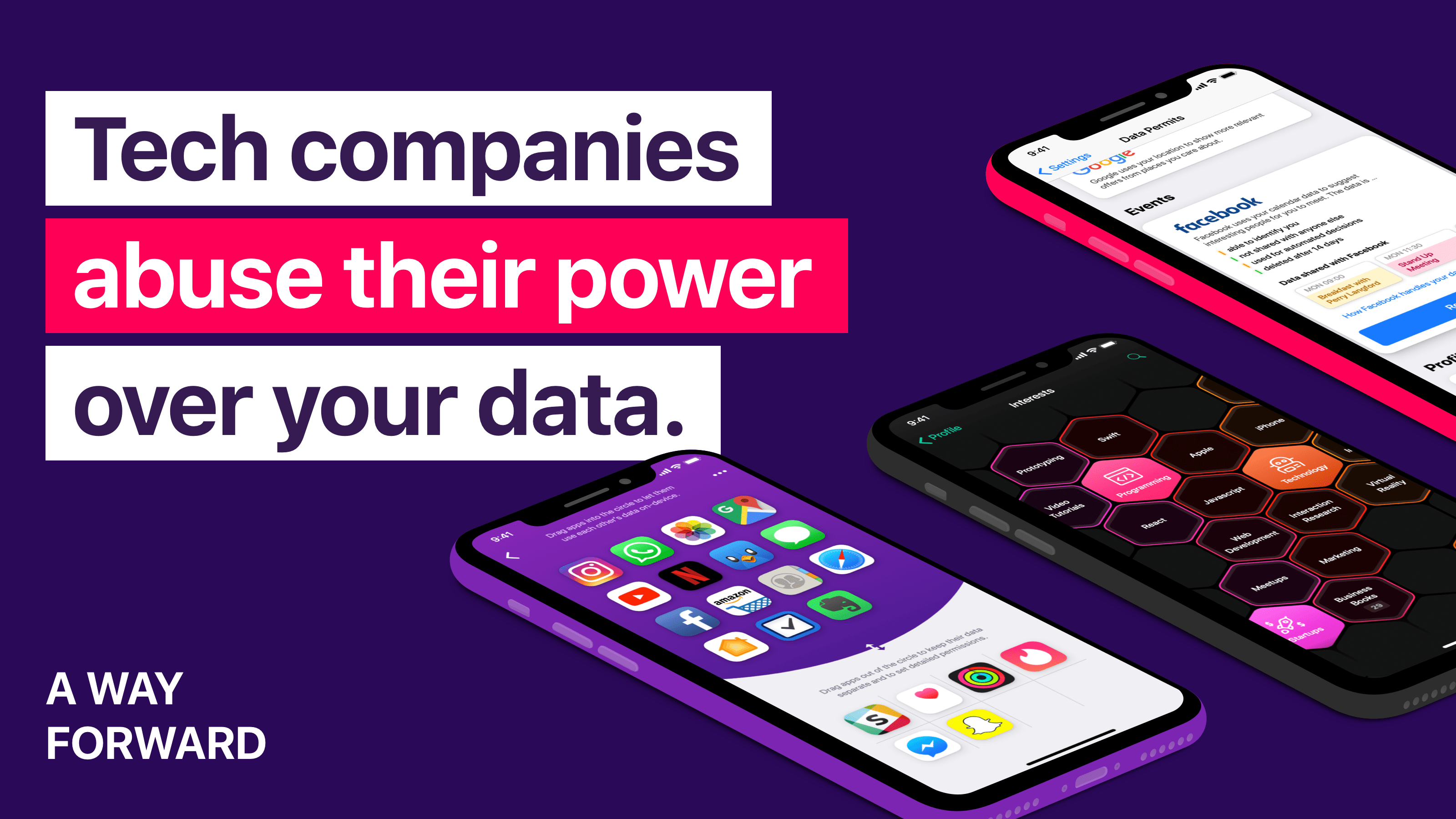
This essay explores visually how keeping data and AI on‑device could empower not only users, but also companies.
Who owns your data?
A Supreme Court case about a bank robbery could redefine your digital rights.

Computational Public Space
A Polycentric Governance Lens on Data Infrastructures
Funding policies for data infrastructure promote open data sharing to drive positive social impact. However, concerns regarding the long-term management of data within and across distributed infrastructures can hinder data sharing. We draw upon the concept of polycentric governance to demonstrate how collaborative practices of data curation, in preparing and maintaining data for (future) sharing, provide a solid foundation for understanding data governance within data infrastructures. Based on a qualitative case study of a distributed ecological network, we investigate the conditions under which data are managed as a shared resource by local actors to ensure the long-term (re)usability of data. We contribute to CSCW by conceptualising data curation as a complex form of governance practice with multiple centres of decision-making, each of which operates with some degree of autonomy in data infrastructures. A polycentric governance lens on data infrastructures advances the CSCW conception of data curation as a collective governance practice that can cultivate a data democracy culture within and across organisations, empower individuals to be accountable for their data, and foster a mindset shift toward decentralised data governance.

Reclaim Control | over your technology, your devices, your data, your digital life.
You have the right to control your data, devices, and services. We coordinate, develop and foster communities of Reclaimers who want digital independence. Together, let's reclaim the right to a technical future of data sovereignty, digital autonomy, responsible governance, and collective care online for all.
A City Is Not a Computer
This seems an obvious truth, but we need to say it loud and clear. Urban intelligence is more than information processing.

Living in Data: A Citizen's Guide to a Better Information Future (Paperback)
Jer Thorp’s analysis of the word “data” in 10,325 New York Times stories written between 1984 and 2018 shows a distinct trend: among the words most closely associated with “data,” we find not only its classic companions “information” and “digital,” but also a variety of new neighbors—from “scandal” and “misinformation” to “ethics,” “friends,” and “play.”To live in data in the twenty-first century

Data Minimisation: a Language-Based Approach (Long Version)
Data minimisation is a privacy-enhancing principle considered as one of the pillars of personal data regulations. This principle dictates that personal data collected should be no more than...
