It’s one of our most widely used natural resources, but it’s scarcer than you think.
Terraforming Singapore
Illegal sand mining is reaching crisis levels in Southeast Asia. Can Singapore rethink its reliance on sand for land reclamation and development?

Seven Key Elements of an Economy of Abundance
Our present economy is an economy of scarcity – only scarce commodities have economic value. Therefore there are strong incentives to make everything into a scarce commodity - first by making it into a commodity, and then by assuring that the demand for that commodity exceeds its supply, either by controlling supplies or by inflating demand, or doing both at the same time. This economy of scarcity leads to environmental destruction because the natural environment is treated as a “free” good to consume or pollute until it becomes scarce enough to commodify and monopolize. It also leads to social inequality because the major avenue to wealth is to control key assets and then make them scarce for everyone else, thus extracting profits.
Sands of Time
Chip away at blocks of stone to make grains of sand for harnessing the power of time!

Finland’s radical answer to renewable energy’s biggest headache: The world’s largest sand battery
A small Finnish town has turned to the world's largest commercial sand battery to tackle a major hurdle in the energy transition: intermittency.

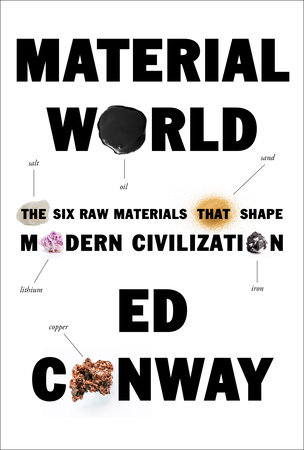
Material World by Ed Conway | Penguin Random House Canada
THE NEW YORK TIMES BOOK REVIEW EDITORS' CHOICE • AN ECONOMIST BEST BOOK OF THE YEAR • Sand, salt, iron, copper, oil, and lithium. These fundamental materials have created empires, razed civilizations, and fed our ingenuity and greed for thousands of years. Without them, our modern world would not exist, and the battle to control them will determine our future. • Finalist for the Financial Times and Schroders Business Book of the Year Award
The shale revolution helped make America’s economy great
But will the country’s oil riches discourage a similar revolution in renewables?

Hawaii’s Beaches Are Disappearing
Major islands have lost nearly a quarter of their beaches in the last century. The culprit? Seawalls and other barriers erected by wealthy homeowners.

Imperialist appropriation in the world economy: Drain from the global South through unequal exchange, 1990–2015
Unequal exchange theory posits that economic growth in the “advanced economies” of the global North relies on a large net appropriation of resources and labour from the global South, extracted through price differentials in international trade. Past attempts to estimate the scale and value of this drain have faced a number of conceptual and empirical limitations, and have been unable to capture the upstream resources and labour embodied in traded goods. Here we use environmental input-output data and footprint analysis to quantify the physical scale of net appropriation from the South in terms of embodied resources and labour over the period 1990 to 2015. We then represent the value of appropriated resources in terms of prevailing market prices. Our results show that in 2015 the North net appropriated from the South 12 billion tons of embodied raw material equivalents, 822 million hectares of embodied land, 21 exajoules of embodied energy, and 188 million person-years of embodied labour, worth $10.8 trillion in Northern prices – enough to end extreme poverty 70 times over. Over the whole period, drain from the South totalled $242 trillion (constant 2010 USD). This drain represents a significant windfall for the global North, equivalent to a quarter of Northern GDP. For comparison, we also report drain in global average prices. Using this method, we find that the South’s losses due to unequal exchange outstrip their total aid receipts over the period by a factor of 30. Our analysis confirms that unequal exchange is a significant driver of global inequality, uneven development, and ecological breakdown.

Your use of AI is directly harming the environment I live in
Writing at the end of the world, from Hveragerði, Iceland
Ghost ships, crop circles, and soft gold: A GPS mystery in Shanghai
A sophisticated new electronic warfare system is being used at the world’s busiest port. But is it sand thieves or the Chinese state behind it?

Where Does All the Cardboard Come From? I Had to Know. (Published 2022)
Entire forests and enormous factories running 24/7 can barely keep up with demand. This is how the cardboard economy works.

We argue badly, and nothing accumulates. How could we do better? | Reason Commons — Issue Trees & Logical Thinking Process
Millions of people argue every day about the things that matter most — climate change, what to do about AI, how we might build a better world. Some of it is sharp, even insightful. And almost none of it accumulates.
The Seas Will Save Us: How an Army of Ocean Farmers are Starting an Economic Revolution
I’m a fisherman who dropped out of high school in 1986 at the age of 14. Over my lifetime, I’ve spent many nights in jail. I’m an…

Reflect nature’s ‘true value’ in economic policies and decisions, UN chief urges
Nations must start weighing up the cost of economic profit against damage to the environment if they are to have a chance at a sustainable future, UN Secretary-General António Guterres said on Tuesday.
The future is made of energy | Orca Notes
A megatrend way bigger than decarbonization is probably the key to abundance and sustainability both.