


Outside The Wall Street Journal, it appears not.
Report: AI Use in Newspapers Is Widespread, Uneven… | Maryland Today
UMD Computer Scientists, Private Firms Examine News and Opinion Pages in U.S. Media

Top WSJ Editor Approves AI-Assisted Writing, Says AI is a “Fact of Modern Life” in Major Inflection Point for Media Industry
The Wall Street Journal is giving opinion authors the go-ahead to use AI in the writing process, without requiring AI disclosures.

AI use in American newspapers is widespread, uneven, and rarely disclosed
AI is rapidly transforming journalism, but the extent of its use in published newspaper articles remains unclear. We address this gap by auditing a large-scale dataset of 186K articles from online editions of 1.5K American newspapers published in the summer of 2025. Using Pangram, a state-of-the-art AI detector, we discover that approximately 9% of newly-published articles are either partially or fully AI-generated. This AI use is unevenly distributed, appearing more frequently in smaller, local outlets, in specific topics such as weather and technology, and within certain ownership groups. We also analyze 45K opinion pieces from Washington Post, New York Times, and Wall Street Journal, finding that they are 6.4 times more likely to contain AI-generated content than news articles from the same publications, with many AI-flagged op-eds authored by prominent public figures. Despite this prevalence, we find that AI use is rarely disclosed: a manual audit of 100 AI-flagged articles found only five disclosures of AI use. Overall, our audit highlights the immediate need for greater transparency and updated editorial standards regarding the use of AI in journalism to maintain public trust.
How AI Is Creeping Into The New York Times
Artificial intelligence seems to be turning up, undisclosed, in the opinion pages of major news publications.

We Talked to a Writer Accused of Publishing An AI-Generated Essay in The New York Times
She was accused of publishing AI slop in The New York Times. She says she didn't use AI to generate content — but did use AI to get published.

Artificial Intelligence in the News: How AI Retools, Rationalizes, and Reshapes Journalism and the Public Arena
<p>Download the pdf here. Executive Summary Despite growing interest, the effects of AI on the news industry and our information environment — the public arena — remain poorly understood. Insufficient attention has also been paid to the implications of the news industry’s dependence on technology companies for AI. Drawing on 134 interviews with news workers […]</p>

AI Policy • States Newsroom
AI Policy States Newsroom is, above all, dedicated to journalism practiced by people. We believe in the power of having on-the-ground reporters covering our communities with the finesse and nuance that only human interaction can produce. We also recognize the power and potential of generative AI. We are open to the responsible and transparent use […]

Ethan Mollick on Twitter / X
There is a lot being written about the stylistic tells of AI writing (em-dashes, etc.) but this paper looks at AI narrative tellsFascinating differences between AI & human narrative, and asking AI to write in different styles doesn't do much to change it https://t.co/azkRHz34NQ pic.twitter.com/oTxSGBNYYE— Ethan Mollick (@emollick) May 28, 2026

New York Times Accused of Running AI-Generated Article
People are speculating that an essay published in the New York Times' "Modern Love" was AI-generated. What's definitely real? AI paranoia.

No Opinion — The New York Times: Boycott, Divest, Unsubscribe
Over the past few years, the Times has increasingly turned to “guest essayists” to help repair its crumbling reputation. Opinion editors recruit respected subject matter experts to lend their diverse — often tokenized — perspectives as a countervailing force to the paper’s in-house conservatism. Without the voices, expertise, and freelance labor of these guest essayists, the Opinion section would be utterly worthless.

Exclusive: It’s bots vs. reporters at the AP
The tensions inside the wire service reveal a broader conflict playing out across the media over how AI should be applied within journalism.

AI and the crisis of the author
Editor’s note (September 21, 2026): We have removed this essay. AI was used in its preparation. The TLS editorial guidelines prohibit the use of AI in the
The Media's Pivot to AI Is Not Real and Not Going to Work
AI is not going to save media companies, and forcing journalists to use AI is not a business model.

AI*-powered news/journalism

Also including prose in general aside from scientific papers and creative writing, like editorials, opinion columns, and essays, unless I separate them out into another collection * I’m neither “pro-AI” nor “anti-AI.” I’ve been blocked for being perceived as both. —Actually, I’m honestly more anti-AI than pro-AI thus far, aside from specialized models and specific use cases, but I’m willing to consider information that’s new to me
AI* and creative writing
To differentiate from e.g. news articles and legal filings. * I’m neither “pro-AI” nor “anti-AI.” I’ve been blocked for being perceived as both. —Actually, I’m honestly more anti-AI than pro-AI thus far, aside from specialized models and specific use cases, but I’m willing to consider information that’s new to me
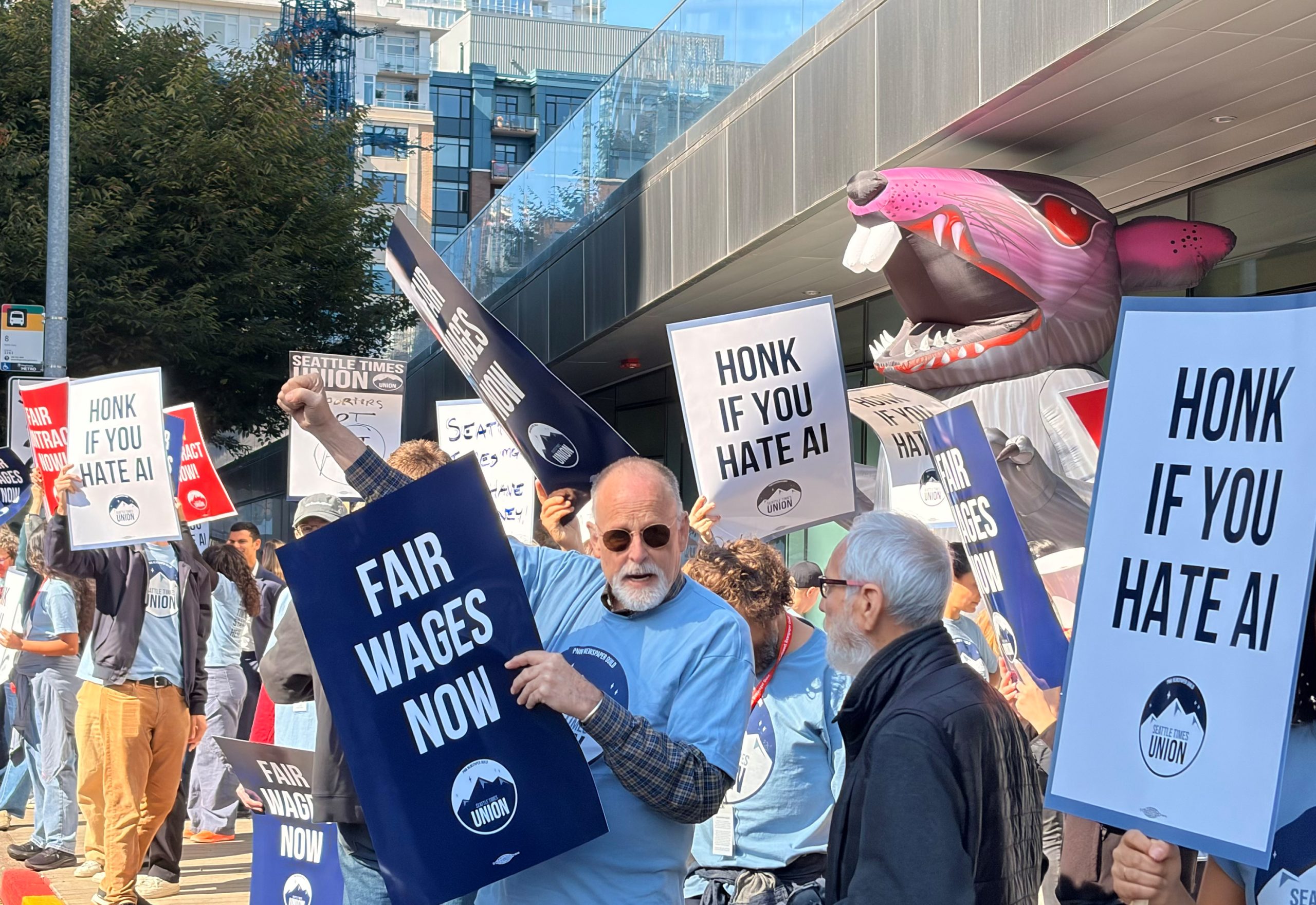
Seattle Times Journalists Picket Newsroom Over Low Pay and Threats of Being Replaced by AI
Are newspaper opinion sections embracing AI-written op-eds?
AI and the crisis of the author
New York Times Accused of Running AI-Generated Article
We Talked to a Writer Accused of Publishing An AI-Generated Essay in The New York Times

New York Times Issues Stern Warning to Its Freelance Writers About AI Use

Heated Rivalry is at the Center of Fanfic’s AI Reckoning