


When deciding which links to click on the web, users choose those with the highest information scent — which is a mix of cues that they get from the link label, the context in which the link is shown, and their prior experiences.
Information foraging
Information foraging is a theory that applies the ideas from optimal foraging theory to understand how human users search for information. The theory is based on the assumption that, when searching for information, humans use "built-in" foraging mechanisms that evolved to help our animal ancestors find food. Importantly, a better understanding of human search behavior can improve the usability of websites or any other user interface.
The information flaneur: a fresh look at information seeking
How Targeting Affects Customer Search: A Field Experiment
It has become common practice for retailers to personalize direct marketing efforts based on customer transaction histories as a tactic to increase sales. Targeted email offers featuring products in the same category as a customer’s previous purchases generate higher purchase rates. However, a targeted offer emphasizing familiar products could result in curtailed search for unadvertised products, as a closely matched offer weakens a customer’s incentives to search beyond the targeted items. In a field experiment using email offers sent by an online wine retailer, targeted offers resulted in decreased search activity on the retailer’s website. This effect is driven by a lower rate of search by customers who visit the site, rather than a lower incidence of search. There are several ways this could potentially hurt retailers and consumers, such as reduced cross-selling and fewer opportunities for customers to explore new products. This paper was accepted by Pradeep Chintagunta, marketing.

Information Architecture. Basics for Designers.
The World Wide Web contains a tremendous amount of information which is hard to imagine unstructured because a human brain wouldn’t be able…

Smart Links for Music Marketing, Podcasts and Artist Promotion | Linkfire
Smart links for music marketing and podcast promotion. From your first single to your first world tour, Linkfire simplifies music and podcast promotion every step of the way. Trusted by major labels and over 50k artists.

Metacognitive experiences as information: Processing fluency in consumer judgment and decision making
Abstract Thinking is accompanied by metacognitive experiences of ease or difficulty. People draw on these experiences as a source of information that can complement or challenge the implications of declarative information. We conceptualize the operation of metacognitive experiences within the framework of feelings‐as‐information theory and review their implications for judgments relevant to consumer behavior, including popularity, trust, risk, truth, and beauty.

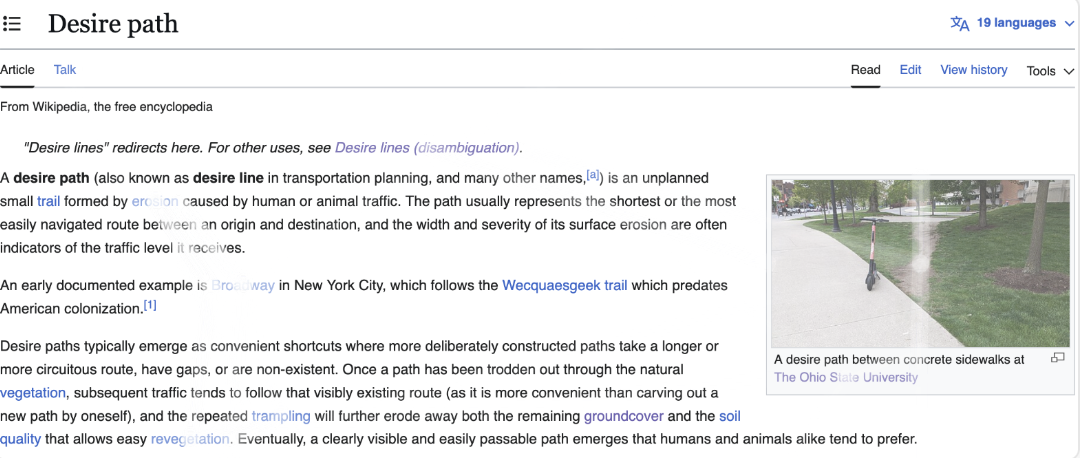
Desire Paths for Wikipedia
An extension that remembers the path of a cursor over the linked pages of Wikipedia, “wearing” them into the page.
Navigation queues | Navigation cues
A web-essay written by Domitille Debret, designed and developed by F451 for The HTML Review Issue 04, Spring 2025.
Platform Information Provision and Consumer Search: A Field Experiment
Despite substantial efforts to help consumers search in more intuitive ways, text search remains the predominant tool for product discovery online. In this paper, we explore the effects of visual and textual cues for search refinement on consumer search and purchasing behavior. We collaborate with one of the largest e-commerce platforms in China and study its roll out of a new search tool. When a customer searches for a general term (e.g., “headphones”), the tool suggests refined queries (e.g., “bluetooth headphones” or “noise-canceling headphones”) with the help of images and texts. The search tool was rolled out with a long-run experiment, which allows us to measure its short-run and long-run effects. We find that, although there was no immediate effect on orders or total expenditures, the search tool changed customers’ search and purchasing behavior in the long-run. Customers with access to the new tool eventually increased orders and expenditures compared to those in the control group, especially for non top-selling products. The purchase increase comes from more effective searches, rather than an increase in activity on the platform. We also find that the effect is not only driven by the direct value of suggested searches, but also by customers indirectly learning to perform more effective searches on their own.

Spatial Web Browsing
Adding spatial affordances to the experience of browsing the web
“‘Information’ is a relational concept that assumes meaning only when related to the cognitive structure of the observer.” -- Heinz von Foerster
Control Information Theory: The “Missing Link” In the Science Of Cybernetics | Institute for the Study of Complex Systems
complexsystems.orgthis is also a thing, but separate from the basic website stuff anna is talking about. the at:// potential is sort of about navigating to that sort of URI in browser bar. but I think more realistically, having anchor links. <a atref="at://..."> (or more realistically: data-atp="at://...")
Thinking about this more: If the goal is to attract more writers I feel like linking to a document doesn’t do much unless that page also encourages it Looking at an example if I’m a first time user, I have no way of knowing that this page is on a Writing platform.

Atproto for small makers
queergeometry.pckt.blog


