


“The scandal is not, as the term Anthropocene implies, that the boundaries between the human and nature get blurred. Rather, the scandal is that we humans still have not learned to think about ourselves in terms of the microbial — the viral — world of which we are a part.”
Safeguarding human health in the Anthropocene epoch: report of The Rockefeller Foundation–Lancet Commission on planetary health
Far-reaching changes to the structure and function of the Earth's natural systems represent a growing threat to human health. And yet, global health has mainly improved as these changes have gathered pace. What is the explanation? As a Commission, we are deeply concerned that the explanation is straightforward and sobering: we have been mortgaging the health of future generations to realise economic and development gains in the present. By unsustainably exploiting nature's resources, human civilisation has flourished but now risks substantial health effects from the degradation of nature's life support systems in the future.

The shock of the anthropocene: the earth, history and us
Dissecting the new theoretical buzzword of the "Anthrop…

How May the ‘Anthropocene’ Enable and Constrain Cybersystemic Governance? The ‘Anthropocene Problematique’
A growing awareness of the need for cybernetics and systems thinking (cybersystemic) in praxes of governance to improve human-biosphere relationships in the Anthropocene has become apparent. Nonetheless, mainstream governance informed by linear-causality seems to perpetuate an increasingly inadequate paradigm of dominant first-order/systematic thinking in governing complex interactions between humans and their natural environments. This conundrum is explored through the second-order lens of a systemic inquiry, using an integrative literature review. We discuss limitations of the Anthropocene metaphor and make the case for a reframing of our situation (humans’ co-evolutionary dynamic with the biosphere) as the ‘Anthropocene problematique’. This reframing as a systemic-duality offers more conducive affordances for trajectory-shifting cybersystemic governance to emerge. Aligning with a body of literature evidencing the influence of language on human cognition, we argue that by joining up the strengths of both ideas, ‘Anthropocene problematique’ may form a conceptual device amenable to changing worldviews and guiding practical action in governing human-biosphere relationships. We suggest a conceptual framework for practitioners to design and enact purposeful systems of cybersystemic governance with potential to improve situated Anthropocene problematiques. This framing and theoretical proposal are motivated by a need for shifts towards a social purpose of healing human-biosphere relationships in current governance systems in the Anthropocene-world.

The “Anthropocene”
Human activities are exerting increasing impacts on the environment on all scales, in many ways outcompeting natural processes. This includes the manufacturing of hazardous chemical compounds which are not produced by nature, such as for instance the...

Anthropocene Epistemology: Political, Ecological, and Economic Entanglements
This essay critically explores the connection between epistemology, political ecology, economy, and technological developments in the Anthropocene, understood a

The Scientist Who Scrambled Darwin’s Tree of Life (Published 2018)
How the microbiologist Carl Woese fundamentally changed the way we think about evolution and the origins of life.

I believed we would face an antibiotics apocalypse - until now | Richard James
For decades my research showed the dangers of new strains of resistance, and this week we heard of another threat. But there’s been a breakthrough
Knowledge infrastructures for the Anthropocene
The technosphere metabolizes not only energy and materials, but information and knowledge as well. This article first examines the history of knowledge about large-scale, long-term, anthropogenic environmental change. In the 19th and 20th centuries, major systems were built for monitoring both the environment and human activity of all kinds, for modeling geophysical processes such as climate change, and for preserving and refining scientific memory, i.e. data about the planetary past. Despite many failures, these knowledge infrastructures also helped achieve notable successes such as the Limited Test Ban Treaty of 1963, the ozone depletion accords of the 1980s, and the Paris Agreement on climate change of 2015. The article’s second part proposes that knowledge infrastructures for the Anthropocene might not only monitor and model the technosphere’s metabolism of energy, materials and information, but also integrate those techniques with new accounting practices aimed at sustainability. Scientific examples include remarkable recent work on long-term socio-ecological research, and the assessment reports of the Intergovernmental Panel on Climate Change. In terms of practical knowledge, one key to effective accounting may be ‘recycling’ of the vast amounts of ‘waste’ data created by virtually all online systems today. Examples include dramatic environmental efficiency gains by Ikea and United Parcel Service, through improved logistics, self-provision of renewable energy, and feedback from close monitoring of delivery trucks. Blending social ‘data exhaust’ with physical and environmental information, an environmentally focused logistics might trim away excess energy and materials in production, find new ways to re-use or recycle waste, and generate new ideas for eliminating toxic byproducts, greenhouse gas emissions and other metabolites.

Knowledge infrastructures for the Anthropocene
The technosphere metabolizes not only energy and materials, but information and knowledge as well. This article first examines the history of knowledge about large-scale, long-term, anthropogenic environmental change. In the 19th and 20th centuries, major systems were built for monitoring both the environment and human activity of all kinds, for modeling geophysical processes such as climate change, and for preserving and refining scientific memory, i.e. data about the planetary past. Despite many failures, these knowledge infrastructures also helped achieve notable successes such as the Limited Test Ban Treaty of 1963, the ozone depletion accords of the 1980s, and the Paris Agreement on climate change of 2015. The article’s second part proposes that knowledge infrastructures for the Anthropocene might not only monitor and model the technosphere’s metabolism of energy, materials and information, but also integrate those techniques with new accounting practices aimed at sustainability. Scientific examples include remarkable recent work on long-term socio-ecological research, and the assessment reports of the Intergovernmental Panel on Climate Change. In terms of practical knowledge, one key to effective accounting may be ‘recycling’ of the vast amounts of ‘waste’ data created by virtually all online systems today. Examples include dramatic environmental efficiency gains by Ikea and United Parcel Service, through improved logistics, self-provision of renewable energy, and feedback from close monitoring of delivery trucks. Blending social ‘data exhaust’ with physical and environmental information, an environmentally focused logistics might trim away excess energy and materials in production, find new ways to re-use or recycle waste, and generate new ideas for eliminating toxic byproducts, greenhouse gas emissions and other metabolites.
A Billion Black Anthropocenes or None
Check out A Billion Black Anthropocenes or None - <p><b>Rewriting the “origin stories” of the Anthropocene</b><br /><br /> No geology is neutral, writes Kathryn Yusoff. Tracing the color line of the Anthropocene, <i>A Billion Black Anthropocenes or None</i> examines how the grammar of geology is foundational to establishing the extractive economies of subjective life and the earth under colonialism and slavery. Yusoff initiates a transdisciplinary conversation between feminist black theory, geography, and the earth sciences, addressing the politics of the Anthropocene within the context of race, materiality, deep time, and the afterlives of geology.<br /><br /> Forerunners is a thought-in-process series of breakthrough digital works. Written between fresh ideas and finished books, Forerunners draws on scholarly work initiated in notable blogs, social media, conference plenaries, journal articles, and the synergy of academic exchange. This is gray literature publishing: where intense thinking, change, and speculation take place in scholarship.</p> by Kathryn Yusoff on Bookshop.org UK!

The one science reform we can all agree on, but we're too cowardly to do
OR: the long overdue forest fire


Caroline Lucas: The shocking climate reports the UK government didn't want you to see
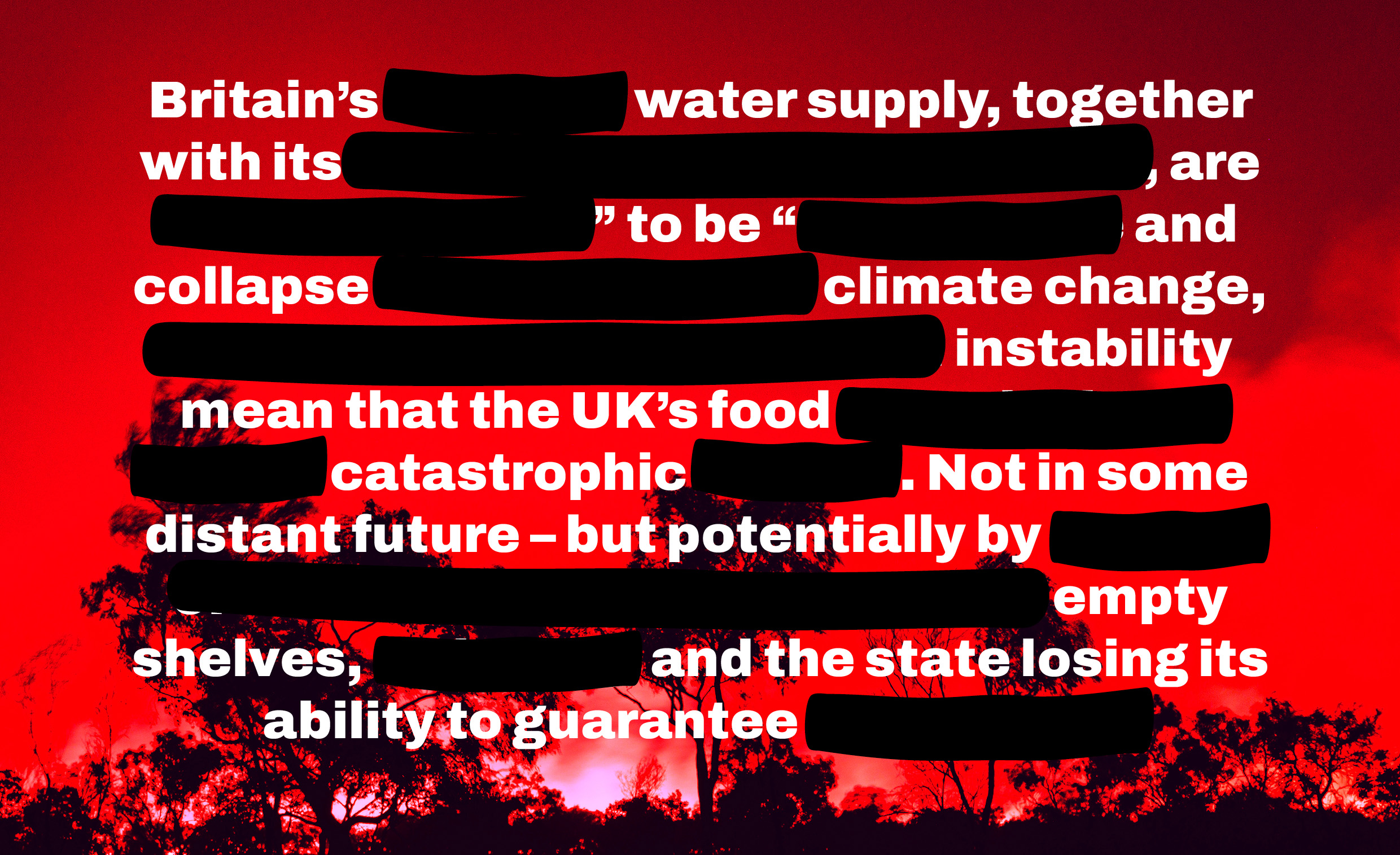
The intelligence services now believe nature collapse is a security threat. For a cabinet determined to sacrifice the environment for growth, was that too uncomfortable a truth, asks the former Green party leader
The problem of knowledge in the Anthropocene
In the twentieth century, debates about economic planning were largely shaped by arguments concerning knowledge and the acquisition of information. As the century drew to a close, the dispute was a...

so I just commented on that paper in Cell Host and Microbe that is cited as evidence that the autism/microbiome link is solid: pubpeer.com/publications/9A4B5695950D3396… (not sure what the word “precision” is supposed to mean in the title) tldr; looks p-hacked 🫤 and I couldn’t find the ethics approval 🤔
PubPeer - Precision microbial intervention improves social behavior bu...
pubpeer.com
Kevin Mitchell
Criticism of Autism-Gut Microbiome Research Sparks Pushback the-scientist.com/criticism-of-autism-gut-micro…
Here’s relevant paper on #metascience lit from 2018, 7 years and a pandemic ago. This hasn’t been hypothetical or hard to see. During the pandemic science reform was weaponized by Ioannidis, Prasad, Bhattacharya, etc and lives were lost. pnas.org/doi/10.1073/pnas.1708276114

Crisis or self-correction: Rethinking media narratives about the well-being of science | PNAS
www.pnas.org
