


Experts say white supremacist hate groups are targeting young video game fans for recruitment via YouTube, Twitch, game-related forums and directly within multiplayer game chat.
The people who watch video games, but never play them
YouTube and Twitch have changed video game fandom

“It is a racial war:” Analyzing the violent rhetoric of active club members on X - Institute for Strategic Dialogue
ISD research revealed that some members of US-based Active Clubs are using X accounts to call for violence against targeted communities.

Leader-driven or Leaderless: How Participation Structure Sustains Engagement and Shapes Narratives in Online Hate Communities
Extremist communities increasingly rely on social media to sustain and amplify divisive discourse. However, the relationship between their internal participation structures, audience engagement, and narrative expression remains underexplored. This study analyzes ten years of Facebook activity by hate groups related to the Israel–Palestine conflict, focusing on anti-Semitic and Islamophobic ideologies. Consistent with prior work, we find that higher participation centralization in online hate groups is associated with greater user engagement across hate ideologies, suggesting the role of key actors in sustaining group activity over time. Meanwhile, our narrative frame detection models—based on an eight-frame extremist taxonomy (e.g., dehumanization, violence justification)—reveal a clear contrast across hate ideologies: centralized Islamophobic groups employ more uniform messaging, while centralized anti-Semitic groups demonstrate greater framing diversity and topical breadth, potentially reflecting distinct historical trajectories and leader coordination patterns. Analysis of the inter-group network indicates that, although centralization and homophily are not clearly linked, ideological distinctions emerge: Islamophobic groups cluster tightly, whereas anti-Semitic groups remain more evenly connected. Overall, these findings clarify how participation structure may shape the dissemination pattern and resonance of extremist narratives online and provide a foundation for tailored strategies to disrupt or mitigate such discourse.
Swarm of bots post astroturf campaign in support of ATF’s anti-trans gun rule - Assigned Media
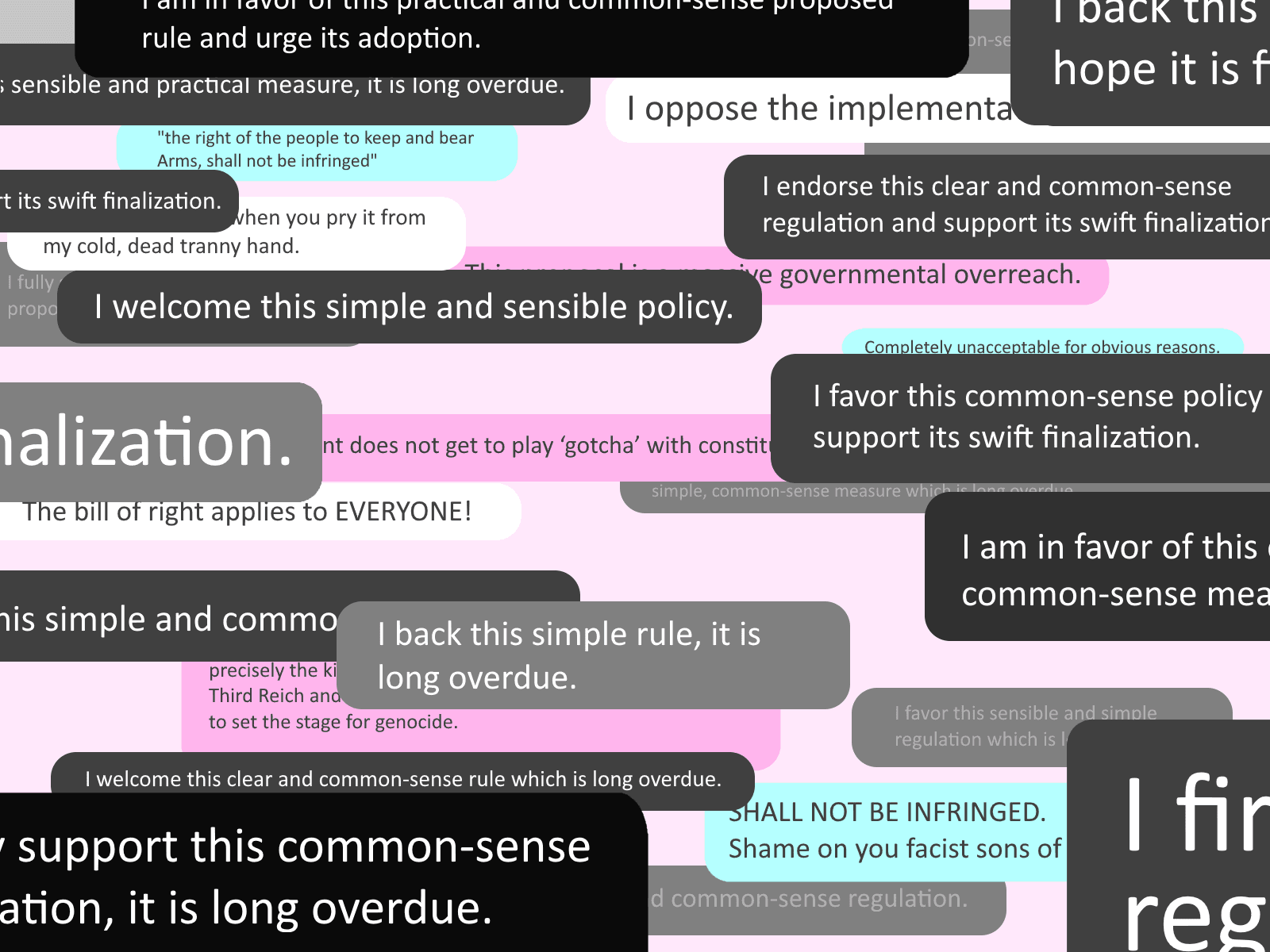
An ATF proposal to curb trans gun rights got thousands of supportive comments. 96 percent of them appear fake.
Advocacy groups urge YouTube to protect kids from 'AI slop' videos
Advocacy groups and experts have slammed YouTube for serving up low-quality artificial intelligence-generated videos to its most vulnerable audience: children.
The Search For The Apolitical Video Game
Data Feminism for AI
Attacks on women and trans people are not happening in a vacuum. Communications scholars W. Lance Bennett and Marianne Kneuer recently argued that we are witnessing the intensification of "illiberal public spheres" around the world (Bennett and Kneuer, 2023). These are characterized by a set of anti-democratic communications tactics that include the denigration and exclusion of minoritized people, targeted attacks on the press and political institutions, and transgression of norms of civil discourse. Such tactics are enabled and amplified by the social media platforms owned by Big Tech, whose business model elevates attention above all other metrics, such that they profit richly off extremism, threats, spectacle, and lies. The success of this corporate partnership with right-wing extremism is evident in the proliferation of book bans (Magnusson, 2024), the demonization of DEI and critical race theory (Crenshaw, 2022), and mob tactics to doxx, intimidate, misrepresent, and otherwise silence people that study misinformation, speak out against racial and gender violence, or rule against insurrectionists (Edmonds, 2024). At the same time, we have seen the continued work of feminists, including Latin American, Indigenous, and abolitionist feminists in the US and globally, doing the work of imagining alternate worlds (Cullors, 2021; Davis, 2022; Ricaurte, 2019; Simpson, 2017). This paper represents our own first attempt to imagine a more equitable, sustainable, feminist world for AI research.
TikTok's algorithm leads users from transphobic videos to far-right rabbit holes
TikTok’s “For You” page (FYP) recommendation algorithm appears to be leading users down far-right rabbit holes. By analyzing and coding over 400 recommended videos after interacting solely with transphobic content, Media Matters traced how TikTok’s recommendation algorithm quickly began populating our research account’s FYP with hateful and far-right content. TikTok has long been scrutinized for its dangerous algorithm, viral misinformation, and hateful video recommendations, yet this new research demonstrates how the company’s recommendation algorithm can quickly radicalize a user’s FYP. Transphobia is deeply intertwined with other kinds of far-right extremism, and TikTok’s algorithm only reinforces this connection. Our research suggests that transphobia can be a gateway prejudice, leading to further far-right radicalization. To assess this phenomenon, Media Matters created a new TikTok account and engaged only with content we identified as transphobic. This included accounts that had posted multiple videos which degrade trans people, insist that there are “only two genders,” or mock the trans experience. We coded approximately the first 450 videos fed to our FYP. Even though we solely interacted with transphobic content, we found that our FYP was increasingly populated with videos promoting various far-right views and talking points. That content did include additional transphobic videos, even though such content violates TikTok’s “hateful behavior” community guidelines, which state that the platform does not permit “content that attacks, threatens, incites violence against, or otherwise dehumanizes an individual or group on the basis of” attributes including gender and gender identity. Key Findings After we interacted with anti-trans content, TikTok’s recommendation algorithm populated our FYP feed with more transphobic and homophobic videos, as well as other far-right, hateful, and violent content. Exclusive interaction with anti-trans content spurred TikTok to recommend misogynistic content, racist and white supremacist content, anti-vaccine videos, antisemitic content, ableist narratives, conspiracy theories, hate symbols, and videos including general calls to violence. Of the 360 total recommended videos included in our analysis, 103 contained anti-trans and/or homophobic narratives, 42 were misogynistic, 29 contained racist narratives or white supremacist messaging, and 14 endorsed violence.

How Anti-LGBTQ+ Rhetoric Fuels Violence
Hate speech from the far right is increasing the risk of violence against LGBTQ+ people such as the Club Q shooting

Study finds persistent spike in hate speech on X - Berkeley News
The new analysis contradicts the social media platform’s claims that exposure to hate speech and bot-like activity decreased during Elon Musk’s tenure.

Social Media Giants Support Racial Justice. Their Products Undermine It. (Published 2020)
Shows of support from Facebook, Twitter and YouTube don’t address the way those platforms have been weaponized by racists and partisan provocateurs.

Substack faces user revolt over anti-censorship stance on neo-Nazis
Newsletter writers with thousands of subscribers threaten to leave platform, which says banning extremists makes things worse

MAGA Newspaper Owner’s AI Bot Defends KKK
An AI-generated summary tried to offer “different views” on the hate group.

AI-powered hate content is on the rise, experts say | CBC News
Experts say that artificial intelligence technology is allowing for a rapid increase in the amount of hateful content and misinformation online.

Soon You'll Hate Group Chat as Much as You Hate E-mail
Group chat applications like Slack, HipChat, and others are due for a backlash. People adored e-mail once, too.

To understand right-wing media's power, study improv and theater of influencers | Opinion
Right-wing populism is leveraging online platforms' participatory nature. A counter-movement must amplify its constituents' values, with a commitment to truth.