


Mainstream economists nowadays might not be particularly good at predicting financial crashes, facilitating general prosperity, or coming up with models for preventing climate change, but when it comes to establishing themselves in positions of intellectual authority, unaffected by such failings, their success is unparalleled. One would have to look at the history of religions to find anything like it. To this day, economics continues to be taught not as a story of arguments—not, like any other social science, as a welter of often warring theoretical perspectives—but rather as something more like physics, the gradual realization of universal, unimpeachable mathematical truths.
The Fallacy of Endless Economic Growth
What economists around the world get wrong about the future.

Power: A Primer for Perplexed Economists
Let's Assume an Unfettered Marketplace of Ideas! Or Actually, Let's Not.

Religion matters for economic growth through various channels
Standard models of economic growth depict physical capital, human capital, population/labour, and total factor productivity as proximate determinants of economic growth. But their deeper determinants are poorly understood. This column argues that religion – as one of the most ubiquitous social phenomena – can spur or impair economic growth by affecting each of these four elements of the macroeconomic production function.

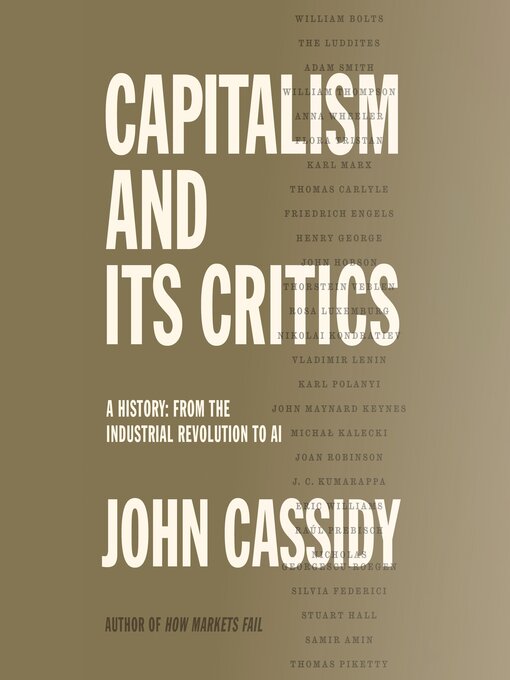
Capitalism and Its Critics: A History
A Financial Times Most Anticipated Book of 2025A sweeping, dramatic history of capitalism as seen through the eyes of its fiercest critics. At a time when artificial intelligence, climate change, and inequality are raising fundamental questions about the economic system, Capitalism and Its Critics provides a kaleidoscopic history of global capitalism, from the East India Company and Industrial Revolution to the di...
Economics for the future – Beyond the superorganism
Our environment and economy are at a crossroads. This paper attempts a cohesive narrative on how human evolved behavior, money, energy, economy and th…
Why the super rich are inevitable
Why some mathematicians argue the economy is designed to create a few super rich people – unless we stop it.

The marketplace of rationalizations
Recent work in economics has rediscovered the importance of belief-based utility for understanding human behaviour. Belief ‘choice’ is subject to an important constraint, however: people can only bring themselves to believe things for which they can find rationalizations. When preferences for similar beliefs are widespread, this constraint generates rationalization markets, social structures in which agents compete to produce rationalizations in exchange for money and social rewards. I explore the nature of such markets, I draw on political media to illustrate their characteristics and behaviour, and I highlight their implications for understanding motivated cognition and misinformation.

The Syllabus on Twitter / X
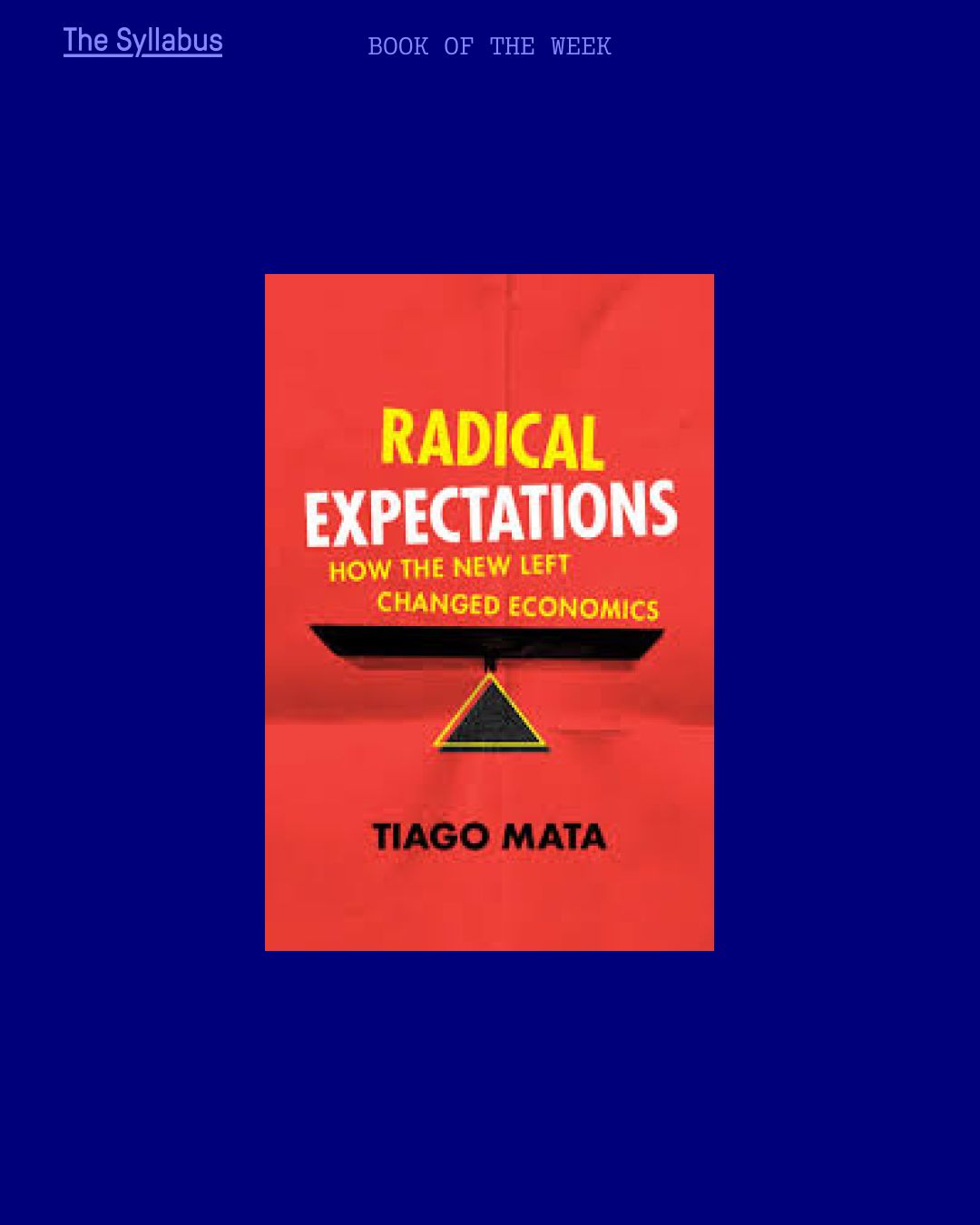
In the 1970s, radical economists left the university to work as activists. From the Union for Radical Political Economics to economic affairs bulletins, our book of the week investigates how the New Left changed economics.By Tiago Mata on @CambridgeUPhttps://t.co/aQQi9nqd0C pic.twitter.com/FM1A9nK5vN— The Syllabus (@syllabus_tweets) September 1, 2026
Pluralistic: Goodhart’s Law vs “prediction markets” (24 Mar 2026) – Pluralistic: Daily links from Cory Doctorow
The most selectively believed-in verse in the conservative catechism is the idea that "incentives matter."

Milton Friedman
Blog de sciences économiques et sociales de Martin Anota. Traductions, revues de presse.
.png)
What Theory is Not, Theorizing Is
Kill Math
The power to understand and predict the quantities of the world should not be restricted to those with a freakish knack for manipulating abstract symbols.
The Nobel for Econsplaining
Acemoglu, Johnson and Robinson won a prize for applying economics to the very things economics is inherently bad at figuring out

annotations: Les économistes orthodoxes sont incapables d’expliquer les inégalités domestiques et la compétition entre les nations
Blog de sciences économiques et sociales de Martin Anota. Traductions, revues de presse.