


Missed opportunities are not the events that define us.
Does Your Brain Think Accurately About Time?
Chicago Booth’s Kristin Donnelly talks about her research on time-duration asymmetry.

Chasing life goals is a recipe for disaster – so try these tiny experiments instead
Whether its our careers, health or relationships, we often set the bar too high and end up feeling disappointed when it doesn’t work out. Try this new way of thinking … and you may just see some real results

Locating Family Values: A Field Trial of the Whereabouts Clock: (Nominated for the Best Paper Award)
When Bad Things Happen in Slow Motion - Nautilus
Is there more to our experience of time than the foibles of memory?

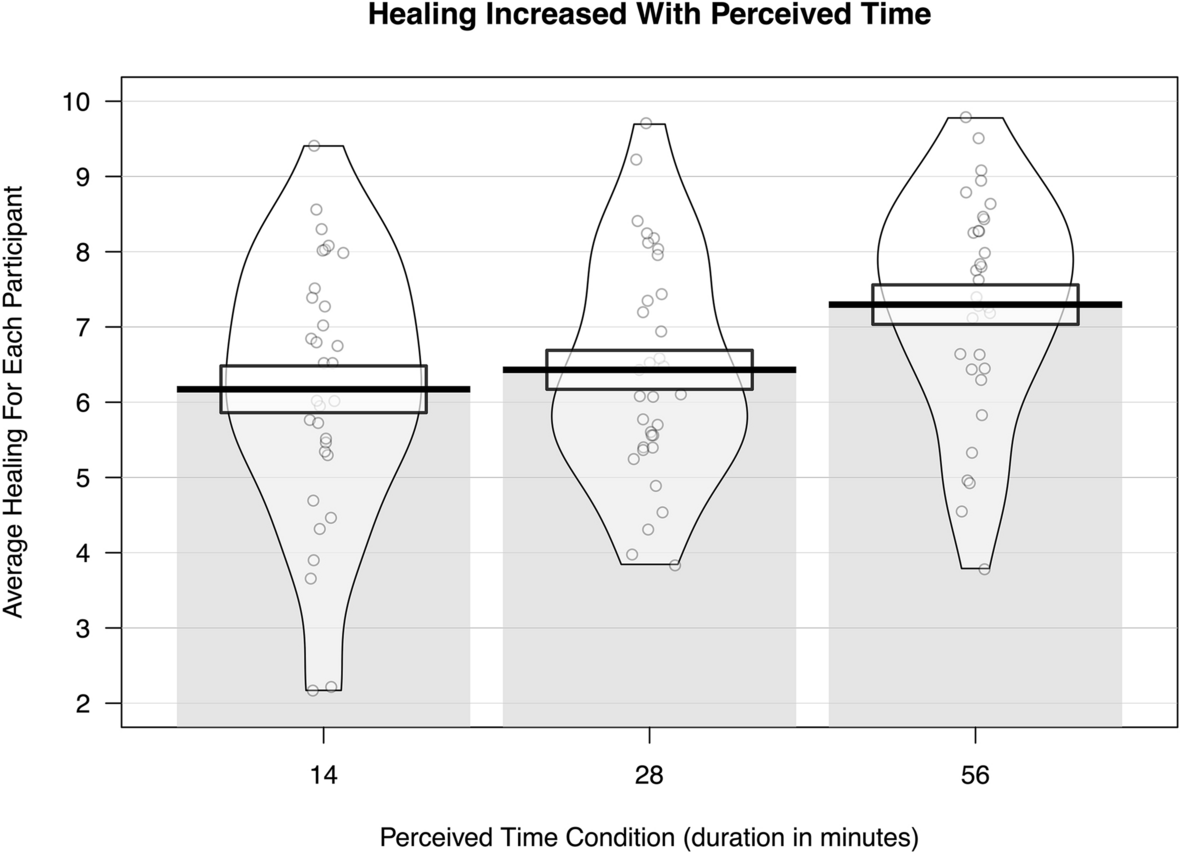
Physical healing as a function of perceived time
In this study we wounded study participants following a standardized procedure and manipulated perceived time to test whether perceived time affected the rate of healing. We measured the amount of healing that occurred across three conditions using a within-subjects design: Slow Time (half as fast as clock time), Normal Time (clock time), and Fast Time (twice as fast as clock time). Based on the theory of mind–body unity—which posits simultaneous and bidirectional influences of mind on body and body on mind—we hypothesized that wounds would heal faster or slower when perceived time was manipulated to be experienced as longer or shorter respectively. Although the actual elapsed time was 28 min in all three conditions, significantly more healing was observed in the Normal Time condition compared to the Slow Time condition, in the Fast Time condition compared to the Normal Time condition, and in the Fast Time condition compared to the Slow Time condition. These results support the hypothesis that the effect of time on physical healing is directly affected by one’s psychological experience of time, independent of the actual elapsed time.
Time anxiety: is it too late?
I have always struggled with a thought: it’s too late. Too late to publish a book, to start a company, to learn a new language. This is called time anxiety.
Izabella Kaminska on Twitter / X
The problem of our time is not merely information overload. It is that the time required to construct a coherent understanding of reality is becoming longer than the time during which that understanding remains valid.— Izabella Kaminska (@izakaminska) October 16, 2026

Learning From Older Adults: An Intergoal Compatibility Account for Successful Happiness Pursuit
Academic Abstract People want to pursue happiness but often fail, a phenomenon known as the paradox of pursuing happiness. The mechanisms underlying this paradox remain elusive. Age differences in happiness—specifically that older adults appear more successful in pursuing happiness (the emotion paradox of aging)—provide valuable insights into effective happiness pursuit. Drawing on this literature, we propose an intergoal compatibility account to interpret both paradoxes through the lens of intergoal interactions, an intuitively critical yet underexplored factor in existing interpretations. This account asserts that greater compatibility (fewer conflicts and greater facilitation) between happiness pursuit and other important personal goals enhances the effectiveness of happiness pursuit, and such compatibility can be enhanced through contextual influences (e.g., age-graded developmental tasks) and strategic self-regulation (e.g., goal adjustments). This account generates testable predictions and practical implications for enhancing happiness pursuit across the lifespan. Public Abstract Why do people often struggle to achieve happiness? And why are older adults happier than younger adults, even though they face more losses in life? While these questions have drawn extensive attention, they remain puzzling. A crucial yet insufficiently explored factor in successful happiness pursuit is intergoal compatibility —the extent to which the pursuit of happiness aligns or conflicts with other important personal goals. For younger adults, the demands of age-related developmental tasks (e.g., educational and career aspirations) often create conflicts with the pursuit of happiness, diminishing its effectiveness. Conversely, in older adults, happiness becomes more prioritized and compatible with other important personal goals, thereby enhancing the effectiveness of pursuing happiness. A lesson we can learn from older adults is to pursue happiness in ways compatible with other important personal goals.

Everything is In-Between — Douglas Rushkoff
I’ve begun this piece maybe twenty times in the past three weeks. By the time I’ve finished the first paragraph, some new thing happens that obsolesces whatever event I’m writing about. And I’m not even writing about the news, so much as using one shared moment as a “peg” for a piece about some larger phenomenon or strategy.
Why I'm Always Late
There's not really any other explanation—chronically late people are actually insane.

This column will change your life: just sit down and think
'No wonder we don't dwell on what's inside: that would underline the loneliness of existence,' says Oliver Burkeman
The Weirdness of Dating/Mating: Deep Nonconsent Preference — LessWrong
Every time I see someone mention statistics on nonconsent kink online, someone else is surprised by how common it is. So let’s start with some statis…

We Chose Frictionless. It Left Us Empty.
On what my parents understood about creating relationships that we have forgotten — and why the inconvenience is the whole point.

Death to Bullshit
If you think about it, our attention is the only thing we truly own in our lives. Our possessions can go away. Our bodies can be compromised. Our relationships can fall apart. Even our memories and intellectual capacity fade away.

And why, while flawed, the study isn't meaningless or worthless - everyone's take is just lacking nuance:

Ariel M. (she/her)
Yes mostly. The paper (still a preprint, so not peer-reviewed) does start off kinda strong in its claims compared to what the results show. But they acknowledge all the limitations too: - this captured brief AI exposure, so did not look at how these effects change with usage over time