


In the White House’s first gathering of A.I. companies, Vice President Kamala Harris told the leaders of major tech companies they had a “moral” obligation to keep products safe.
White House Accord on Super Intelligence | The American Presidency Project
In order to build a positive future for the American people and the world, we believe every company is responsible for developing its own technology safely and in a way that builds trust with customers and the public.
Opinion | These A.I. Policies Will Hurt Our Business. We Should Do Them Anyway.
The risks posed by A.I. are too great to forgo any regulation, even for those who stand to gain tremendously from the technology’s rise.

Misuse of AI is brands’ top reputational threat, new survey says
The findings come after warnings from tech leaders that AI placed in the wrong hands could trigger larger threats such as nuclear war or bioweaponry destruction
Lina Khan on Twitter / X
Law enforcers already have authority to charge companies and their CEOs for creating and releasing dangerous, unvetted, or defective products. We shouldn’t let discussions about new legal regimes distract from the fact that there’s no AI exemption from laws already on the books —…— Lina Khan (@linamkhan) September 13, 2026
White House Considers Vetting A.I. Models Before They Are Released
The Trump administration, which took a noninterventionist approach to artificial intelligence, is now discussing imposing oversight on A.I. models before they are made publicly available.

Opinion | How Scared Should We Be of A.I. Right Now?
The dark and distressing way that Silicon Valley talks about A.I. can be traced to a philosophy that influenced many tech executives.

Report Showcases How Elon Musk Undermined His Own Engineers And Endangered Public Safety
For a long time now, it’s been fairly clear that consumer safety was an afterthought for some of the more well known companies developing self-driving technology. That was made particularly c…

Pentagon says it is labeling AI company Anthropic a supply chain risk 'effective immediately'
The Trump administration is following through with its threat to designate artificial intelligence company Anthropic as a supply chain risk in an unprecedented move that could force other government contractors to stop using the AI chatbot Claude.
OpenAI president urges AI safeguards as group he funds opposes regulation
As OpenAI executives step up their public calls for federal AI safety rules, a political group the company’s president helped fund is spending millions to elect members of Congress who oppose restrictions on the technology.

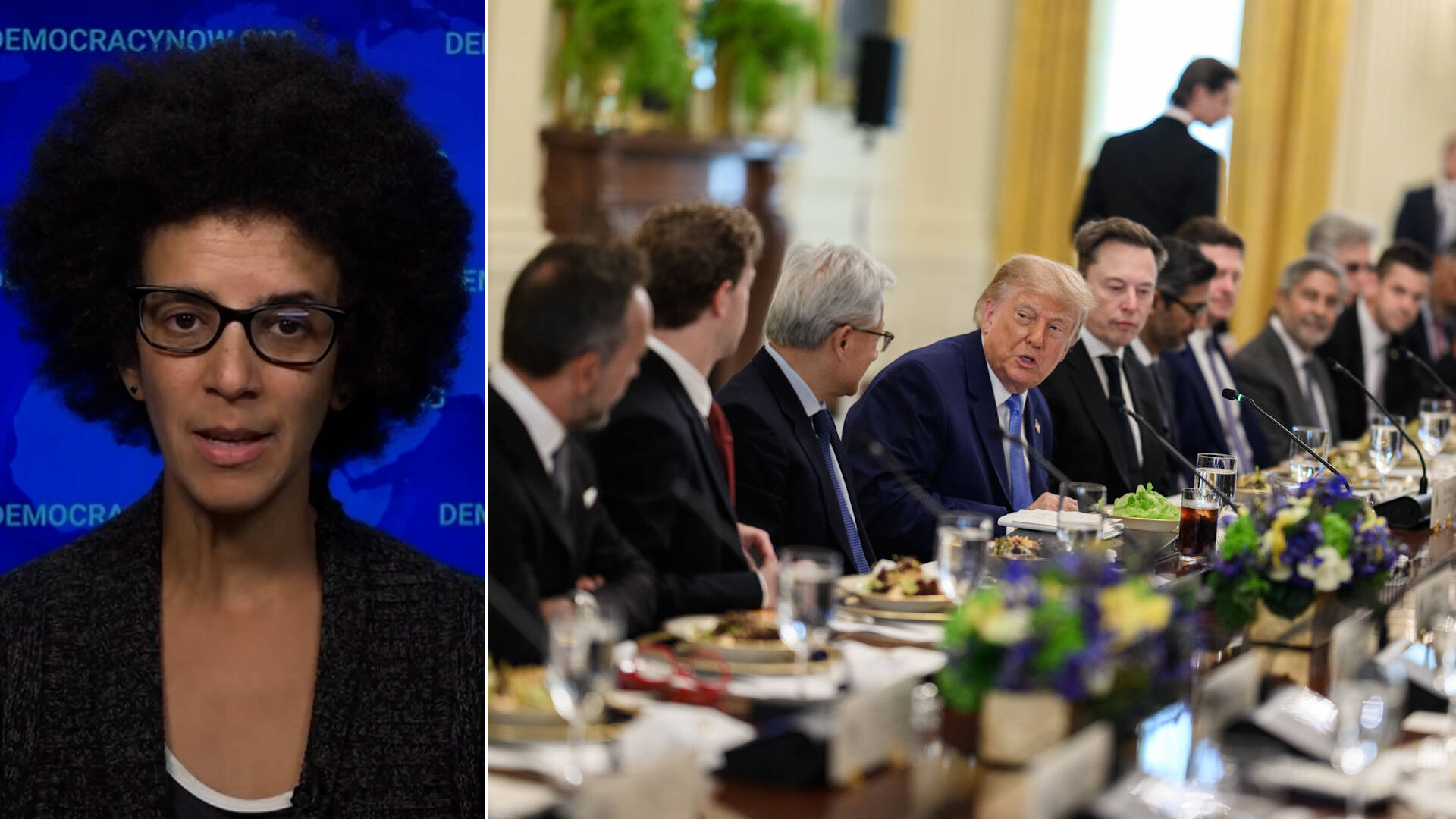
The Real Existential Risk Is AI CEOs Avoiding Oversight: “Alternative Nobel” Winner Timnit Gebru
We speak to the prominent AI researcher and leading critic of the AI industry, Timnit Gebru, who was recently awarded a 2026 Right Livelihood Award for her work investigating the harms and hype behind the global buildup of artificial intelligence. “Instead of discussing faulty, unreliable systems,” Gebru says tech leaders like SpaceXAI’s Elon Musk, OpenAI’s Sam Altman and Anthropic’s Dario Amodei are “marketing their systems as all-knowing, superpowerful, superintelligent,” and lobbying for “self-policing and self-regulation” to avoid being held “liable through existing laws.” Gebru expresses skepticism over increasingly widespread claims that AI algorithms pose an existential risk to humanity, warning that such claims are overblown and that “what is actually happening is regulatory capture.”
Fed Chair Jerome Powell, Treasury's Bessent and top bank CEOs met over Anthropic's Mythos model
Financial industry leaders met to discuss potential cyber risks posed by Anthropic's latest AI model, which has found weaknesses in every major computer operating system.
Promoting Advanced Artificial Intelligence Innovation and Security
By the authority vested in me as President by the Constitution and the laws of the United States of America, it is hereby ordered: Section 1. Purpose.
The Biden Harris administration is proud to bring you “AI safety (tm)” brought to you by Open AI, Google, Meta, Anthropic and all the usual suspects. Literally 0 communities that aren’t tech or not invested in genai involved in this. What a joke. https://t.co/rESU5rbp0k
The Biden Harris administration is proud to bring you “AI safety (tm)” brought to you by Open AI, Google, Meta, Anthropic and all the usual suspects. Literally 0 communities that aren’t tech or not invested in genai involved in this. What a joke. https://t.co/rESU5rbp0k— Karla Ortiz (@kortizart) February 23, 2024
Books — Sharon Weinberger
Drawing on deep, exclusive reporting, a veteran national security correspondent reveals how a new military-industrial complex is arising from the cradle of Silicon Valley, with vast implications for American democracy and the global balance of power.Elon Musk, Peter Thiel, and Alexander Karp. These tech titans are fast becoming some of the most powerful figures in the realm of national security, with enormous implications for us all. As Sharon Weinberger reveals in this gripping account, the American military and spy agencies helped to create Silicon Valley as we now know it, and some of its biggest and most valuable companies today owe much of their success to the Pentagon and CIA. Beginning with the War on Terror and accelerating under Donald Trump, however, the old alliance between elected leaders in Washington and the unelected CEOs of Silicon Valley has grown increasingly uneasy as power has shifted to the private sector and Big Tech exerts greater and greater influence over its old patrons. Companies such as SpaceX and Palantir, along with newer entrants to the field such as Anduril, are proudly supporting—and quietly shaping—US national defense, whether by providing spies and soldiers with AI and cloud-computing tools or actual military hardware such as microwave weapons, hypersonic missiles, and advanced drones. The implications of this historic shift are poorly understood and fraught with peril. What happens when mercurial billionaires like Elon Musk control weapons and technologies that were once the preserve of the US government? How will this new military-industrial complex affect the way wars are fought, or even which wars are fought? That is the urgent question before us today, at the dawn of this new era—and as Weinberger reveals, it is one on which our collective future might well hinge.
Who’s responsible for AI? Verity Harding on AI policy and ethics | 1Password
Who’s responsible for regulating technological change in a democracy? Verity Harding, a globally recognized AI expert, shares her thoughts on policy and tech.
