


We don’t use A.I. to write articles, and journalists are ultimately responsible for everything that we publish.
Policies and Standards
Newsweek is committed to accurate, independent, ethical and responsible journalism. We report fairly; we attribute clearly; we correct mistakes transparently. Our editorial policies and processes are always intended to support those values

AI in journalism: Live tracker of scandals and mistakes
AI in journalism: Live tracker of mistakes and mishaps from the Mississippe Free Press to the New York Times.

We Talked to a Writer Accused of Publishing An AI-Generated Essay in The New York Times
She was accused of publishing AI slop in The New York Times. She says she didn't use AI to generate content — but did use AI to get published.

What do "which is A.I.?" quizzes tell us?
This newsletter is brought to you by Squarespace.

Report: AI Use in Newspapers Is Widespread, Uneven… | Maryland Today
UMD Computer Scientists, Private Firms Examine News and Opinion Pages in U.S. Media

AI use in American newspapers is widespread, uneven, and rarely disclosed
AI is rapidly transforming journalism, but the extent of its use in published newspaper articles remains unclear. We address this gap by auditing a large-scale dataset of 186K articles from online editions of 1.5K American newspapers published in the summer of 2025. Using Pangram, a state-of-the-art AI detector, we discover that approximately 9% of newly-published articles are either partially or fully AI-generated. This AI use is unevenly distributed, appearing more frequently in smaller, local outlets, in specific topics such as weather and technology, and within certain ownership groups. We also analyze 45K opinion pieces from Washington Post, New York Times, and Wall Street Journal, finding that they are 6.4 times more likely to contain AI-generated content than news articles from the same publications, with many AI-flagged op-eds authored by prominent public figures. Despite this prevalence, we find that AI use is rarely disclosed: a manual audit of 100 AI-flagged articles found only five disclosures of AI use. Overall, our audit highlights the immediate need for greater transparency and updated editorial standards regarding the use of AI in journalism to maintain public trust.

AI use in American newspapers is widespread, uneven, and rarely disclosed
AI is rapidly transforming journalism, but the extent of its use in published newspaper articles remains unclear. We address this gap by auditing a large-scale dataset of 186K articles from online editions of 1.5K American newspapers published in the summer of 2025. Using Pangram, a state-of-the-art AI detector, we discover that approximately 9% of newly-published articles are either partially or fully AI-generated. This AI use is unevenly distributed, appearing more frequently in smaller, local outlets, in specific topics such as weather and technology, and within certain ownership groups. We also analyze 45K opinion pieces from Washington Post, New York Times, and Wall Street Journal, finding that they are 6.4 times more likely to contain AI-generated content than news articles from the same publications, with many AI-flagged op-eds authored by prominent public figures. Despite this prevalence, we find that AI use is rarely disclosed: a manual audit of 100 AI-flagged articles found only five disclosures of AI use. Overall, our audit highlights the immediate need for greater transparency and updated editorial standards regarding the use of AI in journalism to maintain public trust.
How the NYT Missed the Story of the Holocaust While It Was Happening
What did The New York Times report about the Holocaust and how did its coverage affect America’s response to the Nazi genocide?Throughout World War II, the American media published and broadcast timely, detailed, and accurate accounts of what was happening to the Jews in Europe. The New York Times alone printed nearly 1,200 articles about what we have now come to call the Holocaust, about one every other day. The articles in the Times and elsewh


Artificial Intelligence in the News: How AI Retools, Rationalizes, and Reshapes Journalism and the Public Arena
<p>Download the pdf here. Executive Summary Despite growing interest, the effects of AI on the news industry and our information environment — the public arena — remain poorly understood. Insufficient attention has also been paid to the implications of the news industry’s dependence on technology companies for AI. Drawing on 134 interviews with news workers […]</p>

NYT: Boycott, Divest, Unsubscribe — WRITERS AGAINST THE WAR ON GAZA
The New York Times is not unique among media outlets in manufacturing consent for war, for exploitation, for genocide. It is, rather, exemplary. The Times’ reputation for liberalism, for rigor, for non-partisan independence is precisely what makes it so dangerous, because it hides what it really is: a publication that exists to serve the interests of U.S. imperialism.
AI News Audit: AI, Canadian Journalism, and Paths for Policy Action — Centre for Media, Technology and Democracy
March 16, 2026 - AI companies built their products using Canadian journalism without permission and without compensation, and are now delivering that journalism to consumers as their own product. Existing copyright and media policy frameworks were not designed to address this. In February and Marc

Home | International Center for Journalists
We enable a global network of journalists to provide the trustworthy news essential to free and strong societies.

personally I think it's a very big deal that the Canada bureau chief for the @nytimes.com — certainly one of the highest-paid journalists in the country — asked an unspecified "AI tool" what Poilievre said & published its AI-hallucinated quotes in her reporting.
personally I think it's a very big deal that the Canada bureau chief for the @nytimes.com — certainly one of the highest-paid journalists in the country — asked an unspecified "AI tool" what Poilievre said & published its AI-hallucinated quotes in her reporting.
US media: The Washington Post

For context, I’m a former NYT and WaPo subscriber who wishes the former would do better and has given up on the latter Search terms: Jeff Bezos

One Year Into Clampdown, WaPo Opinion Cheers for MAGA, Billionaires and AI

Washington Post to cut one-third of all staff
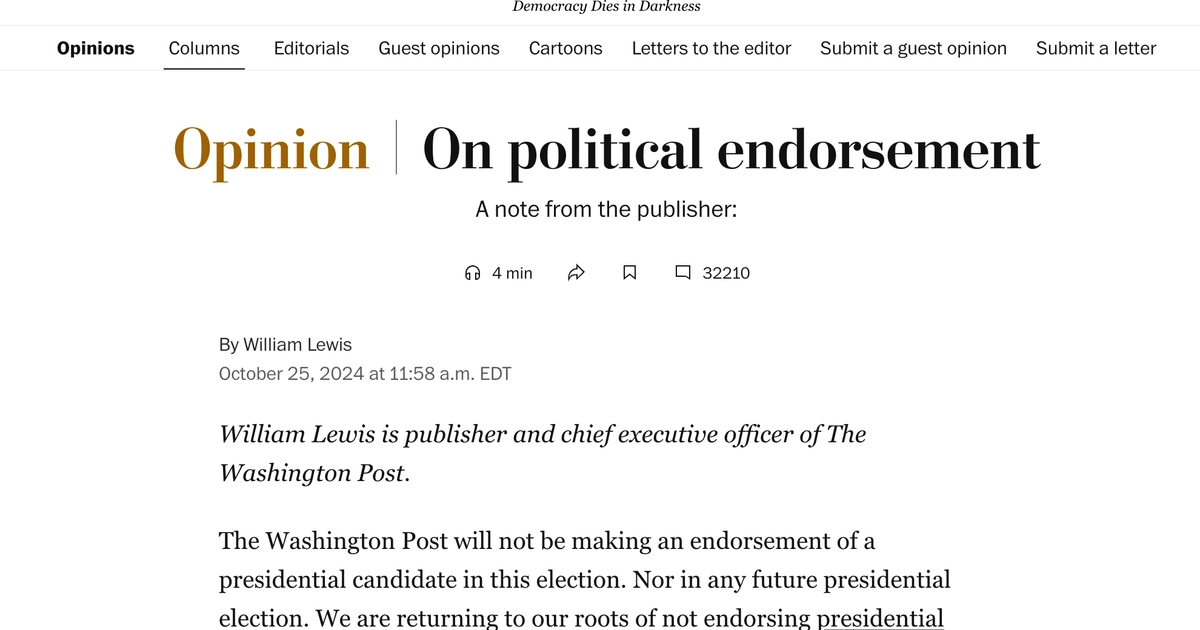
The Washington Post sold Democracy. Now it needs a new line of business.

More than 250,000 subscribers have left 'Washington Post' over withheld endorsement

Washington Post Has Lost 250K Subscribers, LA Times 18,000 Since Owners Axed Kamala Harris Endorsements

The Washington Post has broken my heart | Will Bunch Newsletter
