People and institutions of civil society must coordinate against him.
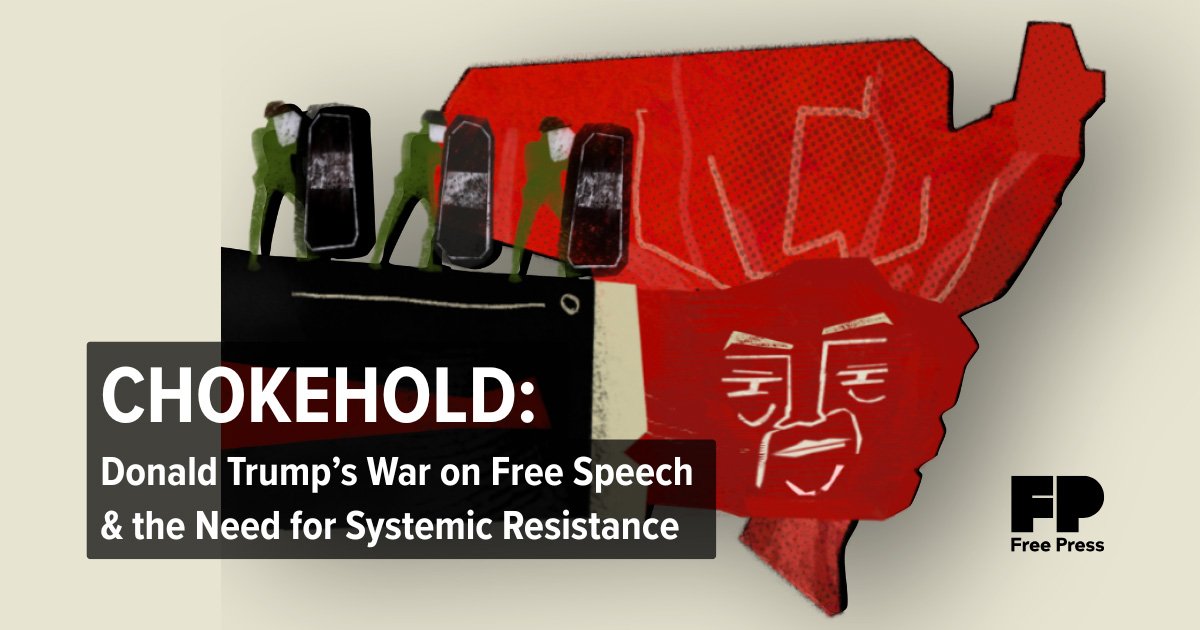
Chokehold: Donald Trump’s War on Free Speech & the Need for Systemic Resistance
This Free Press report examines the Trump administration’s hostile relationship with dissent and free expression in 2025. It analyzes how Trump and his political enablers have sought to undermine and chill the most basic freedoms protected by the First Amendment.
The Predatory Hegemon
Ever since Donald Trump first became U.S. president, in 2017, commentators have searched for an adequate label to describe his approach to U.S. foreign relations. Writing in these pages, the political scientist Barry Posen suggested in 2018 that Trump’s grand strategy was “illiberal hegemony,” and the analyst Oren Cass argued last fall that its defining essence was a demand for “reciprocity.” Trump has been called a realist, a nationalist, an old-fashioned mercantilist, an imperialist, and an isolationist.

What Trump Sells Is Impunity
Trump stands out in the GOP not for his racism, but his vision of emancipatory irresponsibility.
Opinion | I Am Part of the Resistance Inside the Trump Administration (Published 2018)
I work for the president but like-minded colleagues and I have vowed to thwart parts of his agenda and his worst inclinations.

How Trump Made Penn Quake in Its Boots
Fearful of being labeled antisemitic, the University of Pennsylvania has acquiesced to the demands of a punitive Trump administration and vindictive donors—and it’s chilling speech both inside and outside the classroom.

Matthew Sheffield (@mattsheffield@mastodon.social)
🧵 As a former Republican consultant who left in 2015, I'm often asked why Trump and his minions are willingly destroying science, K12 education, universities, international organizations, public broadcasting, and social welfare institutions. There are many reasons, but the main ones are psychological rather than ideological. They struggle with abstract thinking and are afraid of the world...
Regime Change: Inside the Imperial Presidency of Donald Trump
INSTANT #1 NEW YORK TIMES BESTSELLER “Regime Change is exceptional. It transcends its genre...the book is packed with news that will stay news...This is reporting of consequence.” —David Remnick, The New Yorker “A flabbergasting feat of political reporting.” —Tina Brown “Riveting and richly textured...What the authors add is the vivid detail that makes these events feel actual. They wrest reality itself back from the distorted world of entertainment, illusion, fantasy, and denial that Trump has generated around himself. It is this flood of provocation, atrocity, self-dealing, and fabrication that makes Haberman and Swan’s counternarrative so vital.” —Fintan O’Toole, The New York Times A riveting, intimate, and revelatory account of the most radical and consequential presidency of our time.From the two reporters who have covered him more closely than perhaps anyone else over the past decade comes this definitive portrait of Donald Trump in the White House. Regime Change covers the first year of Trump’s second presidency—a term liberated from every constraint that defined his first. The generals who once told him “no” are gone, and the lawyers who remain have learned to pick their battles. His administration has flouted court orders and he has claimed powers that Congress once checked. What remains is a President willing to take enormous risks that have upended global markets and toppled heads of state; an imperial President operating almost entirely on instinct alone. Based on hundreds of interviews and unprecedented reporting from deep within the administration’s most closely guarded rooms, Regime Change takes the reader inside the Situation Room and into the secret Oval Office deliberations that have launched a new war in the Middle East and seen Trump seal the border, surge National Guard troops into cities, and send immigration agents into deadly clashes with protestors. Maggie Haberman and Jonathan Swan bring us behind the scenes of a presidency that has transformed the culture, turned the Justice Department into an agent of retribution against the President’s enemies and the office itself into a brazen vehicle for profit. They reveal a second term propelled by a historical irony that Trump himself has come to understand: that the indictments, the convictions, the assassination attempts, and four years of exile made him not weaker but far more powerful, more vengeful, and more willing to gamble than any President in modern history. This is the story of how Trump has used that power, who has tried to stop him, and why nearly all of them have failed. It is also the story of something American journalists are more accustomed to chronicling in distant capitals than in their own: a President who has fundamentally altered the nature of the office he holds—and, with it, how the rest of the world understands American power. It is an account of Regime Change right here in America—a landmark real-time history of a modern presidency like no other.
On Courage: How to Be a Dissident in an Age of Fear
From a Pulitzer Prize-winning investigative journalist and a former White House senior advisor, a deeply reported manual for how individuals can resist America's slide away from democracy, based on original interviews with more than 100 dissidents, activists, and theorists across the world. The United States has crossed into a new and unfamiliar realm--one in which daring to challenge the state carries real danger. Ordinary Americans now face a government that feels more like foreign autocracies, with a White House stretching the powers of the presidency beyond recognition. The sitting president wields fear as a weapon, punishes political enemies, intimidates sitting members of Congress, bends private businesses to his will, and disappears student protesters off the streets. Based on their acclaimed The New Yorker essay "So You Want to Be a Dissident: A Practical Guide to Courage in Trump's Age of Fear," Pulitzer Prize-winning investigative journalist Julia Angwin and former White House senior advisor Ami Fields-Meyer deliver a guide to courage in America's age of fear. On Courage is a captivating collection of stories and lessons from the front lines of the fight for the future of the free world that invite action and rouse hope. Step into the room where the world's new dissidents--ordinary people, in the U.S. and around the world, who never aspired to be activists--are writing the playbook for courage, risk, and resistance in the age of authoritarianism and unprecedented digital surveillance. On Courage simplifies the calculus of activism by making more accessible than ever the fundamentals of taking political risk. It's a handbook that is equal parts practical and spiritual, a valuable resource and a powerful message for anyone, anywhere, who feels the walls of history closing in on them.
DOJ Using Gang, Terrorist Prosecutors To Ensure People Opposed To Trump Are Treated Like Gang Members, Terrorists
The authoritarianism has been out in the open pretty much since day one with this presidency. Things that leak out around the edges — unaccompanied by official statements, announcements, or r…

‘Now we’re in a power struggle’: Europe’s resentment grows over Trump’s newest provocations
President Trump has backed off his threats toward Denmark's territorial sovereignty, but he and aides have continued to irritate much of Europe.
Donald Trump: A Critical Theory-Perspective on Authoritarian Capitalism
This paper analyses economic power, state power and ideological power in the age of Donald Trump with the help of critical theory. It applies the critical theory approaches of thinkers such as Franz Neumann, Theodor W. Adorno and Erich Fromm. It analyses changes of US capitalism that have together with political anxiety and demagoguery brought about the rise of Donald Trump. This article draws attention to the importance of state theory for understanding Trump and the changes of politics that his rule may bring about. It is in this context important to see the complexity of the state, including the dynamic relationship between the state and the economy, the state and citizens, intra-state relations, inter-state relations, semiotic representations of and by the state, and ideology. Trumpism and its potential impacts are theorised along these dimensions. The ideology of Trump (Trumpology) has played an important role not just in his business and brand strategies, but also in his political rise. The (pseudo-)critical mainstream media have helped making Trump and Trumpology by providing platforms for populist spectacles that sell as news and attract audiences. By Trump making news in the media, the media make Trump. An empirical analysis of Trump’s rhetoric and the elimination discourses in his NBC show The Apprentice underpins the analysis of Trumpology. The combination of Trump’s actual power and Trump as spectacle, showman and brand makes his government’s concrete policies fairly unpredictable. An important question that arises is what social scientists’ role should be in the conjuncture that the world is experiencing.See also the related blog post "How The Frankfurt School Helps Us To Understand Donald Trump’s Twitter Populism"http://www.huffingtonpost.co.uk/christian-fuchs1/how-the-frankfurt-school-_b_14156190.html?utm_hp_ref=uk-donald-trumpThe German translation of this shorter piece was published in Der Falter 5/2017: 21-23.
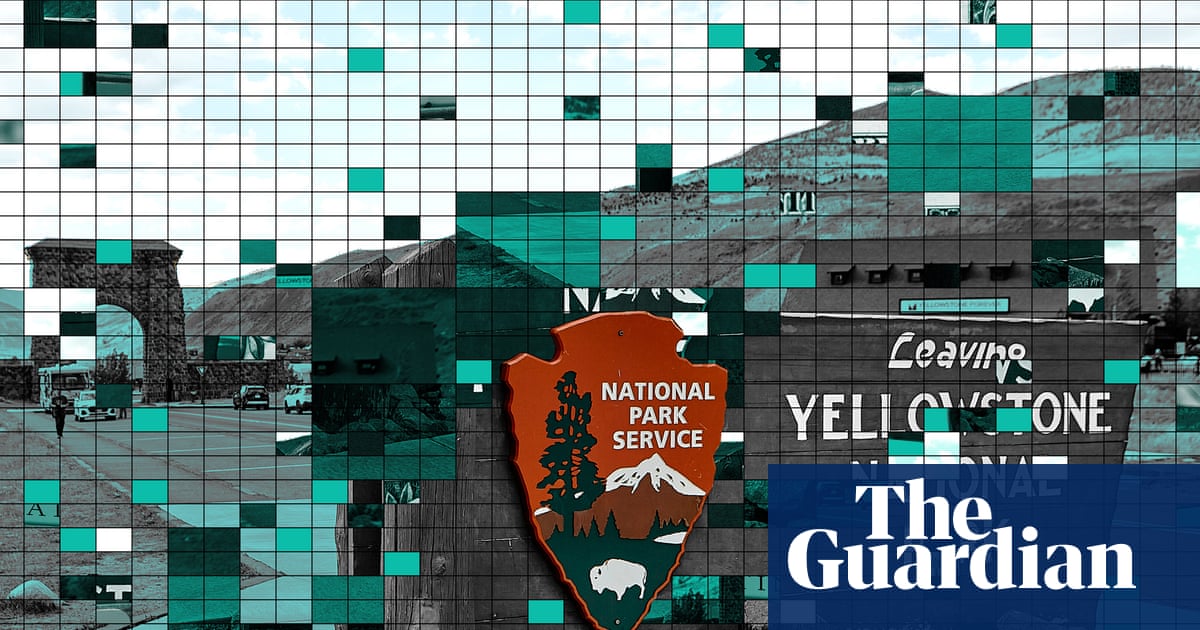
‘A sanitized view of America’: inside Trump’s campaign to erase US history from national parks
Critics say the Trump administration is trying to rewrite and whitewash history by removing and altering scores of signs on public lands
Pluralistic: Preparing for a post-Trump internet (03 Sep 2026) – Pluralistic: Daily links from Cory Doctorow
I know, it's tempting to think of Trump as a cause, rather than an effect – as an aberration who dragged America into fascism. Trump is exceptional, but the thing that makes him exceptional isn't his corruption, recklessness or cruelty. What makes Trump exceptional is his ability to cajole, intimidate and flatter America's most corrupt, reckless and cruel people into a coalition.
Colorado Was Targeted as Trump Fumed Over Election Denier, Email Shows
The state has accused the government in a lawsuit of retaliating after the conviction of Tina Peters, a Trump supporter. An administration official convened a group to discuss “immediate actions.”

Trump Told Supporters To “Cheat Like Hell.” The NY Times Went With “A Bit Tired Of Politics.”
By now it’s old hat to point out that the mainstream media bends over backwards to pretend that Donald Trump is a “normal” president. The number of times you could point to the co…
An American Tragedy
The electorate has, in its plurality, decided to live in Trump’s world of vanity, hate, arrogance, untruth, and recklessness.