


New research sheds light on how mediocre employees help would-be authoritarians maintain power.
The Myth of Authoritarian Efficiency
When it comes to getting stuff done, democracies win every time.
Whitepaper — The Collective Intelligence Project
I. Capitalist Acceleration: Sacrificing safety for progressII. Authoritarian Technocracy: Sacrificing participation for safetyIII. Shared Stagnation: Sacrificing progress for participation


The Authoritarian Stack
How Tech Billionaires Are Building a Post-Democratic America — And Why Europe Is Next
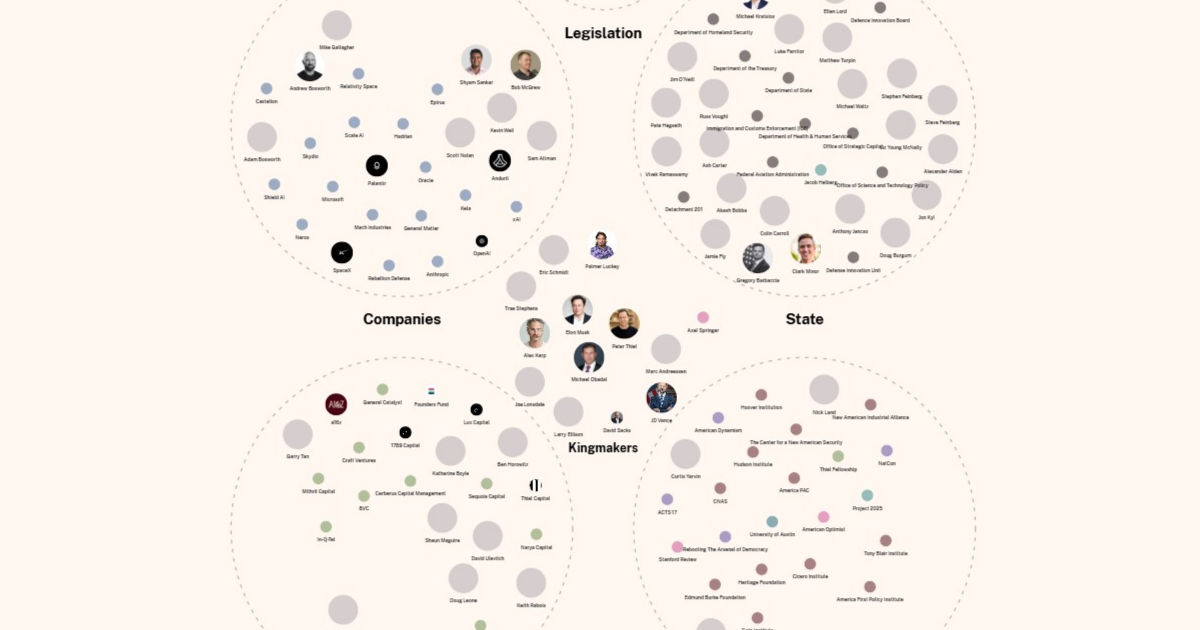
The Authoritarian Stack
How Tech Billionaires Are Building a Post-Democratic America — And Why Europe Is Next
POLYBIUS ACI
Authoritarian Consolidation Index - Real-time democratic health monitoring powered by political science research and AI
The Dispersion of Power: A Critical Realist Theory of Democracy
Abstract The Dispersion of Power is an urgent call to rethink centuries of conventional wisdom about what democracy is, why it matters, and how to make it better. Drawing from history, social science, psychology, and critical theory, it explains why elections do not and cannot realize the classic ideal of popular rule, and why prevailing strategies of democratic reform often make things worse. Instead, Bagg argues, we should see democracy as a way of protecting public power from capture—an alternative vision that is at once more realistic and more inspiring. Despite their many shortcomings, real-world elections do prevent the most extreme forms of tyranny, and are therefore indispensable. In dealing with the vast inequalities that remain, however, we cannot rely on standard solutions such as electoral reform, direct democracy, deliberation, and participatory governance. Instead, Bagg shows, protecting and enriching democracy requires addressing underlying inequalities of power directly. In part, this entails substantive policies attacking the advantages of wealthy elites. Even more crucially, deepening democracy requires the organization of oppositional, countervailing power among ordinary people. Neither task is easy, but historical precedents exist in both cases—and if democracy is to survive contemporary crises, leaders and citizens alike must find ways to revive and reinvent these essential democratic practices for the twenty-first century.

The most powerful institution in most people’s lives is their workplace. We care deeply about governmental democracy but accept dictatorships where we spend most of our waking hours. The cooperative movement has proven it doesn’t have to be this way.
You Can’t Post Your Way Out of Fascism
Authoritarians and tech CEOs now share the same goal: to keep us locked in an eternal doomscroll instead of organizing against them, Janus Rose writes.

Jeremy Gilbert on Twitter / X
Really useful analysis of NR / neo-monarchism/ long-termism as authoritarian responses to the perception that democracy just can't get anything done (cos it's locked in to the short-termism of the popularity / electoral cycle). Free to read here: https://t.co/U4z0qmBReM https://t.co/NG4XIUM6O8— Jeremy Gilbert (@jemgilbert) September 21, 2026
Freedom Now | Polity: Vol 52, No 3
Left-wing politics is resurgent. Self-proclaimed socialists are unexpectedly popular. Proposals like universal health care are a commonplace of Democratic campaigns. But there is not yet a clear, unifying idea behind this political shift. We propose that that idea is freedom. While the left once understood freedom as emancipation from the economy, the right spent the twentieth century neutralizing and appropriating the idea of freedom by reinventing the economy as the true site of freedom. To reclaim freedom as a value of the left, we have to begin with the daily experience of most people: the unfreedom of the workplace. The authoritarian organization of work is not just an offense against freedom; it also helps us understand how freedom requires emancipation both from the economy and within the economy, and why that emancipation requires mass struggle.

LiberationValues
LibertationValues is a political quiz aimed at anti-authoritarian leftists

LiberationValues
LibertationValues is a political quiz aimed at anti-authoritarian leftists
Dictatorship, Democracy, and Development
Under anarchy, uncoordinated competitive theft by “roving bandits” destroys the incentive to invest and produce, leaving little for either the population or the bandits. Both can be better off if a bandit sets himself up as a dictator—a “stationary bandit” who monopolizes and rationalizes theft in the form of taxes. A secure autocrat has an encompassing interest in his domain that leads him to provide a peaceful order and other public goods that increase productivity. Whenever an autocrat expects a brief tenure, it pays him to confiscate those assets whose tax yield over his tenure is less than their total value. This incentive plus the inherent uncertainty of succession in dictatorships imply that autocracies will rarely have good economic performance for more than a generation. The conditions necessary for a lasting democracy are the same necessary for the security of property and contract rights that generates economic growth.
The authoritarians are winning, we can all see that. Maybe, just maybe, it wouldn't be the worst thing if pro-democracy people stopped being ridiculously naive about social media. berjon.com/media-media/

Media Media
berjon.comIt can also be argued that authoritarianism is just politically superior at administering a political economy of broken promises and stagnating or falling standards of living. hup.harvard.edu/books/9780674976788

The Triumph of Broken Promises — Harvard University Press
www.hup.harvard.edu
