


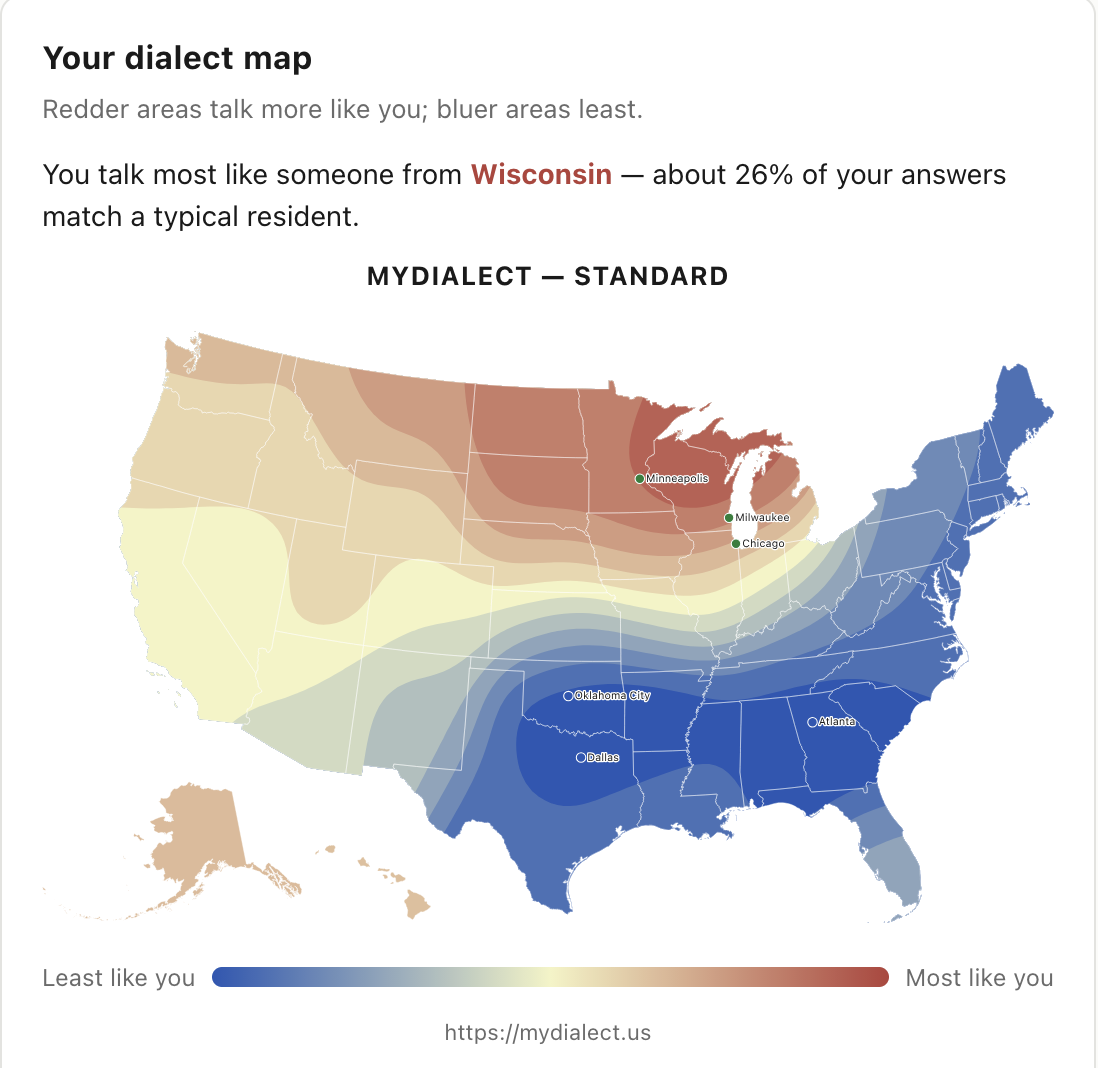
What does the way you speak say about where you’re from? Answer all the questions below to see your personal dialect map.
How Do You Talk? — American Accent Quiz & US Dialect Map
Discover where in the United States people talk like you with this interactive American Accent Quiz. Get a personalized dialect map based on the Harvard Dialect Survey.
Talk recordings and photos for 2026
This year’s Local-First Conf is a warp. Here are the talk recordings from day 1 and 2. Buzz 3rd year at @localfirstconf.com What keeps me coming back isn't...
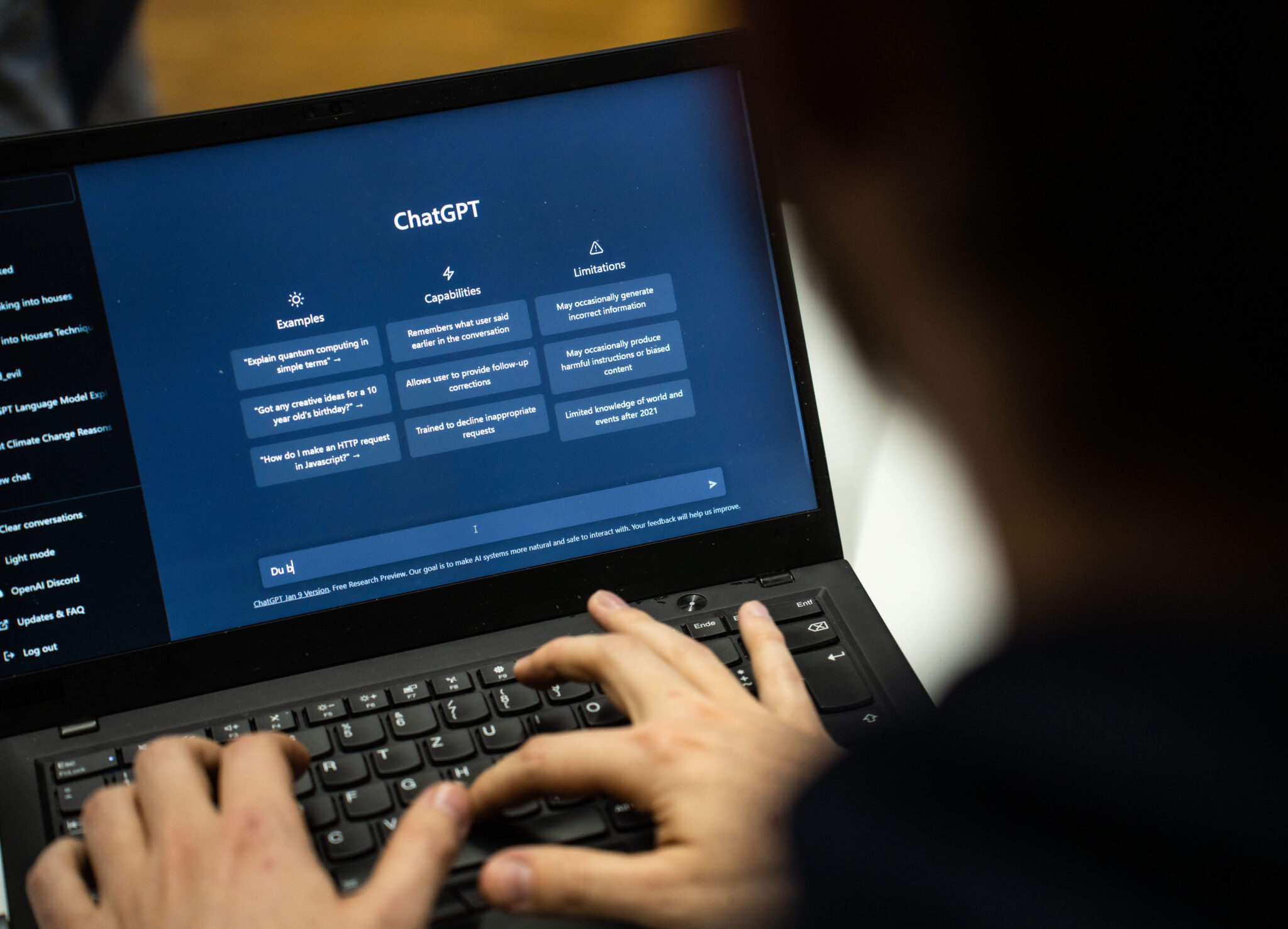
Do You Speak ChatGPTese? Beyond Writing, AI Is Also Flattening The Way We Talk
A study of hundreds of thousands of YouTube videos and podcasts reveals that AI isn’t just changing how we write, it’s subtly altering our spoken language too, raising new concerns about cultural homogenization and who controls the words we use. A study of hundreds of thousands of lectures and podcasts reveals that AI isn’t just changing how we write, it’s subtly altering our spoken language too, raising new concerns about cultural homogenization and who controls the words we use.
In Defense of “Y’all,” a Perfect Word
A New York Times columnist says it’s “much too slangy, regional or what you might even call ethnic to ever gain universal acceptance.” We couldn’t disagree more.

I'm Kenyan. I Don't Write Like ChatGPT. ChatGPT Writes Like Me.
I'm calm. I'm calm. I promise.
The Conversation: In-depth analysis, research, news and ideas from leading academics and researchers.
Curated by professional editors, The Conversation offers informed commentary and debate on the issues affecting our world. Plus a Plain English guide to the latest developments and discoveries from the university and research sector.
Welcome | Yale Grammatical Diversity Project: English in North America
This Project explores syntactic diversity found in varieties of English spoken in North America. By documenting the subtle, but systematic, differences in the syntax of English varieties, it provides a crucial source of data for the development of theories of human linguistic knowledge.
Opinion | Stop Googling. Let’s Talk. (Published 2015)
What have we done to face-to-face conversation?

They have to be able to talk about us without us - Anil Dash
A blog about making culture. Since 1999.

Home – The Discourse.
The Discourse provides community-powered journalism in Cowichan Valley, Nanaimo and Comox Valley. We are here to listen to you and respond with in-depth news about the issues you care about.

On the Alignment of Large Language Models with Global Human Opinion
Today's large language models (LLMs) are capable of supporting multilingual scenarios, allowing users to interact with LLMs in their native languages. When LLMs respond to subjective questions posed by users, they are expected to align with the views of specific demographic groups or historical periods, shaped by the language in which the user interacts with the model. Existing studies mainly focus on researching the opinions represented by LLMs among demographic groups in the United States or a few countries, lacking worldwide country samples and studies on human opinions in different historical periods, as well as lacking discussion on using language to steer LLMs. Moreover, they also overlook the potential influence of prompt language on the alignment of LLMs' opinions. In this study, our goal is to fill these gaps. To this end, we create an evaluation framework based on the World Values Survey (WVS) to systematically assess the alignment of LLMs with human opinions across different countries, languages, and historical periods around the world. We find that LLMs appropriately or over-align the opinions with only a few countries while under-aligning the opinions with most countries. Furthermore, changing the language of the prompt to match the language used in the questionnaire can effectively steer LLMs to align with the opinions of the corresponding country more effectively than existing steering methods. At the same time, LLMs are more aligned with the opinions of the contemporary population. To our knowledge, our study is the first comprehensive investigation of the topic of opinion alignment in LLMs across global, language, and temporal dimensions.
The Conversation Canada (@ca.theconversation.com)
Written by academic experts, edited by journalists, backed by evidence ✉️ Newsletter: http://bit.ly/2W8X3Ev 🎧 Podcast: http://bit.ly/39v1EE0 ➕ Donate: http://bit.ly/3GV1uam

Hey @alexbenzer.com, we're having a discussion on the Discourse that could use your input. #atproto

A lexicon for game activity sharing
discourse.atmosphere.communityWell, well. I’ve been told I have a fairly “neutral” accent, but they guessed my home state based on the Standard Language Quiz with 60 questions (“about 50% of your answers match a typical resident”). mydialect.us/quiz-standard.html

Standard Language Quiz — Dialect Map Quiz
mydialect.usOpportunity for some atproto talks to spread the word about what we’re building in the Atmosphere. Perhaps a @eurosky.social talk?

Maria Farrell
FYI #OpenSource friends: call for papers for Luxembourg's October OS conference. Proposals for 20 min talks are due late August. This makes 2 years I've not been able to go, so, vicariously, please consider it! It's especially strong on OS for sovereignty, gov, AI, and, this year, edtech.


