


Who makes money from destroying reputations online?
Bill Ackman on Twitter / X
Almost nothing makes my blood boil more than when a large powerful institution unfairly destroys someone’s reputation, and its principal reason for doing so is to minimize bad publicity in an effort to protect its own ‘reputation.’ Sadly, I have seen this occur in many academic…— Bill Ackman (@BillAckman) January 2, 2026
“Paging Dr. Fraud”: The Fake Publishers That Are Ruining Science
For years, spurious journals have proliferated online, promising academic credibility in exchange for cash.

The MyPillow guy’s lawyers got fined for using false AI-generated citations.
The attorneys defending MyPillow founder Mike Lindell in a defamation case (which he lost) were ordered to pay $3,000 each for putting AI-generated misquotes and “citations of cases that do not exist” in a brief submitted in February, as reported by ArsTechnica. More and more lawyers are getting caught — and punished — for including AI hallucinations in their work, and this trend will likely only continue to grow. [Link: Why do lawyers keep using ChatGPT? | https://www.theverge.com/policy/677373/lawyers-chatgpt-hallucinations-ai | The Verge]

Digital Social Norm Enforcement: Online Firestorms in Social Media
Actors of public interest today have to fear the adverse impact that stems from social media platforms. Any controversial behavior may promptly trigger temporal, but potentially devastating storms of emotional and aggressive outrage, so called online firestorms. Popular targets of online firestorms are companies, politicians, celebrities, media, academics and many more. This article introduces social norm theory to understand online aggression in a social-political online setting, challenging the popular assumption that online anonymity is one of the principle factors that promotes aggression. We underpin this social norm view by analyzing a major social media platform concerned with public affairs over a period of three years entailing 532,197 comments on 1,612 online petitions. Results show that in the context of online firestorms, non-anonymous individuals are more aggressive compared to anonymous individuals. This effect is reinforced if selective incentives are present and if aggressors are intrinsically motivated.
Facebook faces a reputational meltdown
This is how it, and the wider industry, should respond

Morally Motivated Networked Harassment as Normative Reinforcement
While online harassment is recognized as a significant problem, most scholarship focuses on descriptions of harassment and its effects. We lack explanations of why people engage in online harassment beyond simple bias or dislike. This article puts forth an explanatory model where networked harassment on social media functions as a mechanism to enforce social order. Drawing from examples of networked harassment taken from qualitative interviews with people who have experienced harassment ( n = 28) and Trust & Safety workers at social platforms ( n = 9), the article builds on Brady, Crockett, and Bavel’s model of moral contagion to explore how moral outrage is used to justify networked harassment on social media. In morally motivated networked harassment, a member of a social network or online community accuses a target of violating their network’s norms, triggering moral outrage. Network members send harassing messages to the target, reinforcing their adherence to the norm and signaling network membership. Frequently, harassment results in the accused self-censoring and thus regulates speech on social media. Neither platforms nor legal regulations protect against this form of harassment. This model explains why people participate in networked harassment and suggests possible interventions to decrease its prevalence.

Elena Rossini on GoToSocial ⁂ (@elena@aseachange.com)
[3 media attachments] Dear friends, Please gather around for a long post about #WSocial and how they are responding to critiques. I have noticed a trend: W Social leaders and staunch supporters are describing any critical posts about the company as "targeted disinformation." Its CEO said they will soon have a technical solution in place for this. Oh?!? 🔗: https://mu.social/profile/anna.wsocial.eu/post/3mtqufy6g4s2r I suppose the "targeted disinformation" claims are about recent posts by the likes of me and @pallenberg about troubling hate speech that is allowed on W Social. Claims backed by hard evidence, in the form of screenshots and video captures. (I am increasingly doing screen recordings of problematic posts and interactions by W Social people because they have a tendency to delete evidence - like an infamous comment on a video by the Instutute for Remigration). ⬇️ ⬇️ ⬇️ Discrediting sources, renaming evidence as "disinformation" and creating a victim narrative has a long, storied history. ⬆️ ⬆️ ⬆️ But I'm digressing. I speak up about W Social because: - Mainstream media runs PR fluff about them; - Horrid hate speech on the platform is completely unmoderated. W Social is currently showing the limits of free speech absolutism. Its CEO wrote: "We don’t need W to become another echo chamber." Reminds you of something? Atmosphere user @echna.bsky.social astutely remarked that "W Social is on an X speedrun, without ever having been like Twitter." 🔗: https://mu.social/profile/echna.bsky.social/post/3mtqlknzork2t Bluesky, #Blacksky, and #Northsky have mechanisms in place to report hate speech - and I am super thankful for that. As of today, I cannot report to W Social posts by their users that contain hate speech. The W Social moderation list's only purpose is to make a distinction between verified users and bots. Compare it with Blacksky's moderation list and be amazed (see screenshots). What's the big deal about the lack of content moder…

Meta Faces Lawsuit Over Gambling Scam Ads on Facebook, Instagram - iGamingToday.com - News, insights and Slots review
The Consumer Federation of America has taken Meta to court, accusing the company of misleading users about how it tackles fraudulent advertising on Facebook and Instagram. Filed in Washington, DC, the lawsuit claims Meta’s handling of scam ads, including scam gambling sites, violates local consumer protection laws. Unlike scams that rely on direct contact with […]

Facebook’s Attack on Research is Everyone's Problem
Facebook recently banned the accounts of several New York University (NYU) researchers who run Ad Observer, an accountability project that tracks paid disinformation, from its platform. This has
Semafor Keeps Hosting Ridiculous “Restoring Trust In Media” Events That Only Further Undermine Trust In Media
You might recall that when political news website Semafor entered the media industry on the back of $25 million in private money, they made all kinds of promises about how they were somehow going t…

The Immortal Myths About Online Abuse
After building online communities for two decades, we’ve learned how to fight abuse. It’s a solvable problem. We just have to stop…

Trust: Foundation of Human Knowledge yet online Platforms won't allow | David Karger | TEDxMIT Salon
Trolling democracy: anonymity doesn’t cause conflicts, bad site design does
‘Don’t feed the trolls’, people on social media are told. By forcing people to use their real names online, the managers of online forums hope to shame trolls into silence. But, J…

Banning anonymous social media accounts will do more harm than good | James Ball
Labour’s Angela Rayner wants to end online abuse, but she fails to understand the lives of those outside the political and media bubbles, says former Guardian special projects editor James Ball
Social media scams/scam compounds/disinfo

So-called pig butchering scams, romance scams, disinformation campaigns, etc.

SMS Verification Statistics by platforms | COTSI

Mapping the online manipulation economy
OSF

Reranking partisan animosity in algorithmic social media feeds alters affective polarization
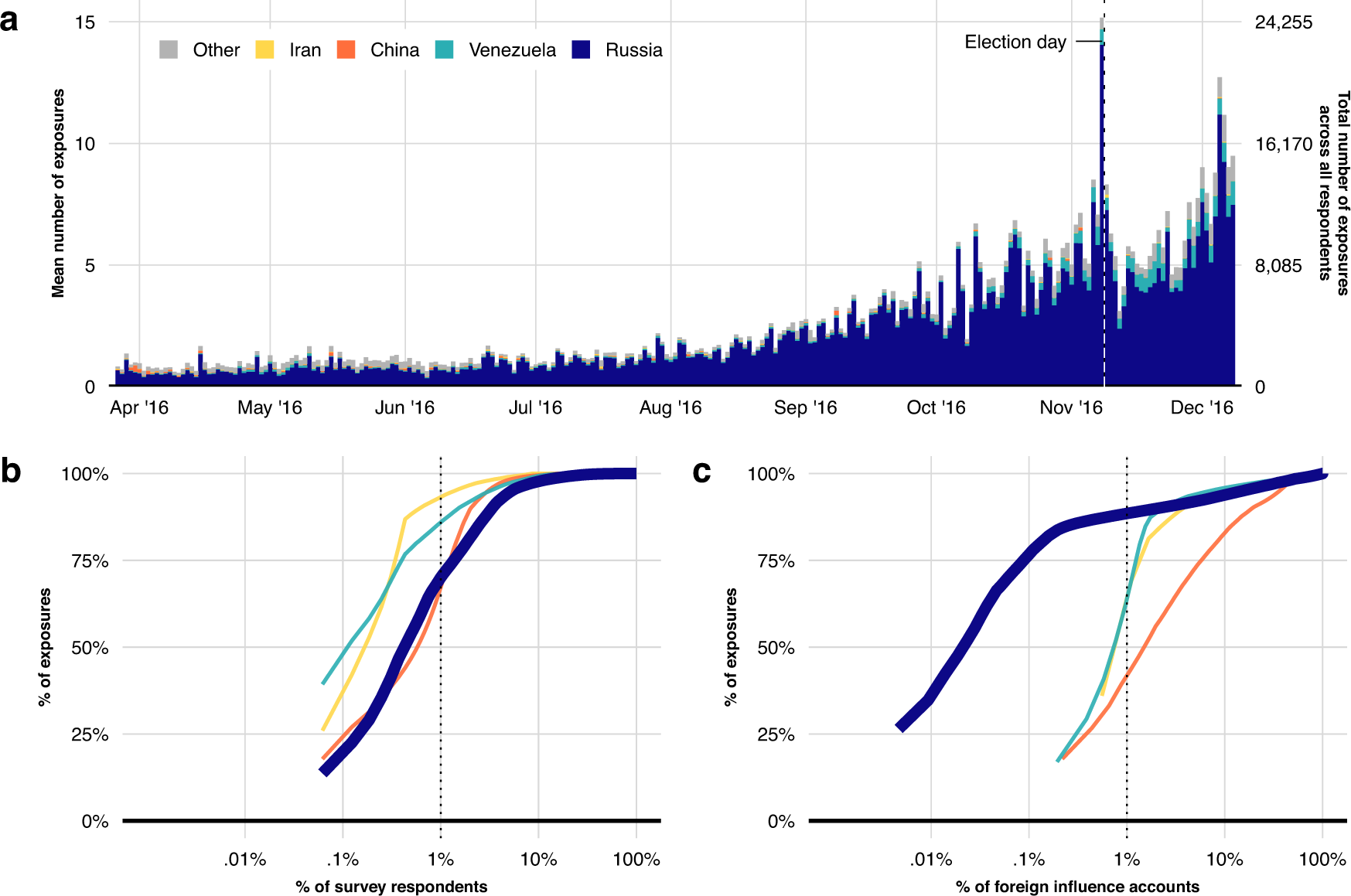
Exposure to the Russian Internet Research Agency foreign influence campaign on Twitter in the 2016 US election and its relationship to attitudes and voting behavior

How malicious AI swarms can threaten democracy