The Federal Reserve raised interest rates for the first time since 2023, by a quarter of a percentage point, and suggested more increases could follow. The move puts its new leader, Kevin Warsh, at odds with President Trump.
With rising interest rates, something deeper than inflation is going on
Typically, bond rates rise when an economy is doing well and inflation appears to be moving up. But something much deeper and more structural is currently going on.
Does Monetary Policy Tightening Reduce Inflation?
Recent research has identified periods when the Federal Reserve intentionally acted to slow inflation when it exceeded desired levels. The success of these disinflation attempts reveals the extent of policymakers’ commitment to lowering inflation. An extension of this analysis indicates that successful disinflations are associated with a decline in the demand-driven component of inflation. This was especially evident during recent monetary policy tightening, with contributions to core inflation from demand declining 2 percentage points since the summer of 2022—the largest decline for any deliberate disinflation attempt since 1969.

Looking for a “fair” international monetary system
President Trump’s Chief Economic Adviser, Stephen Miran, has claimed that the international monetary system in which the US provides the rest of the world with a safe, liquid asset is “unfair” as it supposedly prevents the US from eliminating its current account deficit. His proposed solution is to lower the value of the dollar through coordinated currency market intervention by foreign central banks. This column finds the idea that there could be lasting reversal of exchange rates following an international currency agreement highly speculative, and argues that a multipolar system would attenuate the Triffin dilemma and provide the US with a deficit-adjustment tool.

annotations: La faiblesse des taux d’intérêt nous oblige à reconsidérer la politique budgétaire
Traduction française du billet de blog "Why low interest rates force us to revisit the scope and role of fiscal policy: 45 takeaways" d'Olivier Blanch
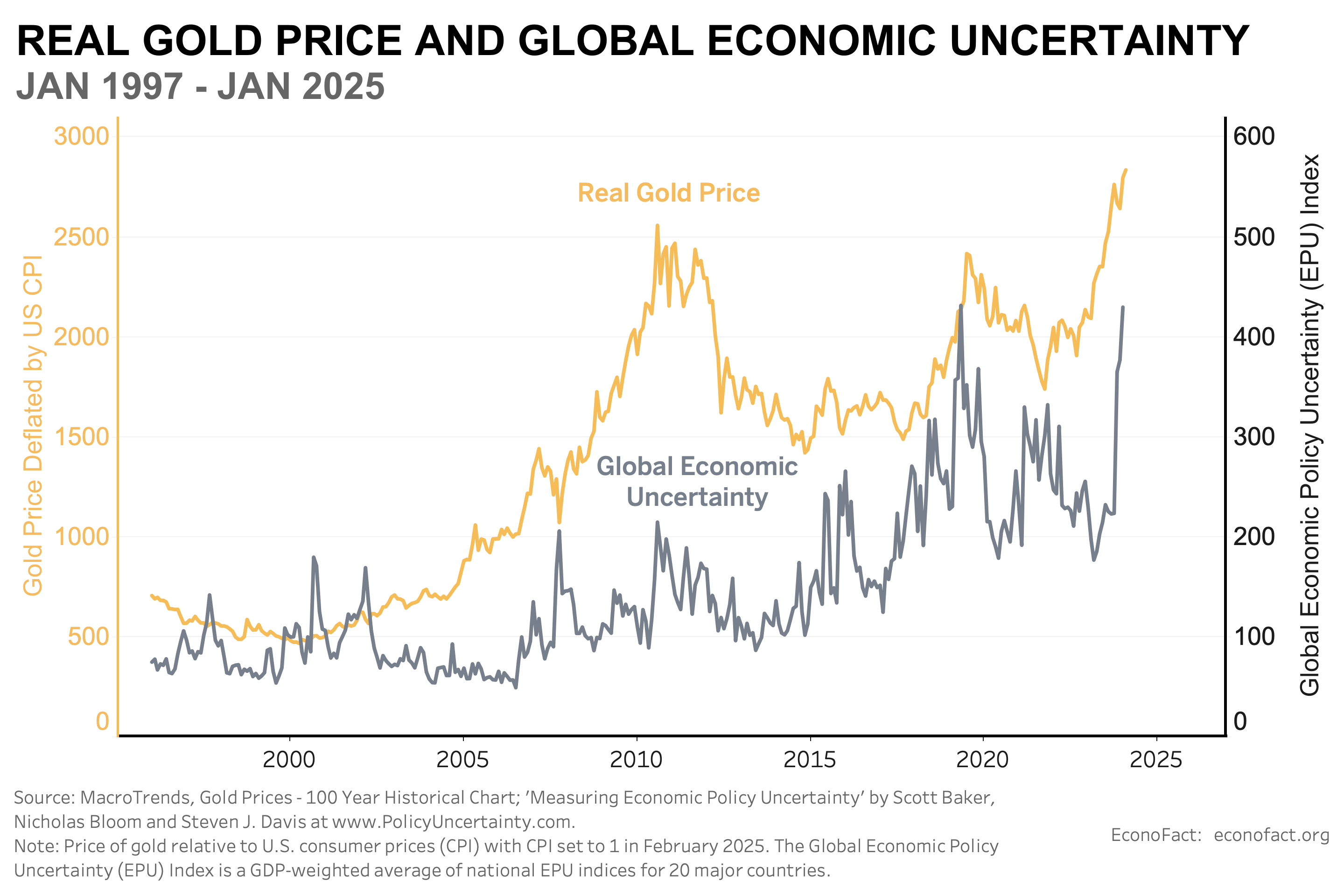
Why Has the Price of Gold Risen So Sharply? | Econofact
Gold has a long history of being held as a financial asset by private investors and central banks, which can be the source of large shifts in its price.

Is the US dollar's reserve currency status eroding? | Brookings
Robin Brooks analyzes changes in the U.S. dollar's reserve currency status during the second Trump administration.

Interest Rates: Prices Hidden in Plain Sight
I study ways the shift in credit price disclosures from dollar terms to interest rates has impacted consumer and firm behavior. In an experiment, I find that co

Issue 104 – World Tyranny Financial
As the Trump family’s crypto dealings raise more alarms, crypto enforcement is falling to new lows

Glass Half Full: Building a Decarbonized U.S. Power Sector -
The Inflation Reduction Act of 2022 (IRA) was built, sold, and attacked as the largest climate investment in U.S. history. […]
Electricity prices rising by double the rate of inflation. Data center demand means no relief ahead, analysts say
The impact of the AI industry on electricity prices has turned into a major political flashpoint ahead of the midterm elections this November.

Monetary policy transmission in the euro area: Why this time it’s different
The unprecedented surge in prices since 2021 led the ECB to embark on the fastest tightening cycle in the euro area’s history. This column analyses the lags and strength of monetary policy transmission to output and inflation over the two decades in the euro area. It shows that the peak effects on real GDP and headline inflation are observed within 12-18 months of the interest rate rise. The impact on inflation has been stronger and more persistent in the recent tightening cycle, reflecting the forceful monetary policy response and the higher flexibility of prices.
Exponential Growth Bias and Household Finance
ABSTRACT Exponential growth bias is the pervasive tendency to linearize exponential functions when assessing them intuitively. We show that exponential growth bias can explain two stylized facts in household finance: the tendency to underestimate an interest rate given other loan terms, and the tendency to underestimate a future value given other investment terms. Bias matters empirically: More‐biased households borrow more, save less, favor shorter maturities, and use and benefit more from financial advice, conditional on a rich set of household characteristics. There is little evidence that our measure of exponential growth bias merely proxies for broader financial sophistication.

Retombées de la politique monétaire de la Fed sur celle de la BCE : le rôle des « nouvelles » sur l’inflation | Banque de France
Billet de blog 386. La politique monétaire de la Fed a eu des effets sur les conditions financières en zone euro lors du cycle monétaire récent. Toutefois, ces effets ont avant tout résulté indirectement de la perception par les marchés de perspectives d’inflation communes entre les deux zones et non d’une influence directe. Ainsi, pour les marchés, la crédibilité de la BCE à lutter contre l’inflation en toute indépendance de la Fed n’a pas été mise en doute.

The Quiet Rewiring of American Finance
Stablecoins, Treasury markets, and the most significant shift in financial infrastructure that almost nobody is discussing.

One Generation Runs the Country. The Next Cashed In on Crypto.
Sons of top Trump administration officials made billions for their families, but their investors didn’t always fare so well.