


The Nebra Sky Disc is considered to be the oldest concrete astronomical depiction in the world. For a long time the experts agreed that the find can be assigned to the Bronze Age. This year, two German prehistorians claimed that the disc came from the Iron Age, sparking controversy. However, new investigations published in the periodical “Archaeologia Austriaca” by the Austrian Academy of Sciences give the all-clear: the Sky Disc definitely dates to the Bronze Age.
Archaeometallurgical investigation of the Nebra Sky Disc
The world heritage object Nebra Sky Disc is one of the best investigated archaeological objects. The origin of the raw materials it is made of is well known. However, its manufacturing process was not completely clear. Investigations were made in order to clarify the steps of manufacturing from the initial casting to the finished disc using the latest metallographic techniques. Therefore, a small piece from the outer part of the disc was investigated and compared with a replica. Both were prepared regarding the metallographic procedure. Microstructural analysis was made by optical microscopy on a colour etched surface, EDS and electron backscatter diffraction. For the investigation of mechanical properties microhardness measurements were made. It could be found that the Nebra Sky Disc was manufactured from a flat cast followed by hot forging process. During the forging process the disc was heated and forged for approximately 10 times.

Nebra Sky Disc
Diese Webseite verwendet Cookies, um die Bedienfreundlichkeit zu erhöhen.
1177 BC: The Year Civilization Collapsed (Eric Cline, PhD)
The Vault Of The Atomic Space Age
Art,fashion,design,technology etc from the atomic space age

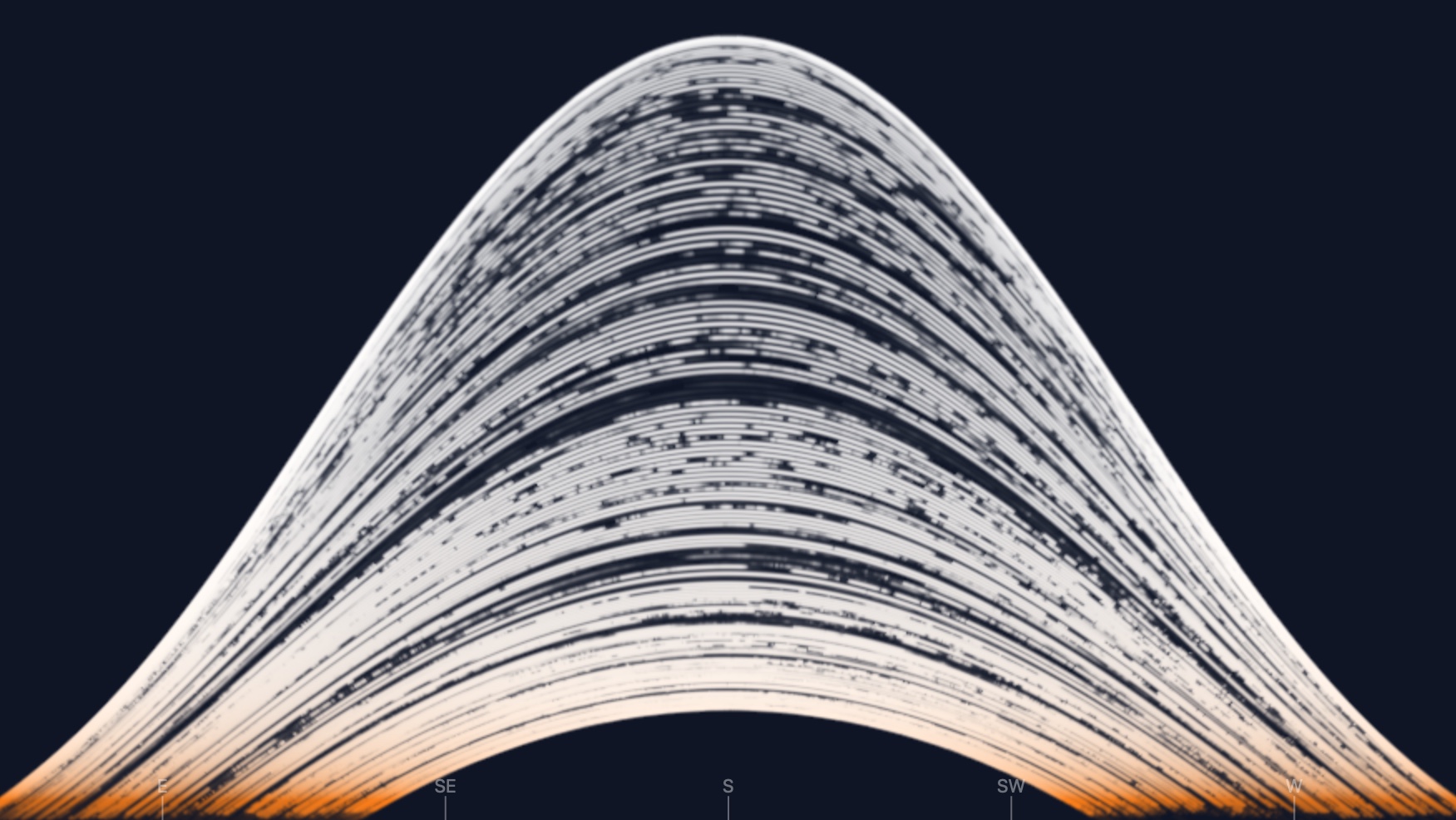
Solargraph Simulator – eagereyes
How a 6-month exposure shows the sun's path across the sky, from solstice to solstice
Venus of Tan-Tan
The Venus of Tan-Tan is an alleged artifact found in Morocco. It and its contemporary, the Venus of Berekhat Ram, have been claimed as the earliest representations of the human form.

We May Be Entering A Second Axial Age
The transition from small hunter-gatherer societies into complex civilizations gave rise to the first Axial Age. Today, the planetary polycrisis of climate chaos, mass migration, increasing warfare and transformative AI represents a rupture of comparable magnitude.

Observational Evidence from Supernovae for an Accelerating Universe and a Cosmological Constant
We present observations of 10 type Ia supernovae (SNe Ia) between 0.16 < z < 0.62. With previous data from our High-Z Supernova Search Team, this expanded set of 16 high-redshift supernovae and 34 nearby supernovae are used to place constraints on the Hubble constant (H_0), the mass density (Omega_M), the cosmological constant (Omega_Lambda), the deceleration parameter (q_0), and the dynamical age of the Universe (t_0). The distances of the high-redshift SNe Ia are, on average, 10% to 15% farther than expected in a low mass density (Omega_M=0.2) Universe without a cosmological constant. Different light curve fitting methods, SN Ia subsamples, and prior constraints unanimously favor eternally expanding models with positive cosmological constant (i.e., Omega_Lambda > 0) and a current acceleration of the expansion (i.e., q_0 < 0). With no prior constraint on mass density other than Omega_M > 0, the spectroscopically confirmed SNe Ia are consistent with q_0 0 at the 3.0 sigma and 4.0 sigma confidence levels, for two fitting methods respectively. Fixing a ``minimal'' mass density, Omega_M=0.2, results in the weakest detection, Omega_Lambda>0 at the 3.0 sigma confidence level. For a flat-Universe prior (Omega_M+Omega_Lambda=1), the spectroscopically confirmed SNe Ia require Omega_Lambda >0 at 7 sigma and 9 sigma level for the two fitting methods. A Universe closed by ordinary matter (i.e., Omega_M=1) is ruled out at the 7 sigma to 8 sigma level. We estimate the size of systematic errors, including evolution, extinction, sample selection bias, local flows, gravitational lensing, and sample contamination. Presently, none of these effects reconciles the data with Omega_Lambda=0 and q_0 > 0.


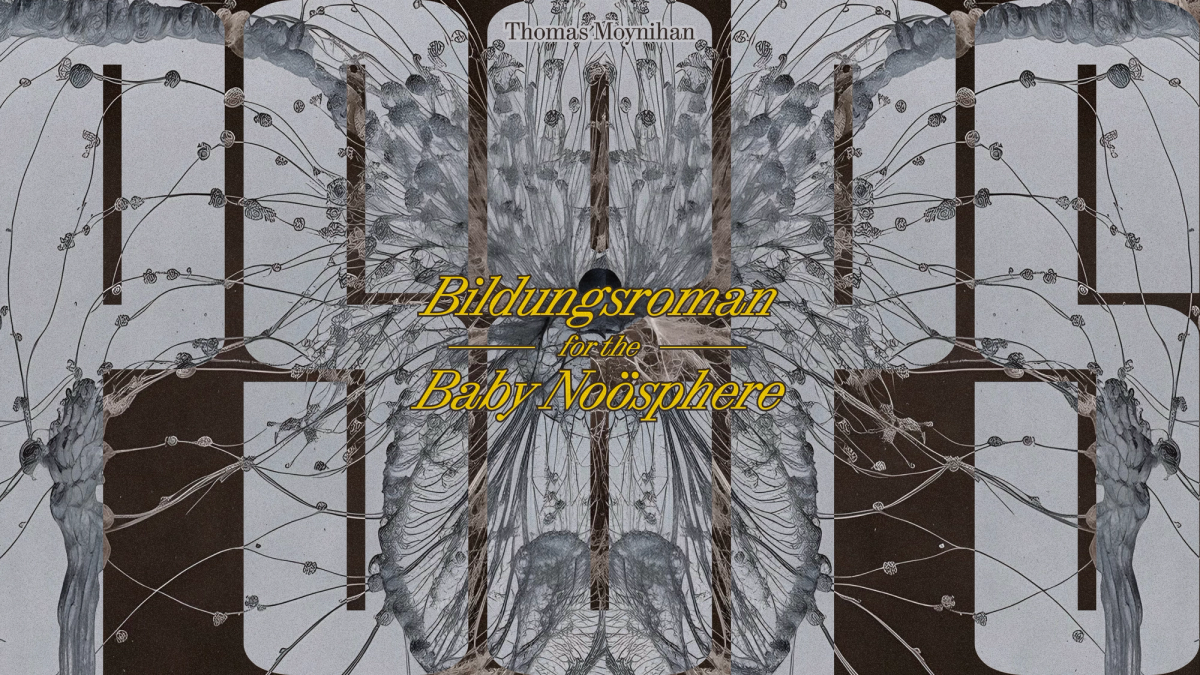
Planetary Sapience & Planetary Stupidity: a Bildungsroman for the Baby Noosphere | Antikythera
That is, the faculty of recollection and foresight? Until recently, I would argue, our planet was amnesiac. That is, no part of it was reflectively aware of the place of the present relative to the established past nor the expected future. But then peculiar animals emerged, capable—no matter how imperfectly—of cooperation, abstraction and invention. In the last blink of geologic time, through the collaboration of these animals with their increasingly cunning artifacts, this state of planetary amnesia has faltering begun being cured. That is, through our artifacts, our planet is becoming aware of its own unfolding biography. In our fallible attempts to model our world—alongside our growing legion of sensors—The Earth system has developed a way of recollecting its deepest past and tracking the changing complexities of its present so as to forecast its furthest future.
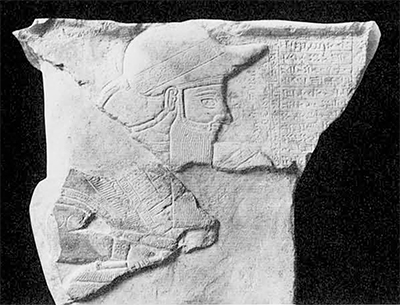
Expedition Magazine | Aspects of Elamite Art and Archaeology
In Sumerian texts we read about the country NIM, the wondrous mountain area which we call Iran today. The biblical […]
Sunsetting Atom
We are archiving Atom and all projects under the Atom organization for an official sunset on December 15, 2022.

Sunsetting Atom
We are archiving Atom and all projects under the Atom organization for an official sunset on December 15, 2022.
Sunsetting Atom
We are archiving Atom and all projects under the Atom organization for an official sunset on December 15, 2022.
solar meditation
The video contains imagery from NASA’s Solar Dynamics Observatory in five wavelengths of ultraviolet light. Scrubbing up and down reveals new layers, from sunspots on the solar surface to prominences extending outward in the corona.