

Take Control of Your Research, Privately
Explainer: what is the open movement?
You’ll have read on this site, and perhaps others, about the push towards “open access” for journal articles. But what is open access, and how does it fit into the wider “open movement”? The topic has…

The Open Machine // The Open Machine
The Open Machine is a cultural research studio that invokes unlikely alliances across technology and culture to advance ethical, open forms of coordination. We conduct research to produce media, events, and frameworks that capture and project the patterns that emerge.
What AI Asks of Open Access - The Scholarly Kitchen
As AI systems increasingly reason from the scientific literature, the integrity signals that make research trustworthy - open data, structured metadata, robust retraction processes - matter more than ever. PLOS CEO Alison Mudditt on why open access publishers have a different set of obligations in an AI world.

Publishing Beyond the Market: Open Access, Care, and the Commons
<I>Publishing Beyond the Market</I> argues that the move to open access should focus less on the free accessibility of research outputs and more on who controls the publications and infrastructures for scholarly communication. By deploying theoretical literature on science and technology studies, care ethics, and the commons, the book critically interrogates open access and reimagines a more ethical future for researcher-led publishing. A case study of Plan S—the multifunder European policy for open access publishing—explores its tendency to rehearse all the failures of commercialisation. Through critical engagement with the open access landscape, the book reveals the shortcomings of market-centric and policy-based approaches to open access book and journal publishing, particularly their tendency to reinforce conservatism, commercialism, and private control of publishing.<BR /><BR /> Going forward, <I>Publishing Beyond the Market</I> explores the importance of collectivity and democratic governance within the transition to open access publishing. It suggests that developing a commons-based, scholar-led publishing landscape through a series of presses that are each managed by working academics could offer a productive counterpoint to marketised systems of open access and subscription publishing. In weaving themselves together in order to "scale small" these publishing initiatives would act as a counter-hegemonic project based on mutual reliance and care. By illustrating how these projects build toward a commons-based publishing future, and how they may complement other approaches to publishing within university presses and libraries, the book culminates in an argument for the infrastructures, policies, and forms of governance needed to nurture such a collective vision.

Why you need a "WTF Notebook"
There's a very specific reputation I want to have on a team: "Nat helps me solve my problems. Nat get things I care about done."

Research Fiction: Storytelling, Plot and Design
As part of the Digital Library's transition to Open Access, new features for researchers are available in the Premium Edition. Click here to learn more.

The Dissemination of Scholarly Information: Journals, Open-Access and Distributed Filtering
Current methods of disseminating scholarly information focus on the use of journals who retain exclusive rights in the material they publish. Recently there has been increasing dissatisfaction with this model, with suggestions for alternative approaches such as "Open Access".
The world is not a desktop | Interactions
As part of the Digital Library's transition to Open Access, new features for researchers are available in the Premium Edition. Click here to learn more.
Introducing notebook.link: The Future of Notebook Sharing
Reimagining how you share, collaborate, and run Jupyter notebooks — all in your browser.

Anonymity and Online Commenting: The Broken Windows Effect and the End of Drive-by Commenting
As part of the Digital Library's transition to Open Access, new features for researchers are available in the Premium Edition. Click here to learn more.

Anonymity and Online Commenting: The Broken Windows Effect and the End of Drive-by Commenting
As part of the Digital Library's transition to Open Access, new features for researchers are available in the Premium Edition. Click here to learn more.
As we may think
As part of the Digital Library's transition to Open Access, new features for researchers are available in the Premium Edition. Click here to learn more.
From Albums to Streams: How Modularity Changes Systems
Scientific publishing is breaking under document-centric formats designed for a physical world. Borrowing from music’s shift from albums to streaming, we make the case that open access alone cannot deliver reuse, trust, or scale. The future of science depends on modular, interoperable research components that move across tools, enabling new workflows, tools, and ecosystems.
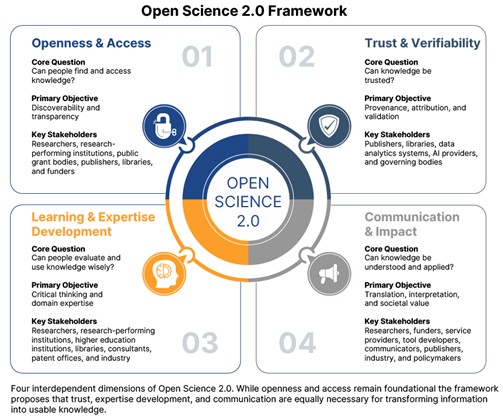
Open Science 2.0: Building Understanding in an AI-Mediated World - The Scholarly Kitchen
Open Science 2.0 must focus not only on access, but also on trust, interpretation, learning, and effective communication. The challenge facing the scholarly publishing ecosystem is ensuring that what is open is also trustworthy, understandable, and genuinely useful.
The Meaning of Open
There are a lot of misconceptions about what open means, when it is the right strategy to apply, and the fundamental tradeoffs that go…
From novices to co-pilots: Fixing the limits on scientific knowledge production by accessing or building expertise
As part of the Digital Library's transition to Open Access, new features for researchers are available in the Premium Edition. Click here to learn more.
