

Though he died too young, Carl Sagan left behind an impressively large body of work, including more than 600 scientific papers and more than 20 books.
The Demon-Haunted World
The Demon-Haunted World: Science as a Candle in the Dark is a 1995 book by the astronomer and science communicator Carl Sagan. In it, Sagan aims to explain the scientific method to laypeople and to encourage people to learn critical and skeptical thinking. He explains methods to help distinguish between ideas that are considered valid science and those that can be considered pseudoscience. Sagan states that when new ideas are offered for consideration, they should be tested by means of skeptical thinking and should stand up to rigorous questioning.

Peter Higgs: I wouldn't be productive enough for today's academic system
Physicist doubts work like Higgs boson identification achievable now as academics are expected to 'keep churning out papers'
What stories should we tell about scientific progress now?
In search of the mysterious fruits of basic science
How and When to Involve Crowds in Scientific Research | James Evans
The lone academic in a basement lab is an endangered species. Years ago I asked Paul Ginsparg, who founded arXiv, what features his machine-learning filter used to flag speculative submissions. The top three: single-authored, submitted on a weekend, and heavy citation of Newton and Einstein. Science is a contact sport now. Marion Poetz and Henry Sauermann's How and When to Involve Crowds in Scientific Research (https://lnkd.in/g5pwVbfD) is the field manual. What crowds can do: Volume. Zooniverse mobilizes 2.7 million people to classify galaxies and court records. Galaxy Zoo's co-founder hand-classified 50,000 galaxies in one week before concluding that isolation would break him. Reach. NASA spent years failing to predict solar flares, then broadcast the problem. The winner was a semi-retired radio engineer in rural New Hampshire who swapped satellite data for radio data. Experience. Patients and caregivers asked to generate research questions produced 826 that scientists had missed, including the link between aging and wound healing. Bench-to-bedside runs backward. One caution the book underplays: an open call is not an inclusive one. Participation costs in time, money, and access screen people out. Self-selection can narrow the very diversity that makes crowds thrive. As AI floods the labor supply of routine, homogeneous cognition, human crowds become more valuable, not less. Machines process. People notice what nobody thought to ask. Check out my review @ https://lnkd.in/gkzvWrRC and the book @ https://lnkd.in/g5pwVbfD!

What happened to Science Goodreads and how do we rebuild it? A 65 million dollar question (at least) - Cosmik Labs
The story of the rise and fall of Mendeley
The new way we’ll do science
Papers should become human-readable views over a graph of data, tools, results, and certificates.
Evaluating Claude with BioMysteryBench
BioMysteryBench tests Claude on 99 real bioinformatics problems. Opus 4.6 solved 77% of human-solvable questions and some that experts could not.

The Bazaar of Scientific Knowledge | shishyko!
Is the current form of the scientific paper still optimal in 2025? How do we preserve, and efficiently leverage, the uncut gems of the scientific process?
Decolonising Science Reading List
In the last couple of weeks, a lot of people have been asking me about what I’ve been reading as reference points for my commentary on the…
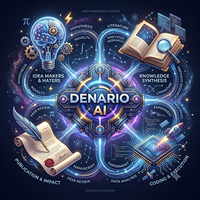
Denario Project: Deep Knowledge Artificial Intelligence Agents for Scientific Discovery
We present , an Artificial Intelligence (AI) multiagent system designed to serve as a scientific research assistant. can perform many different tasks, such as generating ideas, checking the literature, developing research plans, writing and executing code, making plots, and drafting a scientific paper. The system has a modular architecture, allowing it to handle specific tasks, such as generating an idea or carrying out near end-to-end scientific analysis using as a deep-research backend (end-to-end except for the novelty assessment, which is intentionally left for the user to inspect). In this work, we describe in detail and its modules, and illustrate its capabilities by presenting multiple AI-generated papers generated by it in many different scientific disciplines such as astrophysics, biology, biophysics, biomedical informatics, chemistry, material science, mathematical physics, medicine, neuroscience, and planetary science. can also produce work that combines ideas from different disciplines, which we illustrate with a single ( N = 1 ) example: a paper that applies methods from quantum physics and machine learning to astrophysical data. We report the evaluations performed on these papers by domain experts, who provided both numerical scores and reviewlike feedback. These papers were scored by domain experts on our team; we report these scores as an indicative self-assessment rather than an independent evaluation, and we flag the resulting conflict of interest explicitly. Most drafts were rated above the midpoint of a 0–10 scale, with several rated 8–9, indicating that the generated papers reach the level a good undergraduate or early graduate student could achieve after weeks or a few months of work. They should be regarded as first drafts that require expert development, not publication-ready papers. We also document an important failure mode in which, when the input data cannot be read, the system may silently generate synthetic data, which we flag explicitly as a key limitation. We then highlight the strengths, weaknesses, and limitations of the current system. Finally, we discuss the ethical implications of AI-driven research and reflect on how such technology relates to the philosophy of science. We publicly release the code at . A demo can also be run directly on the web at , and the full app will be deployed on the cloud.
Zechen Zhang on Twitter / X
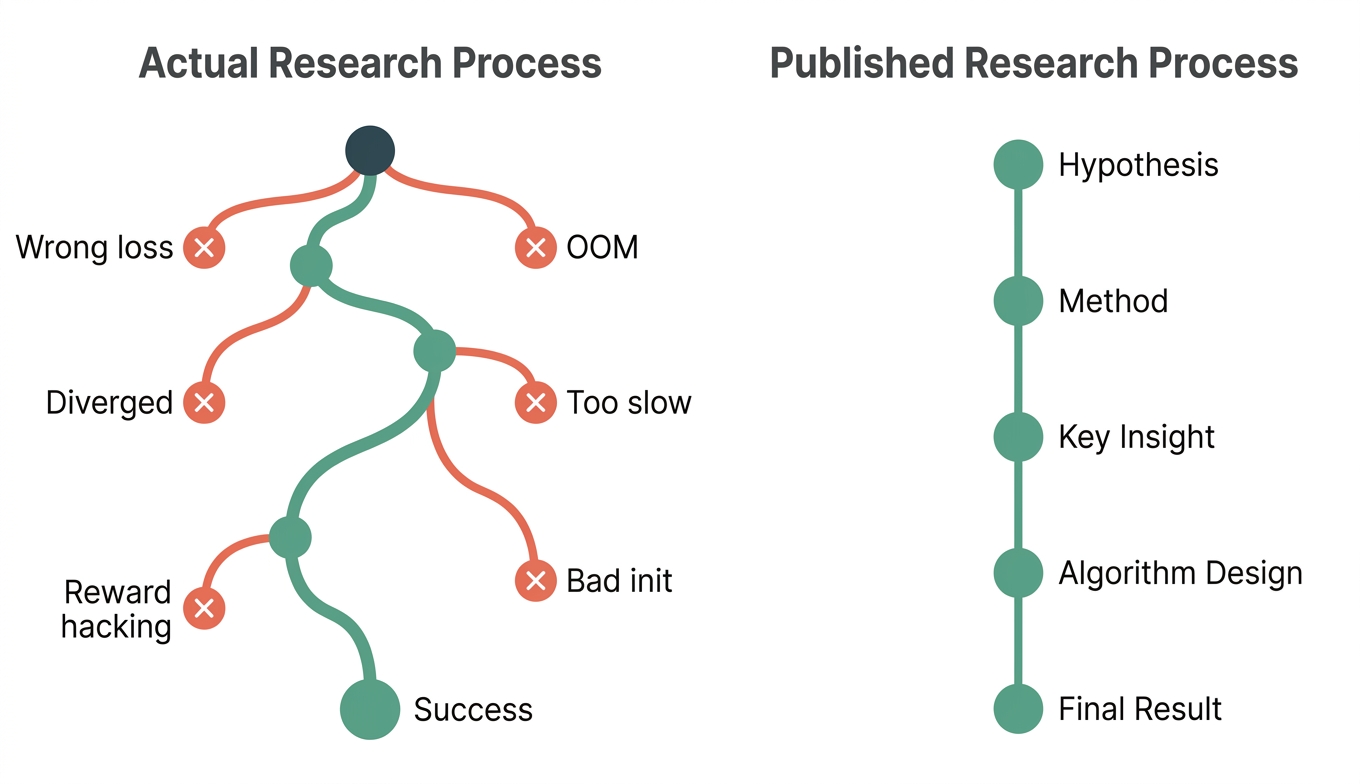
1/ For nearly 350 years, science has communicated itself through one object: the paper. A linear narrative, frozen as a PDF, written for a human reader. We've come to treat that format as the medium of science itself.It doesn't have to be. It's a historical artifact. 🧵 pic.twitter.com/P5UUhceLkC— Zechen Zhang (@ZechenZhang5) April 30, 2026
The Scientific Contribution Graph: Automated Literature-based Technological Roadmapping at Scale
Sir Isaac Newton famously wrote, “If I have seen further, it is by standing on the shoulders of giants”. Scientific contributions are rarely developed in isolation, but build upon prior contributions, such as problem framings, experimental methods, and empirical findings. Understanding these prerequisite relationships is important for studying scientific progress, and for automated scientific discovery systems that must reason about which existing capabilities can be used to develop new ones (e.g. Lu et al., 2024; Jansen et al., 2025b; Baek et al., 2025).
The Periodic Table of Cognition
I’ve been studying the early history of electricity’s discovery as a map for our current discovery of artificial intelligence. The smartest people alive back then, including Isaac Newton, who may have been the smartest person who ever lived, had confident … Continue reading →
AI has supercharged scientists—but may have shrunk science
Analysis of 41 million papers finds that although AI expands individual impact, it narrows collective scientific exploration
No. 013: Provenance vocabulary, Wikipedia contamination, OpenAI rare-disease diagnoses, ARA paper format - The Hallway Track
The Hallway Track No. 013 - How AI is affecting the practice of science
Claude for Life Sciences
Discover how Claude accelerates life sciences research with new scientific connectors, skills, and improved performance for drug discovery and clinical work.