
5 questions for Amy Silvers: Implementing, embedding, and championing user research in design teams.
When to Use Which User-Experience Research Methods
20 user-research methods: where they fit in the design process, whether they are attitudinal or behavioral, qualitative or quantitative, and their context of use.
Built by Designers: No Explanation Needed
Designers now turn ideas into working products. Explore a curated collection of apps, tools, websites, and experiments designed, built, and shipped by designers.

Are You Ready to Become a Product Designer?
Five years ago, it was all about UX, but we saw through that. At the time, we were pretty stoked about figuring out the best way to get to answers in product design (still are!). However, we realized that there aren't a lot of designers out there that understand what it actually means to be a product designer.

The Incongruence of the Designed and the Designer — fasterandworse
A fundamental attribute of User Experience design is its inability to change the underlying product. The concerns of a UX designer, or r...

Behind-the-Design: Meet Copilot
When the system is the product; on crafting the next generation of user experiences
Build Products That Solve Real Problems — A Lightweight JTBD Framework for Product Teams
Drawing on her experiences building products at Lumosity, Oculus, and Facebook's New Product Experimentation group, Sunita Mohanty shares a lightweight "jobs-to-be-done" framework for early-stage product teams, along with templates and go-to-market tactics.

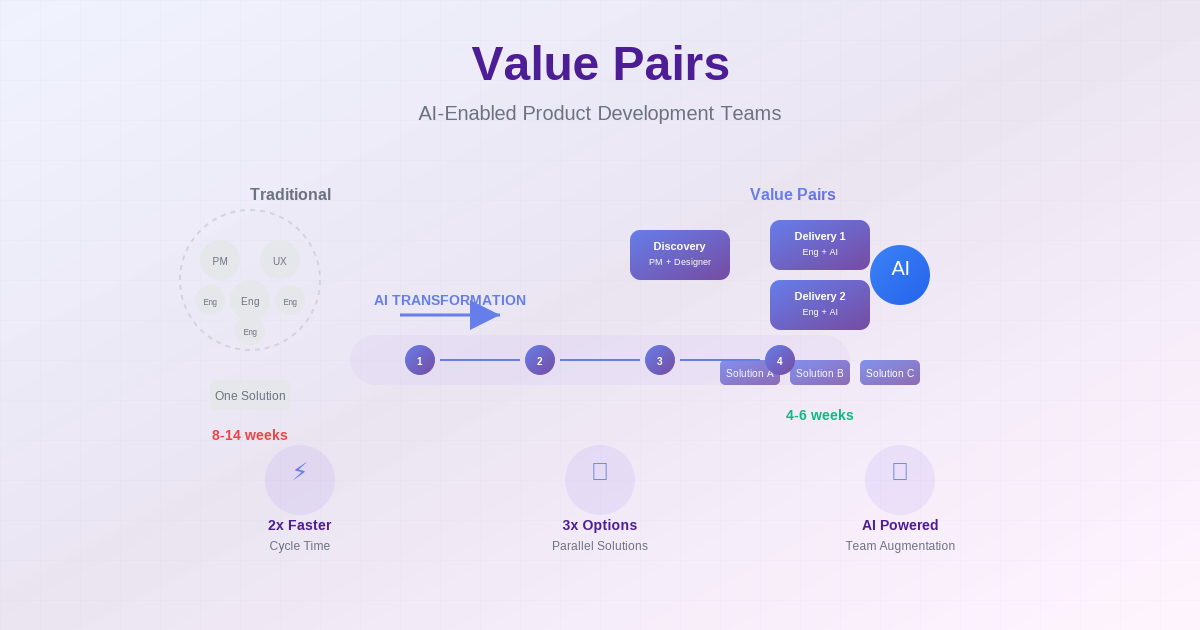
Value Pairs: A New Way of Approaching Product Development
How AI-enabled teams can change how we think about product development
Ideation with Generative AI—in Consumer Research and Beyond
Abstract The use of generative AI (genAI) in consumer research is rapidly evolving, with applications including synthetic data generation, data analysis, and more. However, their role in creative ideation—a cornerstone of consumer research—remains underexplored. Drawing on the human creativity literature, we propose that ideation with genAI is facilitated by its productivity and semantic breadth, which are psychologically analogous to the dual pathways of persistence and flexibility in human ideation. Further, we distinguish between the utility of genAI as a key ideator versus humans as key ideator, conceptualized through the genAI ideation roles of Designer and Writer and of Interviewer and Actor. While genAI excels in generating incremental improvements, its potential for groundbreaking innovation could be unlocked by leveraging its ability to prompt human creativity. This article advances the theoretical and practical understanding of genAI in ideation for consumer research, offering numerous practical guidelines for integrating generative AI into research while emphasizing human–AI collaboration to achieve radical insights.

An introduction to radical participatory design: decolonising participatory design processes
Outside of community-led design projects, most participatory design processes initiated by a company or organisation maintain or even strengthen power imbalances between the design organisation and the community on whose purported behalf they are designing, further increasing the absencing experience. Radical participatory design (RPD) is a radically relational answer to the coloniality inherent in participatory design where the community members’ disappointment is greater due to the greater expectations and presencing potential of a ‘participatory design’ process. We introduce the term RPD to show how research and design processes can be truly participatory to the root or core. Instead of treating participatory design as a method, a way of conducting a method, or a methodology, we introduce RPD as a meta-methodology, a way of doing any methodology. We explicitly describe what participation means and compare and contrast design processes based on the amount of participation, creating a typology of participation. We introduce ‘designer as community member’, ‘community member as designer,’ and ‘community member as facilitator’ models and provide characteristics for the meta-methodology of RPD.
An introduction to radical participatory design: decolonising participatory design processes
Outside of community-led design projects, most participatory design processes initiated by a company or organisation maintain or even strengthen power imbalances between the design organisation and the community on whose purported behalf they are designing, further increasing the absencing experience. Radical participatory design (RPD) is a radically relational answer to the coloniality inherent in participatory design where the community members’ disappointment is greater due to the greater expectations and presencing potential of a ‘participatory design’ process. We introduce the term RPD to show how research and design processes can be truly participatory to the root or core. Instead of treating participatory design as a method, a way of conducting a method, or a methodology, we introduce RPD as a meta-methodology, a way of doing any methodology. We explicitly describe what participation means and compare and contrast design processes based on the amount of participation, creating a typology of participation. We introduce ‘designer as community member’, ‘community member as designer,’ and ‘community member as facilitator’ models and provide characteristics for the meta-methodology of RPD.
A Design Science Research Methodology for Expert Systems Development
The knowledge of design science research (DSR) can have applications for improving expert systems (ES) development research. Although significant progress of utilising DSR has been observed in particular information systems design – such as decision support systems (DSS) studies – only rare attempts can be found in the ES design literature. Therefore, the aim of this study is to investigate the use of DSR for ES design. First, we explore the ES development literature to reveal the presence of DSR as a research methodology. For this, we select relevant literature criteria and apply a qualitative content analysis in order to generate themes inductively to match the DSR components. Second, utilising the findings of the comparison, we determine a new DSR approach for designing a specific ES that is guided by another result – the findings of a content analysis of examination scripts in Mathematics. The specific ES artefact for a case demonstration is designed for addressing the requirement of a ‘wicked’ problem in that the key purpose is to assist human assessors when evaluating multi-step question (MSQ) solutions. It is anticipated that the proposed design knowledge, in terms of both problem class and functions of ES artefacts, will help ES designers and researchers to address similar issues for designing information system solutions.
High-Tech Anthropology® Process Tour
Come learn about the benefits of observing end users, creating and mapping personas, and assessing iterative designs. Additionally, see the other tools we use and visuals we create to capture and distill information that will help us mitigate the risk of a failed end product. These steps build the foundation for user-friendly designs tailored to target persona(s) – for products that are actually adopted (and even enJOYed!) rather than tossed to the side or treated like paperweights.

Design Sprints
A structured, time-boxed process for rapidly exploring problems, generating ideas, and validating solutions with real users.

Why Do We Conduct Qualitative User Research? – Firefox UX
The following post is based on a talk I presented at MozFest about interviewing users. I recently had a conversation with a former colleague who now works for a major ...

The Informed Life with Andy Budd
Overview of a conversation on how designers can create value in early-stage startups.

Design for Real Life
You can't always predict who will use your products, or what emotional state they'll be in when they do. But by identifying stress cases and designing with compassion, you'll create experiences that support more of your users, more of the time.