

A new vision for the web where the users master their data and link them to everybody's benefit in a giant global graph.
LN 040: The venerable hyperlink
Decades after hyperlinks transformed humanity's information and text into a densely-linked graph, mainstream OSs have yet to afford users their benefits in personal computing.
Sigma.js
a JavaScript library aimed at visualizing graphs of thousands of nodes and edges
The Together Project
What if we could actually see the acknowledgement graph that connects humans and communities in a hidden economic web?

The 34th International Symposium on Graph Drawing and Network Visualization
The 34th International Symposium on Graph Drawing and Network Visualization will be held at Brock University in St. Catharines, Ontario, Canada from August 17-21, 2026. A PhD school will take place on August 17-18, 2026.
The State of the Open Social Web
A comprehensive look at Mastodon, Bluesky, and the growing ecosystem of open, interoperable social networks.

Brad's Thoughts on the Social Graph
I've been thinking a lot about the social graph for awhile now: aggregating the graph, decentralization, social network portability, etc.
Context Graph: It’s time to bring context back to the web
The largest button on a modern browser is the back button. Trips to the web are short. Enter a search, get a result, click back, then try…

Harnessing Crowds: Mapping the Genome of Collective Intelligence
Over the past decade, the rise of the Internet has enabled the emergence of surprising new forms of collective intelligence. Examples include Google, Wikipedia,

Lab Notes #007: Semble Following - Cosmik Labs
The Cosmik Network social graph launches
Open Graph protocol
The Open Graph protocol enables any web page to become a rich object in a social graph.

Tim Berners Lee: Thoughts On The Internet Evolution
"I’ve always believed the web is for everyone. That's why I and others fight fiercely to protect it."


surrealdb/surrealdb
A scalable, distributed, collaborative, document-graph database, for the realtime web
A survey of community search over big graphs
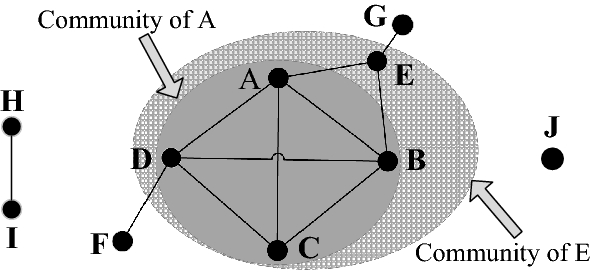
With the rapid development of information technologies, various big graphs are prevalent in many real applications (e.g., social media and knowledge bases). An important component of these graphs is the network community. Essentially, a community is a group of vertices which are densely connected internally. Community retrieval can be used in many real applications, such as event organization, friend recommendation, and so on. Consequently, how to efficiently find high-quality communities from big graphs is an important research topic in the era of big data. Recently, a large group of research works, called community search, have been proposed. They aim to provide efficient solutions for searching high-quality communities from large networks in real time. Nevertheless, these works focus on different types of graphs and formulate communities in different manners, and thus, it is desirable to have a comprehensive review of these works. In this survey, we conduct a thorough review of existing community search works. Moreover, we analyze and compare the quality of communities under their models, and the performance of different solutions. Furthermore, we point out new research directions. This survey does not only help researchers to have better understanding of existing community search solutions, but also provides practitioners a better judgment on choosing the proper solutions.
@semble.so is really cool. It's basically if someone implemented the original comind knowledge graph stuff I wrote up here: cameron.stream/blog/comind-network
The cognitive layer for the open web
cameron.stream