


Dive into the technical foundations behind Pangram's AI detection stack and understand how we achieve low false positive rates across modalities.
Introducing Pangram 3.0 with AI assistance detection | Pangram Labs
Explore our latest model with AI assistance detection.
AI Detector: Free AI Checker for ChatGPT, Claude & Gemini | Pangram
AI Detector for ChatGPT, Gemini & Claude — Remarkably Accurate. Detect AI-generated text in essays, articles & documents. Third-party verified results.
America Has a Pangram Problem
AI-detection tools are getting better. But they still aren’t good enough.

ImageWhisperer — AI Image Detector
Upload an image. Get the investigation. 41 checks, one verdict, plain-language evidence. By Henk van Ess.
What I learned running an adversarial test on an AI text detector
If you get your bot to rhyme / Pangram will misclassify it many a time
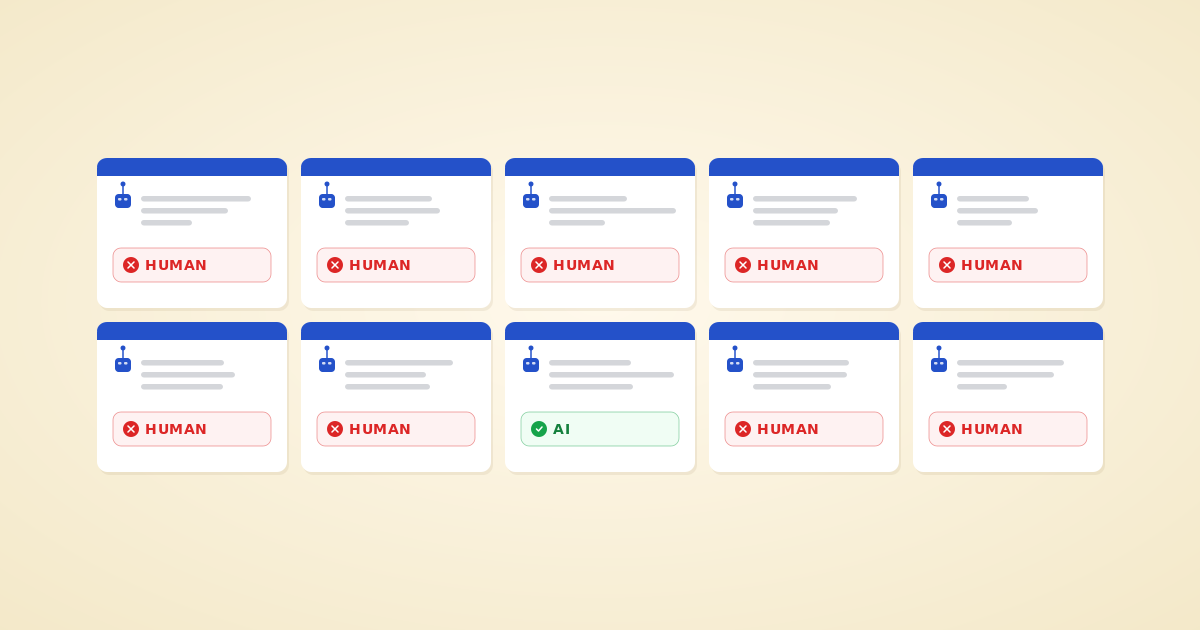
AI-text detection tools are really easy to fool
A recent crop of AI systems claiming to detect AI-generated text perform poorly—and it doesn’t take much to get past them.

Meta made its own AI detection system. It should have just used Google’s
Content Seal has a lot of catching up to do.


Briefing: X handed fact-checking to the crowd. Then it became the crowd.
Plus: A new image analysis tool and a list of companies selling AI training data.

Artificial Writing and Automated Detection
Artificial intelligence (AI) tools are increasingly used for written deliverables. This has created demand for distinguishing human-generated text from AI-generated text at scale, e.g., ensuring assignments were completed by students, product reviews written by actual customers, etc. A decision-maker aiming to implement a detector in practice must consider two key statistics: the False Negative Rate (FNR), which corresponds to the proportion of AI-generated text that is falsely classified as human, and the False Positive Rate (FPR), which corresponds to the proportion of human-written text that is falsely classified as AI-generated. We evaluate three leading commercial detectors—Pangram, OriginalityAI, GPTZero—and an open-source one —RoBERTa—on their performance in minimizing these statistics using a large corpus spanning genres, lengths, and models. Commercial detectors outperform open-source, with Pangram achieving near-zero FNR and FPR rates that remain robust across models, threshold rules, ultra-short passages, "stubs" (≤ 50 words) and ’humanizer’ tools. A decision-maker may weight one type of error (Type I vs. Type II) as more important than the other. To account for such a preference, we introduce a framework where the decision-maker sets a policy cap—a detector-independent metric reflecting tolerance for false positives or negatives. We show that Pangram is the only tool to satisfy a strict cap (FPR ≤ 0.005) without sacrificing accuracy. This framework is especially relevant given the uncertainty surrounding how AI may be used at different stages of writing, where certain uses may be encouraged (e.g., grammar correction) but may be difficult to separate from other uses.

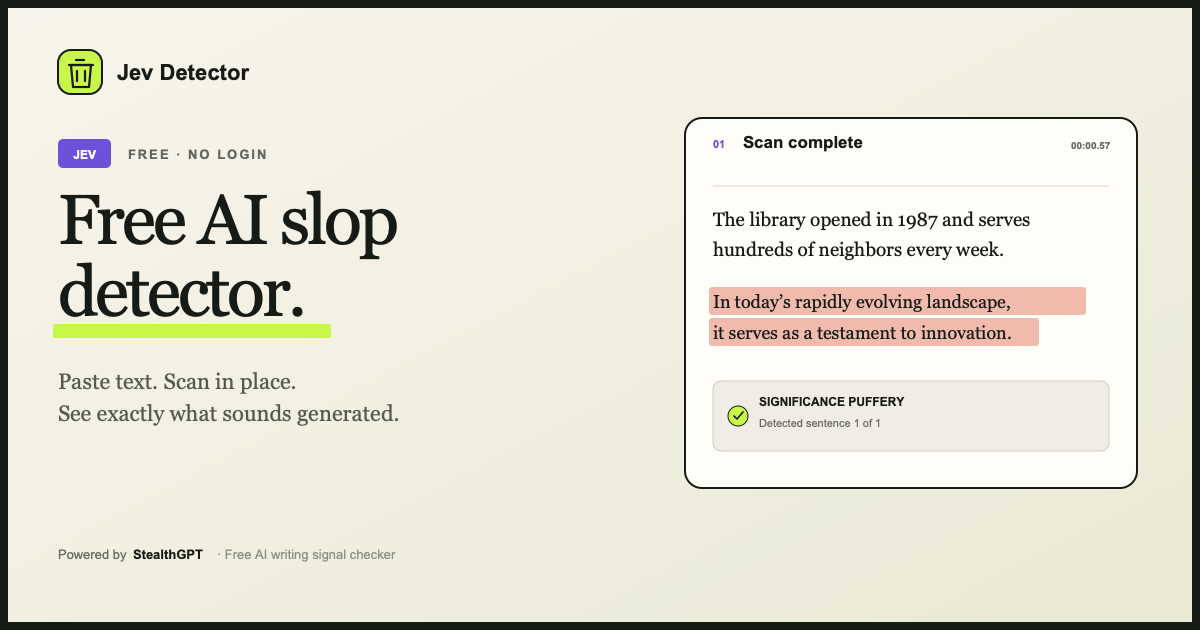
Jev Detector: Free AI Slop Detector
Paste up to 10,000 words and highlight generated-sounding writing. Free and no login.
SynthID Detector — a new portal to help identify AI-generated content
Learn about the new SynthID Detector portal we announced at I/O to help people understand how the content they see online was generated.
Tracking AI-enabled Misinformation: 3,749 AI Content Farm sites (and Counting), Plus the Top False Claims Generated by Artificial Intelligence Tools
Coverage by McKenzie Sadeghi, Dimitris Dimitriadis, Virginia Padovese, Giulia Pozzi, Sara Badilini, Chiara Vercellone, Natalie Huet, Zack Fishman, Leonie Pfaller, and Natalie Adams | Last Updated June 23, 2026

