


Predicting viral content is an art and a science, made significantly easier with Parse.ly's predictive analytics and data insights.
Virality Prediction and Community Structure in Social Networks
How does network structure affect diffusion? Recent studies suggest that the answer depends on the type of contagion. Complex contagions, unlike infectious diseases (simple contagions), are affected by social reinforcement and homophily. Hence, the spread within highly clustered communities is enhanced, while diffusion across communities is hampered. A common hypothesis is that memes and behaviors are complex contagions. We show that, while most memes indeed spread like complex contagions, a few viral memes spread across many communities, like diseases. We demonstrate that the future popularity of a meme can be predicted by quantifying its early spreading pattern in terms of community concentration. The more communities a meme permeates, the more viral it is. We present a practical method to translate data about community structure into predictive knowledge about what information will spread widely. This connection contributes to our understanding in computational social science, social media analytics and marketing applications.


Google Search's guidance about AI-generated content | Google Search Central Blog | Google for Developers
In this post, we'll share more about how AI-generated content fits into our long-standing approach to show helpful content to people on Search.

How Platform Recommenders Work – Center for Human-Compatible Artificial Intelligence
A recommender system (or simply ‘recommender’) is an algorithm that takes a large set of items and determines which of those to display to a user—think the Facebook News Feed, the Twitter timeline, Google News, or the YouTube homepage. Recommenders are necessary tools to help navigate the sheer volume of content produced each day, but their scale and rapid development can cause unintended consequences. Facebook’s algorithms have been blamed for radicalizing users, TikTok’s for inundating teens with eating-disorder videos, and Twitter’s for political bias.
Bridgy
Connects your web site to social media. Likes, reposts, mentions, cross-posting, and more...

Deep Dive: Inside X (fka Twitter)’s Recommendation Algorithm
Decoding the Machine That Powers Your “For You” Timeline ,When Elon Musk open-sourced Twitter’s recommendation algorithm in March 2023, it…

Social Media Feed Ranking Algorithms: Guide to Field Experiments
IC2S2'26 Tutorial | Social Media Feed Ranking Algorithms: Guide to Field Experiments
Stay ahead of the curve with Feedly AI
Welcome to Feedly — the platform where businesses and curious minds stay ahead of the curve! We're passionate about helping teams track competitors, discover new trends, and research emerging security threats. Feedly AI is a collection of machine learning models that automatically collect, analyze, and help you share actionable insights from millions of sources in real-time.

Social Media Algorithms Warp How People Learn From Each Other, Research Shows - Slashdot
William Brady writes via The Conversation: People are increasingly interacting with others in social media environments where algorithms control the flow of social information they see. Algorithms determine in part which messages, which people and which ideas social media users see. On social media...

The spreading of misinformation online
Significance The wide availability of user-provided content in online social media facilitates the aggregation of people around common interests, worldviews, and narratives. However, the World Wide Web is a fruitful environment for the massive diffusion of unverified rumors. In this work, using a massive quantitative analysis of Facebook, we show that information related to distinct narratives––conspiracy theories and scientific news––generates homogeneous and polarized communities (i.e., echo chambers) having similar information consumption patterns. Then, we derive a data-driven percolation model of rumor spreading that demonstrates that homogeneity and polarization are the main determinants for predicting cascades’ size. , The wide availability of user-provided content in online social media facilitates the aggregation of people around common interests, worldviews, and narratives. However, the World Wide Web (WWW) also allows for the rapid dissemination of unsubstantiated rumors and conspiracy theories that often elicit rapid, large, but naive social responses such as the recent case of Jade Helm 15––where a simple military exercise turned out to be perceived as the beginning of a new civil war in the United States. In this work, we address the determinants governing misinformation spreading through a thorough quantitative analysis. In particular, we focus on how Facebook users consume information related to two distinct narratives: scientific and conspiracy news. We find that, although consumers of scientific and conspiracy stories present similar consumption patterns with respect to content, cascade dynamics differ. Selective exposure to content is the primary driver of content diffusion and generates the formation of homogeneous clusters, i.e., “echo chambers.” Indeed, homogeneity appears to be the primary driver for the diffusion of contents and each echo chamber has its own cascade dynamics. Finally, we introduce a data-driven percolation model mimicking rumor spreading and we show that homogeneity and polarization are the main determinants for predicting cascades’ size.

Bridging-Based Ranking
There is significant concern about the engagement-based ranking systems used by TikTok, Facebook, YouTube, etc. to recommend content. Bridging-based ranking systems can address one of the most dangerous aspects of such algorithmic recommendations—the push toward polarization and divisiveness that is tearing nations apart—and do so without reducing anonymity or increasing censorship. This report explores what bridging-based ranking is, how it helps (overcoming downsides of chronological feeds and middleware), addresses common objections, and provides early examples of its use and benefits in the wild. The report concludes by providing next steps for platforms, governments, funders, and researchers in order to accelerate the deployment of bridging.

Evaluating Twitter’s algorithmic amplification of low-credibility content: an observational study
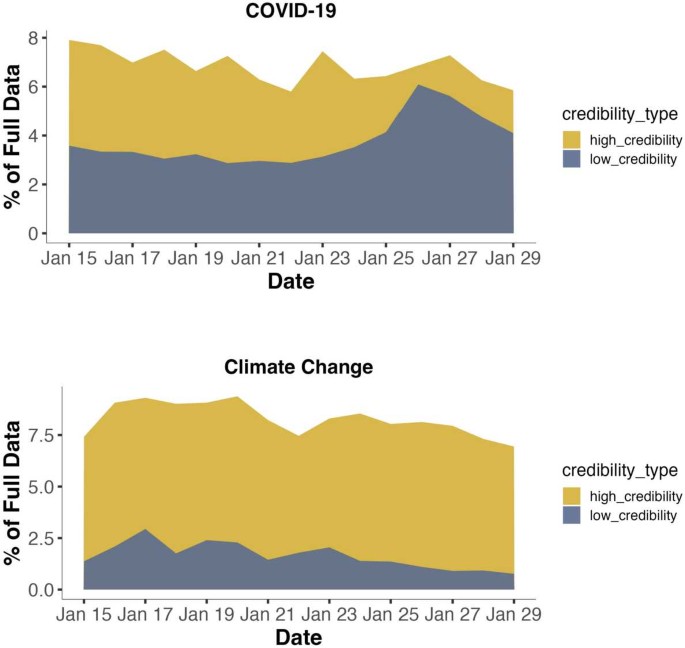
Artificial intelligence (AI)-powered recommender systems play a crucial role in determining the content that users are exposed to on social media platforms. However, the behavioural patterns of these systems are often opaque, complicating the evaluation of their impact on the dissemination and consumption of disinformation and misinformation. To begin addressing this evidence gap, this study presents a measurement approach that uses observed digital traces to infer the status of algorithmic amplification of low-credibility content on Twitter over a 14-day period in January 2023. Using an original dataset of ≈ 2.7 million posts on COVID-19 and climate change published on the platform, this study identifies tweets sharing information from low-credibility domains, and uses a bootstrapping model with two stratifications, a tweet’s engagement level and a user’s followers level, to compare any differences in impressions generated between low-credibility and high-credibility samples. Additional stratification variables of toxicity, political bias, and verified status are also examined. This analysis provides valuable observational evidence on whether the Twitter algorithm favours the visibility of low-credibility content, with results indicating that, on aggregate, tweets containing low-credibility URL domains perform better than tweets that do not across both datasets. However, this effect is largely attributable to a difference in high-engagement, high-followers tweets, which are very impactful in terms of impressions generation, and are more likely receive amplified visibility when containing low-credibility content. Furthermore, high toxicity tweets and those with right-leaning bias see heightened amplification, as do low-credibility tweets from verified accounts. Ultimately, this suggests that Twitter’s recommender system may have facilitated the diffusion of false content by amplifying the visibility of low-credibility content with high-engagement generated by very influential users.
Evaluating Twitter’s algorithmic amplification of low-credibility content: an observational study
Artificial intelligence (AI)-powered recommender systems play a crucial role in determining the content that users are exposed to on social media platforms. However, the behavioural patterns of these systems are often opaque, complicating the evaluation of their impact on the dissemination and consumption of disinformation and misinformation. To begin addressing this evidence gap, this study presents a measurement approach that uses observed digital traces to infer the status of algorithmic amplification of low-credibility content on Twitter over a 14-day period in January 2023. Using an original dataset of ≈ 2.7 million posts on COVID-19 and climate change published on the platform, this study identifies tweets sharing information from low-credibility domains, and uses a bootstrapping model with two stratifications, a tweet’s engagement level and a user’s followers level, to compare any differences in impressions generated between low-credibility and high-credibility samples. Additional stratification variables of toxicity, political bias, and verified status are also examined. This analysis provides valuable observational evidence on whether the Twitter algorithm favours the visibility of low-credibility content, with results indicating that, on aggregate, tweets containing low-credibility URL domains perform better than tweets that do not across both datasets. However, this effect is largely attributable to a difference in high-engagement, high-followers tweets, which are very impactful in terms of impressions generation, and are more likely receive amplified visibility when containing low-credibility content. Furthermore, high toxicity tweets and those with right-leaning bias see heightened amplification, as do low-credibility tweets from verified accounts. Ultimately, this suggests that Twitter’s recommender system may have facilitated the diffusion of false content by amplifying the visibility of low-credibility content with high-engagement generated by very influential users.
SlopShape: Identifying AI-Generated Commercial Web Content
Word-level detectors identify unedited AI-generated text almost perfectly, but the literature documents their brittleness under rewording, and a word-level score neither characterizes a text nor identifies which AI model wrote it. We ask whether AI-generated text can be identified one level deeper, from structural signatures: how information is presented, in what order, with what evidence, and in what voice. We replicate StoryScope (Russell et al., 2026), which showed such patterns for AI-generated fiction, on commercial content: 2,250 pre-ChatGPT human blog posts from 268 company domains against 11,250 AI mirrors from five frontier models. A 203-feature instrument, applied by an LLM and validated in a human gold-annotation session (human-human kappa 0.939, human-model 0.951), detects AI posts from its 176 structural features alone at 97.0 macro-F1 on held-out companies, nearly unchanged (96.1) when every AI post is reworded by its own model. The signal characterizes and attributes: AI posts share a tidy, self-announcing shape, 68.6% are attributed to the correct source against a 16.7% chance rate, and human posts occupy rare structural configurations. All effects replicate StoryScope's, consistent in direction and at least as large in magnitude. We release pipeline, instrument, prompts, code, and aggregate artifacts.

SlopShape: Identifying AI-Generated Commercial Web Content
Word-level detectors identify unedited AI-generated text almost perfectly, but the literature documents their brittleness under rewording, and a word-level score neither characterizes a text nor identifies which AI model wrote it. We ask whether AI-generated text can be identified one level deeper, from structural signatures: how information is presented, in what order, with what evidence, and in what voice. We replicate StoryScope (Russell et al., 2026), which showed such patterns for AI-generated fiction, on commercial content: 2,250 pre-ChatGPT human blog posts from 268 company domains against 11,250 AI mirrors from five frontier models. A 203-feature instrument, applied by an LLM and validated in a human gold-annotation session (human-human kappa 0.939, human-model 0.951), detects AI posts from its 176 structural features alone at 97.0 macro-F1 on held-out companies, nearly unchanged (96.1) when every AI post is reworded by its own model. The signal characterizes and attributes: AI posts share a tidy, self-announcing shape, 68.6% are attributed to the correct source against a 16.7% chance rate, and human posts occupy rare structural configurations. All effects replicate StoryScope's, consistent in direction and at least as large in magnitude. We release pipeline, instrument, prompts, code, and aggregate artifacts.
Social media algorithms don't allow us to understand or control what we see online and why... until now! Top scholars @jonathanstray.com and @noupside.bsky.social are sharing @mysky.social, a tool that allows users to adjust their feed’s priorities and explains why certain posts appear over others.

🎛️📲 Meet the algorithm you can actually control and understand
newpublic.substack.com