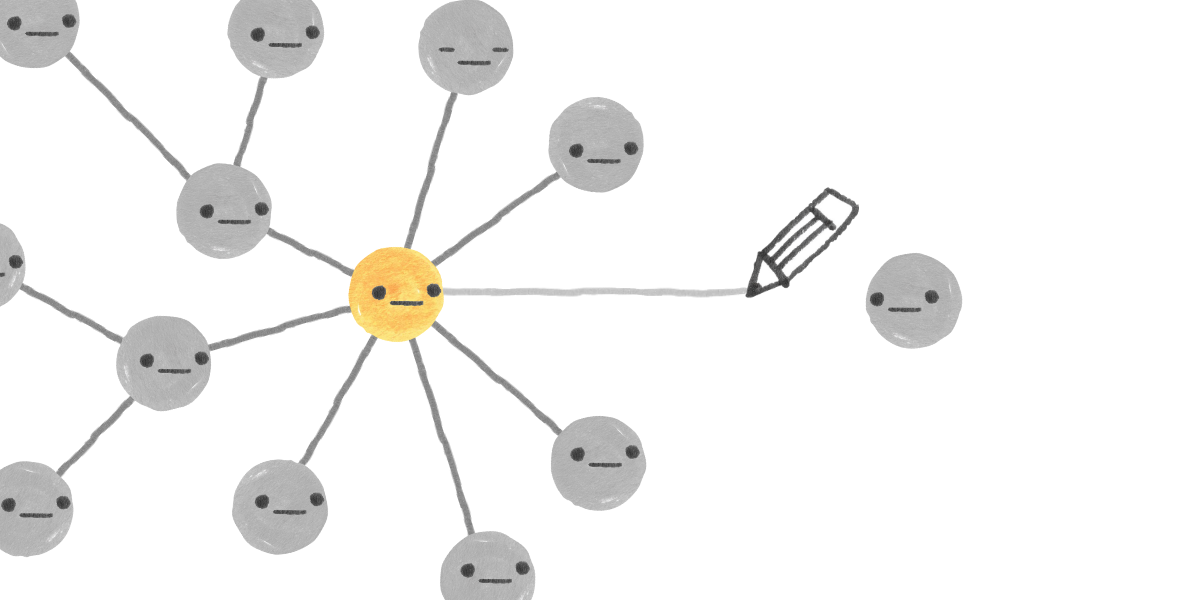
Crowds hold a predictive power that can have startling accuracy.
How and When to Involve Crowds in Scientific Research - The Book
This book explores how millions of people can significantly contribute to scientific research. Discover main elements, authors, and who this book is for and why.
Release the pressure | Paul Stephenson | Offprint
Episode four of Sunset Season Five is here!

The Reckoning | Paul Stephenson | Offprint
The final episode of Season Five is here

Episode 5: Metaphors for AI, with Shannon Vallor
This week, Adam talks with Shannon Vallor, a philosopher of AI, about the metaphors we use to talk about AI and ourselves. They also dunk on libertarians and San Francisco billboards, and consider what kind of hope we can have for the future of technology.Messages: • Support the show at patreon.com/DreamingAgainstTheMachine • Follow us on Bluesky and Instagram • Subscribe to the show wherever you get your podcasts! • Check out other great podcasts from Multitude like Wow if TrueAbout the show:Dreaming Against the Machine is a podcast about envisioning a realistic and hopeful future. Each week, the show’s host, journalist and astrophysicist Dr. Adam Becker, will have an earnest (and entertaining!) conversation with a guest about possible futures, seen through the lenses of history, science, and culture. In a world where tech oligarchs and their power fantasies are driving visions of the future, Dreaming Against the Machine aims to take back the terms of the public conversation about what our world can and should be.
Network dynamics of social influence in the wisdom of crowds
Significance Since the discovery of the wisdom of crowds over 100 years ago theories of collective intelligence have held that group accuracy requires either statistical independence or informational diversity among individual beliefs. Empirical evidence suggests that allowing people to observe the beliefs of others leads to increased similarity of individual estimates, reducing independence and diversity without a corresponding increase in group accuracy. As a result, social influence is expected to undermine the wisdom of crowds. We present theoretical predictions and experimental findings demonstrating that, in decentralized networks, social influence generates learning dynamics that reliably improve the wisdom of crowds. We identify general conditions under which influence, not independence, produces the most accurate group judgments. , A longstanding problem in the social, biological, and computational sciences is to determine how groups of distributed individuals can form intelligent collective judgments. Since Galton’s discovery of the “wisdom of crowds” [Galton F (1907) Nature 75:450–451], theories of collective intelligence have suggested that the accuracy of group judgments requires individuals to be either independent, with uncorrelated beliefs, or diverse, with negatively correlated beliefs [Page S (2008) The Difference: How the Power of Diversity Creates Better Groups, Firms, Schools, and Societies ]. Previous experimental studies have supported this view by arguing that social influence undermines the wisdom of crowds. These results showed that individuals’ estimates became more similar when subjects observed each other’s beliefs, thereby reducing diversity without a corresponding increase in group accuracy [Lorenz J, Rauhut H, Schweitzer F, Helbing D (2011) Proc Natl Acad Sci USA 108:9020–9025]. By contrast, we show general network conditions under which social influence improves the accuracy of group estimates, even as individual beliefs become more similar. We present theoretical predictions and experimental results showing that, in decentralized communication networks, group estimates become reliably more accurate as a result of information exchange. We further show that the dynamics of group accuracy change with network structure. In centralized networks, where the influence of central individuals dominates the collective estimation process, group estimates become more likely to increase in error.

Special episode: Apps vs Files with Gordon Brander, Peter van Hardenberg & Jess Martin.
Athena Aktipis with David Sloan Wilson - Evolving Alignment Podcast
Episode 31: Science Is a Human Endeavor (feat. Molly Crockett and Lisa Messeri), April 15 2024 - Mystery AI Hype Theater 3000
Will AI someday do all our scientific research for us? Not likely. Drs. Molly Crockett and Lisa Messeri join for a takedown of the hype of

How and When to Involve Crowds in Scientific Research | James Evans
The lone academic in a basement lab is an endangered species. Years ago I asked Paul Ginsparg, who founded arXiv, what features his machine-learning filter used to flag speculative submissions. The top three: single-authored, submitted on a weekend, and heavy citation of Newton and Einstein. Science is a contact sport now. Marion Poetz and Henry Sauermann's How and When to Involve Crowds in Scientific Research (https://lnkd.in/g5pwVbfD) is the field manual. What crowds can do: Volume. Zooniverse mobilizes 2.7 million people to classify galaxies and court records. Galaxy Zoo's co-founder hand-classified 50,000 galaxies in one week before concluding that isolation would break him. Reach. NASA spent years failing to predict solar flares, then broadcast the problem. The winner was a semi-retired radio engineer in rural New Hampshire who swapped satellite data for radio data. Experience. Patients and caregivers asked to generate research questions produced 826 that scientists had missed, including the link between aging and wound healing. Bench-to-bedside runs backward. One caution the book underplays: an open call is not an inclusive one. Participation costs in time, money, and access screen people out. Self-selection can narrow the very diversity that makes crowds thrive. As AI floods the labor supply of routine, homogeneous cognition, human crowds become more valuable, not less. Machines process. People notice what nobody thought to ask. Check out my review @ https://lnkd.in/gkzvWrRC and the book @ https://lnkd.in/g5pwVbfD!

The signal and the noise: why so many predictions fail - but some don't
"Nate Silver's The Signal and the Noise is The Soul of …
The Intelligence Curse
This series examines the incoming crisis of human irrelevance and provides a map towards a future where people remain the masters of their destiny.
W Social am Abgrund - Digital Independence Day #9