

We build a computer inside a transformer — executing arbitrary C programs for millions of steps with exponentially faster inference via 2D attention heads.
Can LLMs Be Computers? | Percepta
We build a computer inside a transformer — executing arbitrary C programs for millions of steps with exponentially faster inference via 2D attention heads.
Constructing an LLM-Computer | Percepta
How we analytically compiled a WebAssembly VM into a transformer using a code-to-weights compiler we built.
Solving a Million-Step LLM Task with Zero Errors
LLMs have achieved remarkable breakthroughs in reasoning, insights, and tool use, but chaining these abilities into extended processes at the scale of those routinely executed by humans,...

Why Can’t Powerful LLMs Learn Multiplication?
These days, large language models (LLMs) can handle increasingly complex tasks, writing complex code and engaging in sophisticated reasoning. But when it comes to 4-digit multiplication, a task taught in elementary school, even state-of-the-art systems fail. Why? A new paper by Computer Science PhD student Xiaoyan Bai and Faculty Co-Director of the Data Science Institute’s …
Alex Cheema on Twitter / X
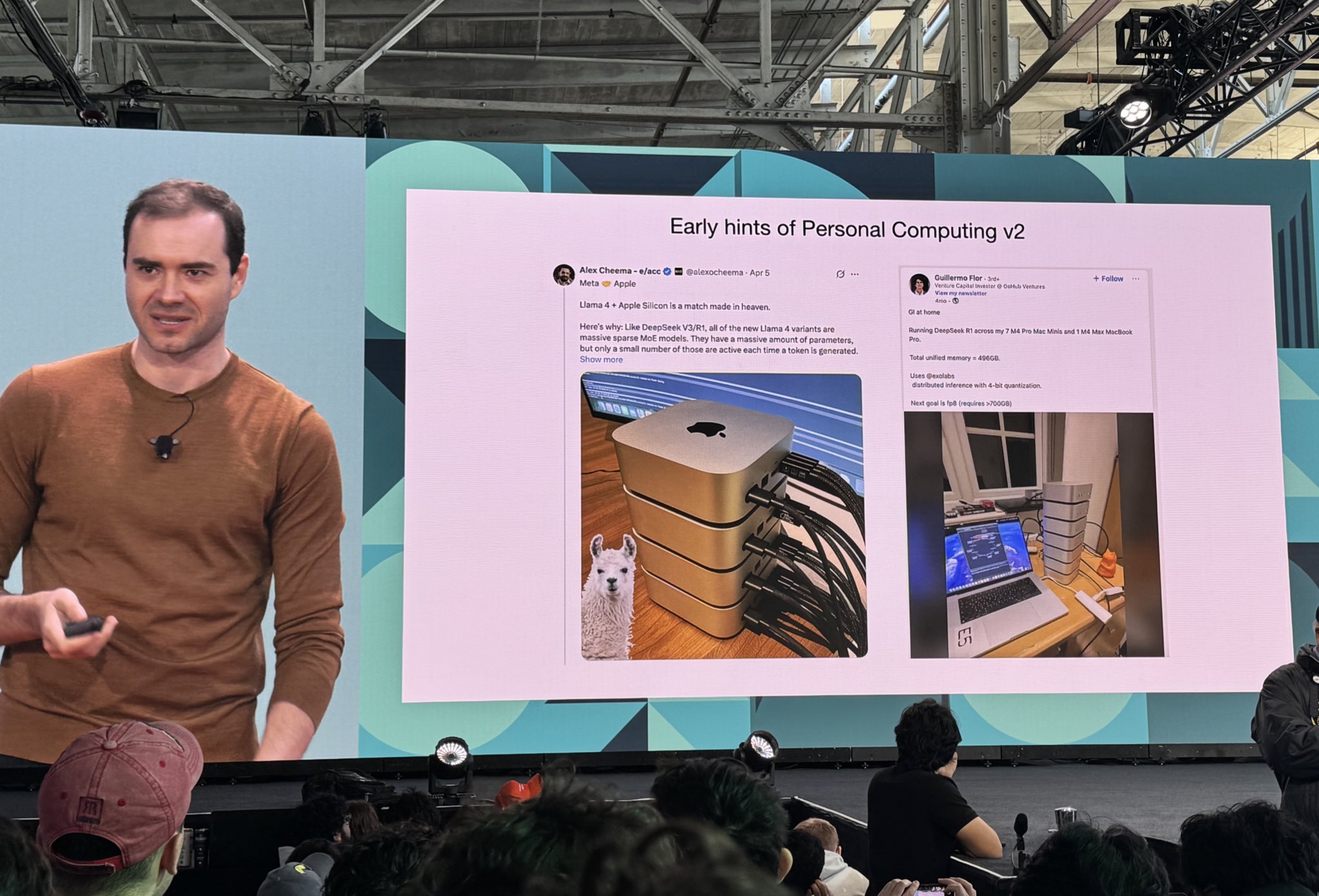
.@karpathy shouted out my work on @exolabs at @ycombinator AI SUS!“we use LLMs similarly to mainframes in the ‘70s - compute is timeshared by having a slice in the batch dimension. models will compress over time, and with this we’ll be able to run more on-device” pic.twitter.com/UKSrquQGAL— Alex Cheema (@alexocheema) June 18, 2025
vllm-project/vllm
A high-throughput and memory-efficient inference and serving engine for LLMs
Beyond Standard LLMs
Linear Attention Hybrids, Text Diffusion, Code World Models, and Small Recursive Transformers
Towards Feasible, Private, Distributed LLM Inference
Exploring how the Secure Transformer Inference Protocol (STIP) protects inputs, outputs, and model weights with lightweight permutations enabling efficient, privacy-safe LLM inference at scale.
Andrej Karpathy on Twitter / X
The race for LLM "cognitive core" - a few billion param model that maximally sacrifices encyclopedic knowledge for capability. It lives always-on and by default on every computer as the kernel of LLM personal computing.Its features are slowly crystalizing:- Natively multimodal… https://t.co/2jsVevkTSJ— Andrej Karpathy (@karpathy) June 27, 2025
Why Can't Transformers Learn Multiplication?...
Language models are increasingly capable, yet still fail at a seemingly simple task of multi-digit multiplication. In this work, we study why, by reverse-engineering a model that successfully...
Why Can't Transformers Learn Multiplication?...
Language models are increasingly capable, yet still fail at a seemingly simple task of multi-digit multiplication. In this work, we study why, by reverse-engineering a model that successfully...
Artificial
An LLM is a computer program. We should talk about it like a computer program.

Artificial
An LLM is a computer program. We should talk about it like a computer program.
Francois Chaubard on Twitter / X
I believe that LSTM based architectures (constant hidden state, constant flops / step) will crush transformers as we know them in 2-3 years. we will laugh about KV Caches and how dumb we were.. to achieve this, the LSTM will need to have a large external memory bank with…— Francois Chaubard (@FrancoisChauba1) July 30, 2026
A Visual Guide to Quantization
Exploring memory-efficient techniques for LLMs
1/4 Do LLMs understand? "They understand in a way that’s very different from how humans understand," Dileep George, @dileeplearning.bsky.social, of Google DeepMind at the Simons Institute workshop on The Future of Language Models and Transformers. Video: simons.berkeley.edu/talks/dileep-george-google-de…
