Fast and accurate search is vital to all of Perplexity, from Search and Computer to our API Platform. Behind the scenes, the heavy lifting is done by embedding
Google for Developers Blog - News about Web, Mobile, AI and Cloud
Discover EmbeddingGemma, Google's new on-device embedding model designed for efficient on-device AI, enabling features like RAG and semantic search.

Spiral on Twitter / X
4/ Spiral is our database built on Vortex: • Direct S3 → GPU data loading (skip the CPU bottleneck) • One API for 10KB embeddings AND 4GB videos • Time-bounded, audited permissions (no more credentials passed to AI agents) • Actually saturates your GPUs— Spiral (@SpiralDB) September 11, 2025
turbopuffer: fast search on object storage
Inaugural blog post about the development of turbopuffer, a search engine that uses object storage and SSD caching for cost-effective, low latency search. This post describes into the motivation behind its creation, its unique architecture, and how it significantly reduces costs for large-scale vector searches. Discover how turbopuffer is transforming search infrastructure for companies like Cursor and Suno, offering a scalable and reliable solution.

Google for Developers Blog - News about Web, Mobile, AI and Cloud
EmbeddingGemma 2 is a compact, open-source multimodal embedding model that maps text, code, images, video, and audio into a unified 768-dimensional space. Developers can use the sentence-transformers library to selectively load modular modality encoders—ranging from 270M to 740M parameters—to optimize memory usage. Additionally, Matryoshka Representation Learning enables dynamic dimension truncation down to 128d, significantly reducing vector database storage requirements while maintaining high retrieval performance.
Linkup - SPARSEUP: Linkup's Open-Source Sparse Embedding Model
Linkup Research releases SPARSEUP, an open-source sparse embedding model under 150M parameters. SOTA on BEIR-13, sub-millisecond retrieval, Apache 2.0 license.

Thousands of Styled Rectangles in 120FPS on GPU
Secrets of rendering extremely fast UIs in WebGPU by minimizing overhead on the GPU.

Modern GPU Programming For MLSys — Modern GPU Programming For MLSys
Machine learning systems sit at the heart of modern AI workloads. In these systems, performance often comes down to the quality of a small number of GPU kernels. Attention kernels, LLM prefill and decode kernels, low-precision block-scaled GEMMs, fused MoE layers, and other large fused kernels all directly shape end-to-end speed in both training and serving.
Modern GPU Programming For MLSys — Modern GPU Programming For MLSys
Machine learning systems sit at the heart of modern AI workloads. In these systems, performance often comes down to the quality of a small number of GPU kernels. Attention kernels, LLM prefill and decode kernels, low-precision block-scaled GEMMs, fused MoE layers, and other large fused kernels all directly shape end-to-end speed in both training and serving.
vik on Twitter / X
Photon, our inference engine, isn't fast just because of GPU kernels. A lot of the speedup comes from engine-level work: request scheduling, prefix caching, image processing, all tuned to keep the GPU saturated. https://t.co/3M7eFcFKo5— vik (@vikhyatk) May 2, 2026
project-you-apps/vector-plus-studio
Semantic search via 16M-neuron CUDA lattice. Content-addressable memory with noise tolerance.
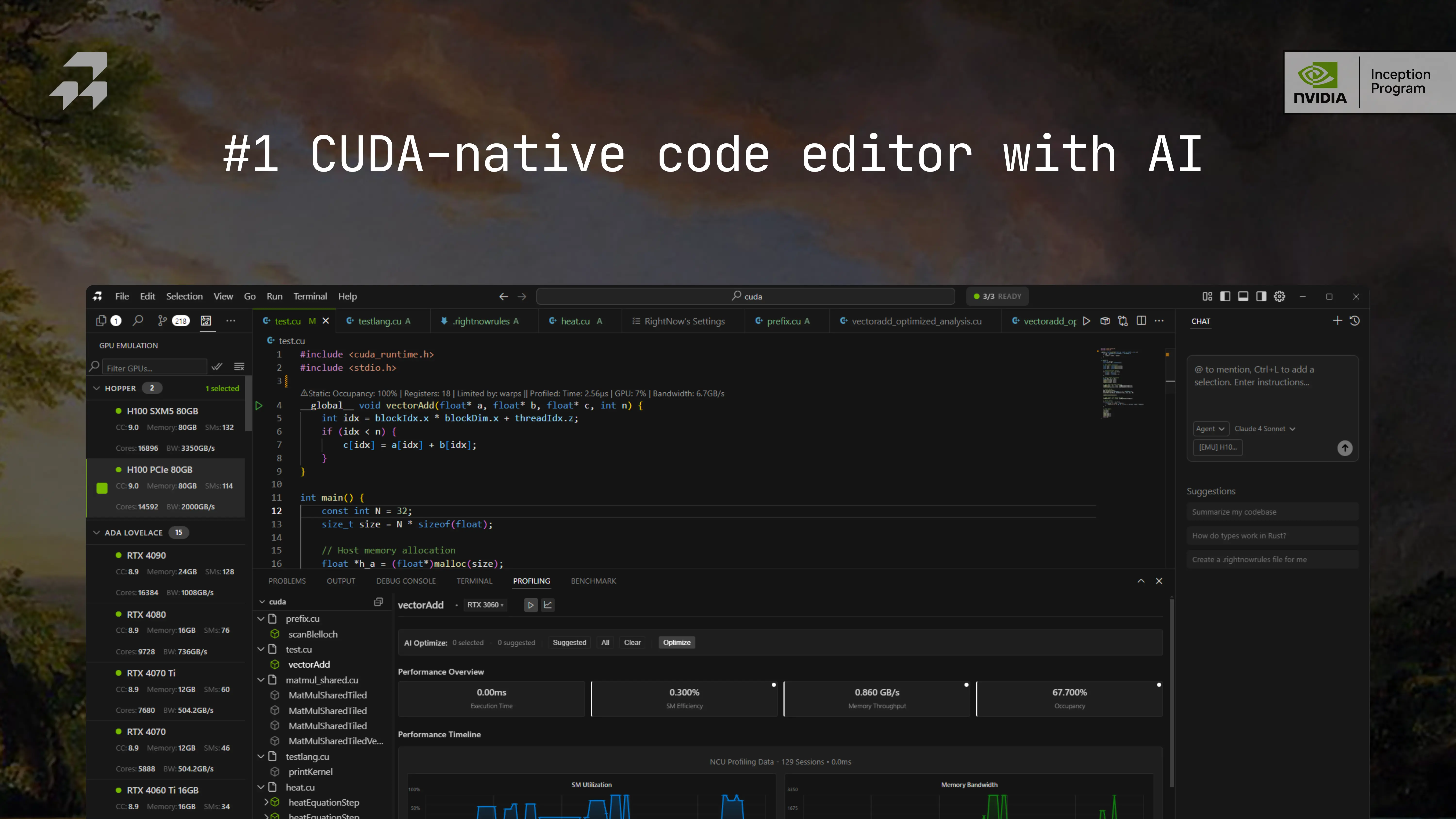
RightNow AI - YC-Backed GPU Research Lab
YC-backed GPU research lab building the RightNow CUDA editor, RunInfra inference infra, Forge kernels, and publishing AutoMegaKernel and related papers on arXiv.
Accelerating GPT-5.6 Sol Ultrafast with OpenAI
Cerebras powers OpenAI’s GPT-5.6 Sol Ultrafast in the OpenAI API, delivering frontier intelligence at real-time speeds for critical AI work.
EmbeddingGemma: Powerful and Lightweight Text Representations
We introduce EmbeddingGemma, a new lightweight, open text embedding model based on the Gemma 3 language model family. Our innovative training recipe strategically captures knowledge from larger models via encoder-decoder initialization and geometric embedding distillation. We improve model robustness and expressiveness with a spread-out regularizer, and ensure generalizability by merging checkpoints from varied, optimized mixtures. Evaluated on the Massive Text Embedding Benchmark (MTEB) across multilingual, English, and code domains, EmbeddingGemma (300M) achieves state-of-the-art results. Notably, it outperforms prior top models, both proprietary and open, with fewer than 500M parameters, and provides performance comparable to models double its size, offering an exceptional performance-to-cost ratio. Remarkably, this lead persists when quantizing model weights or truncating embedding outputs. This makes EmbeddingGemma particularly well-suited for low-latency and high-throughput use cases such as on-device applications. We provide ablation studies exploring our key design choices. We release EmbeddingGemma to the community to promote further research.

Gökdeniz Gülmez on Twitter / X
🚀 introducing mlx-embeddings-lora v1.0.5!„pip install -U mlx-embeddings-lora“Train your own text embedding models locally on Apple Silicon 🍏 using contrastive learning + LoRA fine-tuning — no GPUs, no cloud, just pure MLX speed.💡 Built on mlx-embeddings🧠 Supports LoRA…— Gökdeniz Gülmez (@ActuallyIsaak) November 13, 2025
A 16× Smaller Index for EmbeddingGemma 2
EmbeddingGemma 2’s one advertised way to shrink its vectors, keeping 128 of 768 dimensions, loses about 0.06 nDCG@10. Storing all 768 at 2 bits each is 16× smaller with no measurable loss on SciFact or NFCorpus.