


This study explores the makeup of the social media news influencer universe, including who they are, what content they create and who their audiences are.
News Influencers Fact Sheet
About one-in-five U.S. adults say they regularly get news from news influencers on social media, and this is especially common among younger adults.

The right dominates the online media ecosystem, seeping into sports, comedy, and other supposedly nonpolitical spaces
As Americans increasingly get their news from online shows and streamers, the influence of this media ecosystem becomes more prominent — and Media Matters has found that the most popular of this content is overwhelmingly right-leaning.In a new study, Media Matters assessed the audience size of popular online shows — podcasts, streams, and other long-form audio and video content regularly posted online. To do so, we gathered data on the number of followers, subscribers, and views across streaming platforms (YouTube, Spotify, Rumble, Twitch, and Kick) and social media platforms that are used to amplify and promote these shows (Facebook, Instagram, and TikTok). Apple Podcasts does not publicly provide follower counts on its platform, so it was not included in the audience data.This analysis was based on 320 online shows with a right-leaning or left-leaning ideological bent. We found that right-leaning online shows dominate the ecosystem, with substantially larger audiences on both politics/news shows and supposedly nonpolitical shows that we determined often platformed ideological content or guests.Key findings:We found 320 online shows — 191 right-leaning and 129 left-leaning — that were active in 2024 and covered news and politics and/or had related guests. These shows had at least 584.6 million total followers and subscribers.We found substantial asymmetry in total following across platforms: Right-leaning online shows had at least 480.6 million total followers and subscribers — nearly five times as many as left-leaning.Across platforms — YouTube, Rumble, Twitch, Kick, Spotify, Facebook, Instagram, and TikTok — right-leaning online shows accounted for roughly 82% of the total following of the online shows we assessed.Comparatively, left-leaning online shows had nearly 104 million followers and subscribers across the eight platforms — nearly five times less.Nine out of the 10 online shows with the largest followings across platforms were right-leaning, with a total following of more than 197 million. The only left-leaning show among the top 10 was What Now? with Trevor Noah, which had 21.1 million total followers and subscribers across platforms.Our analysis — which looked entirely at shows with an ideological bent — found over a third self-identify as nonpolitical, even though 72% of those shows were determined to be right-leaning. Instead, these shows describe themselves as comedy, entertainment, sports, or put themselves in other supposedly nonpolitical categories.Out of 320 online shows, right-leaning programs categorized as comedy — 15 shows in all — had 117.5 million followers and subscribers, or 20% of the total following of all programs we assessed. This category included The Joe Rogan Experience, This Past Weekend with Theo Von, and Full Send Podcast.Right-leaning shows accounted for two-thirds of the total YouTube views on videos from channels affiliated with the shows we assessed — 65 billion views in total. Comparatively, left-leaning online shows totaled 31.5 billion total views.Right-leaning shows use Rumble to expand their audience — gaining millions of subscribers and billions of views for their content.

Fact or opinion? New research finds who best tells the difference
American news consumers are inundated with tweets and headlines and stories. But in a world where news stories and opinion pieces blur and…

The echo chamber effect on social media
Significance We explore the key differences between the main social media platforms and how they are likely to influence information spreading and the formation of echo chambers. To assess the different dynamics, we perform a comparative analysis on more than 100 million pieces of content concerning controversial topics (e.g., gun control, vaccination, abortion) from Gab, Facebook, Reddit, and Twitter. The analysis focuses on two main dimensions: 1) homophily in the interaction networks and 2) bias in the information diffusion toward like-minded peers. Our results show that the aggregation in homophilic clusters of users dominates online dynamics. However, a direct comparison of news consumption on Facebook and Reddit shows higher segregation on Facebook. , Social media may limit the exposure to diverse perspectives and favor the formation of groups of like-minded users framing and reinforcing a shared narrative, that is, echo chambers. However, the interaction paradigms among users and feed algorithms greatly vary across social media platforms. This paper explores the key differences between the main social media platforms and how they are likely to influence information spreading and echo chambers’ formation. We perform a comparative analysis of more than 100 million pieces of content concerning several controversial topics (e.g., gun control, vaccination, abortion) from Gab, Facebook, Reddit, and Twitter. We quantify echo chambers over social media by two main ingredients: 1) homophily in the interaction networks and 2) bias in the information diffusion toward like-minded peers. Our results show that the aggregation of users in homophilic clusters dominate online interactions on Facebook and Twitter. We conclude the paper by directly comparing news consumption on Facebook and Reddit, finding higher segregation on Facebook.

How we decide what news is important, and why that process maybe flawed
Have you ever thought about the type of news that populates on your Facebook feed? Where does it come from and how is it specifically…
Following news on social media boosts knowledge, belief accuracy and trust
Many worry that news on social media leaves people uninformed or even misinformed. Here we conducted a preregistered two-wave online field experiment in France and Germany (N = 3,395) to estimate the effect of following the news on Instagram and WhatsApp. Participants were asked to follow two accounts for 2 weeks and activate the notifications. In the treatment condition, the accounts were those of news organizations, while in the control condition they covered cooking, cinema or art. The treatment enhanced current affairs knowledge, participants’ ability to discern true from false news stories and awareness of true news stories, as well as trust in the news. The treatment had no significant effects on feelings of being informed, political efficacy, affective polarization and interest in news or politics. These results suggest that, while some forms of social media use are harmful, others are beneficial and can be leveraged to foster a well-informed society.

Why Don’t We Learn from Social Media? Studying Effects of and Mechanisms behind Social Media News Use on General Surveillance Political Knowledge
Does exposure to news affect what people know about politics? This old question attracted new scholarly interest as the political information environment is changing rapidly. In particular, since c...

Advocacy groups and Metric Media collaborate on local ‘community news’
<p>This is the second part of a two-part investigation. The first piece can be found here. Metric Media launched “Community Newsmaker” in 2020 using the language of citizen journalism. However, what appeared to be grassroots news is part of a sprawling network that promotes political agendas and corporate interests, without disclosing those ties to the […]</p>
Early-stage brands should also unlock the power of influencers | TechCrunch
Let’s demystify influencer marketing, learn how to couple it with a little-known paid marketing hack and uncover the numerous mediums to leverage influencer assets

Brands using AI-generated influencers to promote products on social media
Investigation finds AI content that purports to show genuine customers, prompting calls for greater transparency

Media Influence Matrix – The World's Most Reliable Influence Tracker
This week’s edition reads five FY2025 reports against each other: Dnevnik (Slovenia), Delfi Latvia, Phoenix New Media (China), Hanza Media (Croatia) and Digi Communications (Romania). It finds two publishers separating their journalism from their balance sheets, a Croatian publisher closing a 35-year-old political weekly on a 1.1% net margin, a Chinese state-linked digital news group whose financial centre has quietly shifted from advertising to mini-program reading apps, and a Romanian telecom giant’s having its news channel walk off the must-carry list.
Push journalism vs. pull journalism
Let's experiment with making news products so relevant that people pull them into their lives

Who are the rightwing influencers filling Trump’s head with visions of antifa?
Meet the content creators whose videos from Portland and Chicago shape the president’s distorted view of reality

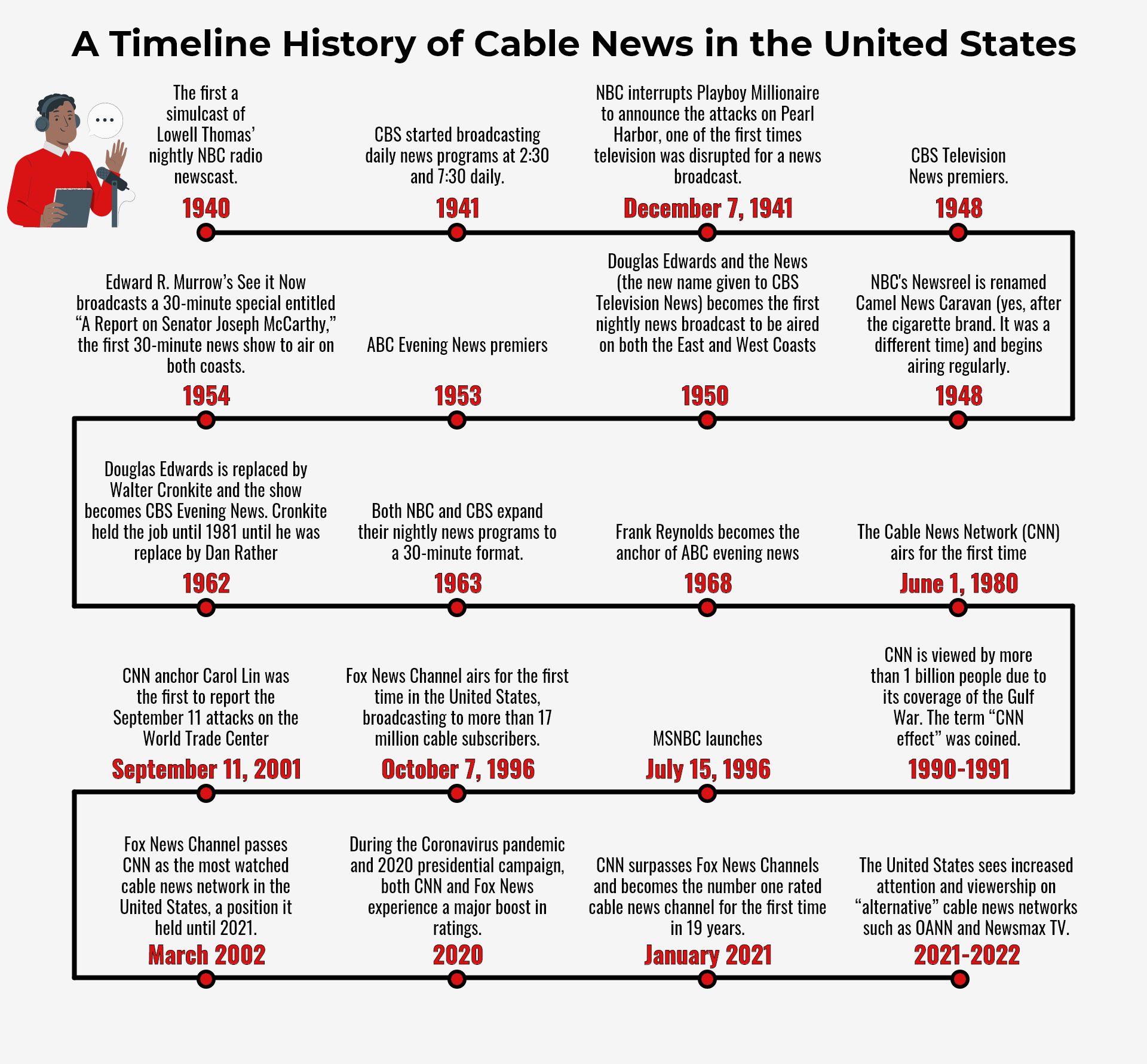
The Growth and Impact of Cable News
Cable news has had a tremendous impact on how people consume news. We discuss the growth and impact of cable news including the good, bad and downright ugly.
Can Puck reinvent the news business for the influencer age?
CEO Sarah Personette’s risky bet on journalists as influencers

The Left’s Nonprofit Journalism Empire: The Nonprofit News Sector
In 2019 and 2021, Capital Research Center surveyed the changing media landscape, taking note of the increasing role of nonprofit and benefactor-driven “for-loss” media investments that are beginning to replace the 20th century’s commercial press empires. Since our last analysis, Fox News has held its national prominence among national-level right-leaning broadcast media even as it paid dearly for its post-2020 election content, liberal foundations have vowed a half-billion-dollar initiative to “revitalize” liberal-leaning local outlets, and Elon Musk, the world’s richest and perhaps most controversial man, upended the social media landscape.
